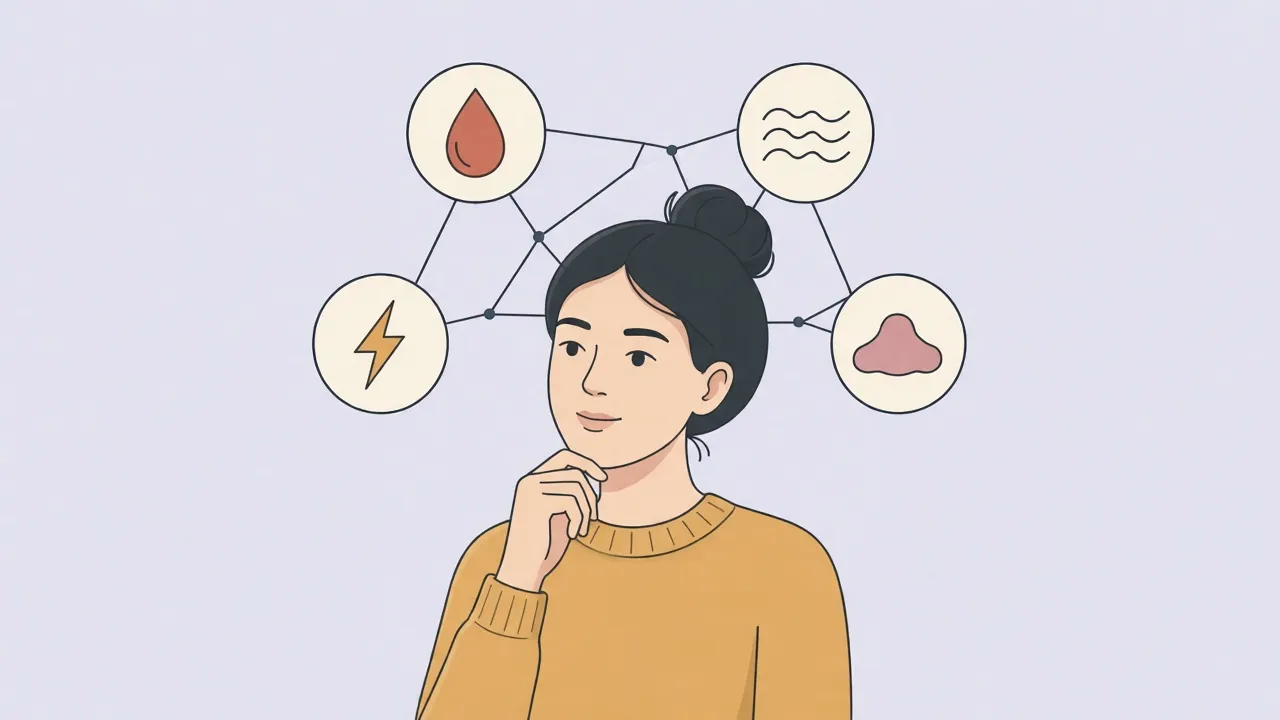
Quick answer
Internal hemorrhoids usually show up as bright red blood or tissue that slips out, and they often do not hurt. External hemorrhoids itch or leave a tender lump. A sudden hard, painful lump is often a small clot. Sharp tearing pain with a bowel movement fits a fissure better. New rectal bleeding still needs a check, especially from age 45.
Key takeaways
- Internal hemorrhoids usually cause bright red bleeding or tissue that slips out, and they often do not hurt unless the tissue is stuck outside.
- External hemorrhoids cause itching or a tender lump, and for many people those symptoms ease within a few days.
- A sudden firm, painful lump at the anal edge is often a clot in an external hemorrhoid. The worst pain often eases in 4 to 5 days, though full settling can take about 3 weeks with home care.
- In a German clinic study of 458 patients, most people who thought they had hemorrhoids did not have them on exam, and their symptoms looked like the symptoms of people who did not.
- Bright red bleeding can also come from a tear, a polyp, or colorectal cancer. Average-risk screening in the United States starts at age 45.
On this page
Hemorrhoid symptoms depend on the type. Internal hemorrhoids, which sit in the lining of the anus and lower rectum, usually announce themselves with bright red blood or with tissue that slips out. External hemorrhoids, under the skin at the anal edge, are the ones that itch, ache, and leave a tender lump. A full picture of what hemorrhoids are helps, because the same word covers both.
A clot inside an external hemorrhoid is a third pattern. The lump shows up fast, feels firm, and can hurt a lot. The NIDDK’s page on hemorrhoid symptoms lists the usual clues for each type, and it also says rectal bleeding can come from other bowel diseases, including cancer of the colon or rectum.
The rest of this page is what each pattern tends to feel like, how doctors grade a hemorrhoid that slips out, and the other problems that copy these symptoms. A tear, an abscess, a fistula, itching from irritated skin, a leftover skin tag, a polyp, and colorectal cancer can all be mistaken for a hemorrhoid.
How internal and external hemorrhoids feel different
Hemorrhoids are swollen, displaced anal cushions, the pads of blood vessels and supporting tissue that line the anal canal 3. You have them even when you feel fine. They become a problem when they enlarge or slide downward. Sandler and Peery note that those cushions also help the anus stay closed 6.
Where they sit decides what you feel. Internal hemorrhoids are covered by lining that does not sense touch, pain, or temperature. External hemorrhoids are covered by ordinary skin, so they can ache 2. A bleed from inside can be painless. A swollen lump on the outside often hurts when you sit 14.
| What you notice | Internal | External | Clot in an external hemorrhoid |
|---|---|---|---|
| Bleeding | Bright red blood with a bowel movement is the usual clue | Less often the main clue | Possible if the skin over the clot splits |
| Pain | Often none, unless tissue is stuck outside | Aching, worse with sitting | Sudden, constant, and sometimes severe |
| A lump | Tissue may slip out, then go back | A tender lump at the edge | A firm lump at the edge, often bluish |
| Itching | Can happen | Common | Can happen once the swelling irritates the skin |
Internal hemorrhoid symptoms
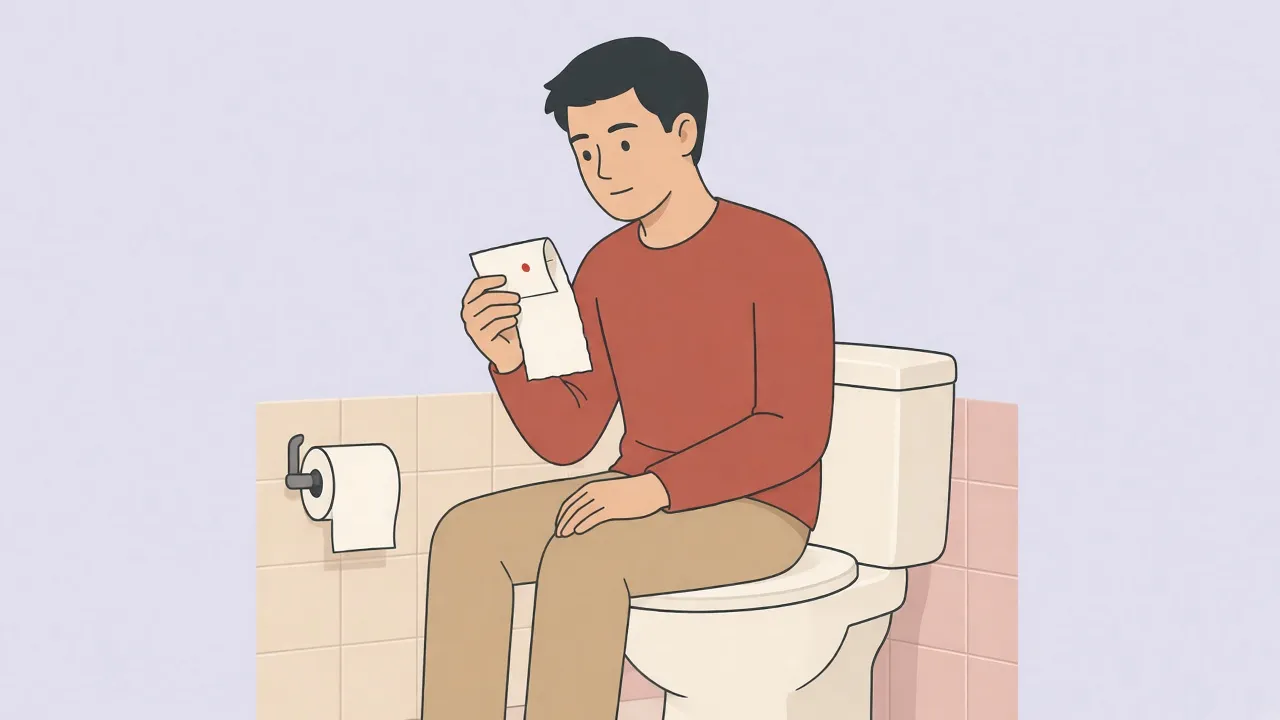
The most common internal symptom is rectal bleeding with a bowel movement 3. The blood is bright red. You may see it on the stool, on the toilet paper, or in the bowl 1. The ASCRS patient page on hemorrhoids says the bleeding can be brisk, dripping into the bowl, and that some people with internal hemorrhoids bleed very little or not at all.
Pain is the exception, until the tissue prolapses (slips through the anal opening). Internal hemorrhoids that stay inside most often do not hurt. Prolapsed ones can cause pain and discomfort 1. Some people also notice mucus, a feeling that the bowel did not finish emptying, or itching 24.
Doctors grade internal hemorrhoids by how far they slip, which also guides treatment. You can still have painless bleeding at any grade 4.
| Grade | What happens | What it feels like |
|---|---|---|
| 1 | No prolapse | Often only bleeding, seen on an exam rather than felt |
| 2 | Slips out and goes back on its own | A bulge during a bowel movement that disappears afterward |
| 3 | Slips out and you have to push it back | A lump that stays out until you ease it in |
| 4 | Will not go back in | Often very painful. The anal muscles can cut off the blood supply, called strangulation 210 |
Grade 2 and grade 3 are the patterns people mean when they ask if they can push a hemorrhoid back in. Details of grades and which treatments fit each one are on the internal hemorrhoids page. Bleeding on its own, including what is typical and what is not, is covered under bleeding hemorrhoids.
External hemorrhoid symptoms
External hemorrhoids form under the skin around the anus 10. You may have anal itching, one or more hard tender lumps, and an ache or pain that is worse when you sit 1. Between clots, people often describe intermittent swelling, pressure, and discomfort 2.
Cleaning can be harder after a bowel movement, because the swelling changes the skin folds 14. Extra straining, rubbing, or scrubbing tends to make itching and soreness worse. For many people, external symptoms settle within a few days 1. If a lump is still painful after that, or if it appeared suddenly and feels like a marble, read the next section before you wait it out. Day-to-day relief for this type is on the external hemorrhoids page.
What does a hemorrhoid look like?
Most people never see an internal hemorrhoid. It sits inside the anal canal, so the usual clue is blood rather than something you can spot 1. A doctor sees it with a short lighted tube called an anoscope, where it looks like a bulge in the lining 413.
What you might see or feel in a mirror depends on the type:
- A prolapsed internal hemorrhoid shows up as a soft bulge from the anus during or after a bowel movement. It is covered by moist lining rather than skin, and it may slip back in on its own or need a gentle push 24.
- An external hemorrhoid is one or more lumps under the skin at the edge of the anus. They can feel hard and tender, and sitting often makes them ache 1.
- A thrombosed hemorrhoid is a firm lump that is often bluish, because it holds a clot. It appears over hours and hurts constantly 2.
- A skin tag is a soft, painless flap of skin that can stay after a swollen hemorrhoid goes down 10.
Looking is hard in this spot, and many other problems can look like a lump. A small tear, an abscess or a skin tag can all be mistaken for a hemorrhoid, so a mirror check is a starting point rather than a diagnosis. The section on look-alikes below covers the most common ones.
What a thrombosed hemorrhoid feels like
A thrombosed hemorrhoid is a blood clot in an external hemorrhoid. It is one of the complications NIDDK lists, along with skin tags, a sore that gets infected, strangulation, and anemia from ongoing blood loss 10.
The usual story is specific. A bluish lump appears just outside the anus, often after an unusual amount of straining. The skin there is tightly attached, so the clot raises pressure quickly. Pain is constant and can be severe. Sometimes the skin splits and clotted blood leaks out 2. The pain often peaks about 48 to 72 hours after it starts and is largely easing after 4 to 5 days 2.
Home care and removal do not follow the same clock. In a review of 231 people with a thrombosed external hemorrhoid, symptoms resolved in an average of 24 days with conservative care and in 3.9 days when the clot was excised. Most people treated without surgery did get better. Recurrence was less common after the clot was removed 7. Removal is worth a same-week visit if the pain is severe and the lump is only a few days old, because that is when excision helps most 4.
A thrombosed hemorrhoid is a clot under the skin. Why the first 72 hours matter, how pain eases over 1 to 3 weeks, and when to get care.
Why the symptom and the exam sometimes disagree
People often blame every anal complaint on hemorrhoids. The exam does not always agree.
In an Austrian screening study, 380 of 976 adults had hemorrhoids on colonoscopy. About 73% were grade 1, 18% grade 2, 8% grade 3, and under 1% grade 4. Of the people with hemorrhoids, 55% reported no symptoms at all 5. A 2019 review that rechecked what we know about hemorrhoids describes a German clinic study of 458 patients sent for abdominal or anal symptoms. Of the 63% who believed they had hemorrhoids, 18% actually had them when a short scope looked at the anal canal. Among people who did not think they had hemorrhoids, 13% did. Symptoms were similar in both groups 6.
If you want a first sort before you call, use the questions below or the full hemorrhoid symptom checker. It will not replace an exam.
Conditions that mimic hemorrhoids
The look-alikes below are the ones a first exam is meant to separate. A family physician review lays them out by the story and what the exam shows 4.
| If this is the main clue | The more likely match | What the exam tends to show |
|---|---|---|
| Sharp tearing pain as you pass stool, then burning | Anal fissure | A small tender tear |
| Pain that builds over hours to days, with a hot tender swelling | Abscess | A tender, fluctuant mass |
| Ongoing moisture, soiling, or itching, sometimes after an old abscess | Fistula | A small opening that may drain |
| Itch as the only symptom, worse after wiping | Pruritus ani, with or without a hemorrhoid | Irritated skin. The hemorrhoid may be a side issue |
| A soft painless flap, no bleeding | Skin tag | Extra skin, often after an old clot |
| Painless bleeding and nothing to feel outside | Polyp, hemorrhoid, or both | A polyp is seen on endoscopy, not from the outside |
| Bleeding plus a change in bowel habits, or weight loss | Colorectal cancer until proven otherwise | Needs a look at the whole colon |
Anal fissure
An anal fissure is a small tear in the anus. The NHS page on anal fissure describes severe, sharp pain when you pass stool, then burning that can last for several hours, plus bright red blood on the paper or in the toilet. Hemorrhoids are on that same list of other causes of pain and bleeding, which is why the two get mixed up.
A fissure usually has no lump you can push back in. A hemorrhoid that only bleeds, without that tearing pain, is less likely to be a fissure. Constipation and frequent diarrhea raise the chance of a tear 8. Many fissures heal with softer stools and time. The NHS says to see a GP if symptoms are getting worse or there is no improvement after 7 days of self-care 8. A side-by-side comparison is on hemorrhoid or anal fissure.
Anal abscess and anal fistula
An abscess is a pocket of infection. Pain comes on gradually, and the exam shows a tender, fluctuant mass (a swelling that feels like it contains fluid) 4. Fever, feeling shivery, or pus are reasons to get help the same day. The NHS piles page says to ask for an urgent appointment if you feel hot, cold, or shivery and generally unwell, or if pus is leaking 15. A sitz bath will not treat a spreading infection.
A fistula is a small tunnel that can form after an abscess. The story is soiling and itching, and the exam may show a visible opening 4. It will not behave like a hemorrhoid that flares for a few days and then quiets down. Drainage that keeps coming back needs a surgeon, not another tube of cream.
Pruritus ani
Pruritus ani means itching around the anus. It is common, it has many causes, and anorectal problems are the ones found most often. A 2008 review noted that most treatment advice rests on low-level evidence, and that the practical plan is to stop irritants and stop scratching. Symptoms and skin changes often settle when that cycle breaks 9.
Hemorrhoids can be part of the itch, and so can leftover moisture, vigorous wiping, and scented paper. NIDDK notes that too much rubbing or cleaning makes hemorrhoid symptoms worse 1. Pat dry. If you are wiping until the skin burns, switch to a gentle cleanser and read the notes on hemorrhoid wipes. Itch that wakes you up has its own pattern, covered in why hemorrhoids itch more at night.
Skin tags
A skin tag is extra skin. NIDDK describes it as what is left when a clot in an external hemorrhoid dissolves 10. The ASCRS account is the same: the clot stretches the skin, and the skin stays stretched after the body absorbs the clot. Some people have tags with no clot they can remember. Tags are covered with normal skin, they usually do not bleed, and they mostly need reassurance. Removal comes up when the tag makes cleaning difficult 24.
A tag is soft and painless. A new, hard, tender lump is not a tag. Treat that as a thrombosed hemorrhoid or, if you also have fever, as a possible abscess.
Polyps and colorectal cancer
Polyps can cause painless bleeding and are found on endoscopy, not by feeling the outside of the anus 4. Cancer can cause pain, bleeding, a change in bowel movements, and weight loss, and the exam may show an ulcerating, firm lesion 4.
The American Cancer Society’s list of colorectal cancer symptoms includes a change in bowel habits that lasts more than a few days, a feeling that you still need to pass stool after you have gone, rectal bleeding with bright red blood, stool that looks dark brown or black, and weight loss you did not plan. The same page says infection, hemorrhoids, and irritable bowel syndrome can cause many of these symptoms, and that you should still see a doctor so the cause can be found. A closer look at the overlap, including studies of bleeding in adults under 50, is on hemorrhoids or colon cancer.
Typical hemorrhoid bleeding is a bright red streak and rarely causes anemia 4. Long-term blood loss can still lead to iron deficiency anemia, and heavy bleeding is uncommon but real 14. Dark stool, or bleeding with dizziness or feeling faint, is not a “wait and see” hemorrhoid symptom 1114.
The US Preventive Services Task Force recommendation on colorectal cancer screening advises screening for all adults age 45 to 75 at average risk. Adults 45 to 49 get a B recommendation, and adults 50 to 75 get an A recommendation 12. Screening is for people without symptoms. Bleeding is a symptom, so it is a reason to be seen even if you are younger than 45. If you are due for screening, book that too.
NIDDK says to contact a doctor if symptoms are still there after 1 week of home care, and also if you have any bleeding from the rectum 1. Fever, abdominal pain, and signs of anemia are red flags when someone has rectal bleeding 4. What happens in the room, and which clinician to book, is on when to see a doctor for hemorrhoids.
What the visit can and cannot tell from the story alone
A clinician can often diagnose external hemorrhoids by looking. Internal ones need a gloved finger exam and sometimes a short scope (anoscopy) to see the lining of the anus and lower rectum. The same visit is when they look for prolapsed tissue, a clot, leakage, irritated skin, tags, and a fissure 13. Colonoscopy or a flexible sigmoidoscopy is how they check the rest of the colon when bleeding might not be from a hemorrhoid 13.
While you wait for that visit, skip straining and long sits on the toilet, and ease up on wiping. Those habits make the symptoms you already have feel worse 1. Causes of the pressure that starts a flare, and which of them the studies actually support, are on what causes hemorrhoids.
Frequently asked questions
Can you have hemorrhoids and feel nothing?
Yes. In a colonoscopy study of 976 adults, about 39% had hemorrhoids, and 55% of those people reported no symptoms. A cushion seen on an exam is not the same thing as a flare-up you can feel. Symptoms are what decide whether you need treatment.
Do internal hemorrhoids hurt when you sit?
Internal hemorrhoids that stay inside usually do not hurt, including when you sit. Pain with sitting is more typical of an external hemorrhoid or a clot under the skin. A prolapsed internal hemorrhoid that will not go back in can hurt, and that needs a prompt look.
How can I tell a hemorrhoid from a fissure at home?
A fissure usually causes a sharp, tearing pain as stool passes, then a burning pain that can last for hours, plus a small amount of bright red blood. An internal hemorrhoid more often bleeds with little or no pain. A lump you can feel at the edge fits an external hemorrhoid better than a fissure. Only an exam can settle the difference.
What does a leftover skin tag feel like?
After a clot in an external hemorrhoid is absorbed, the stretched skin can stay as a soft, painless tag. It usually does not bleed. It can make wiping harder. Most tags need no treatment. Removal is an option if cleaning stays difficult.
Is bright red blood on the paper always a hemorrhoid?
No. Hemorrhoid bleeding is often bright red, but so is bleeding from a fissure, a polyp, or a cancer in the colon or rectum. Dark brown or black stool is a different pattern and needs a prompt visit. Anyone 45 or older who is not up to date on colorectal screening should be checked, even if the blood looks like a typical hemorrhoid streak.
How long does the pain from a clotted external hemorrhoid last?
The American Society of Colon and Rectal Surgeons says the pain often peaks about 48 to 72 hours after it starts and is largely easing after 4 to 5 days. In one series of 231 patients, symptoms took an average of 24 days to resolve with home care, and about 4 days after the clot was removed.
Sources
- 1. Symptoms & Causes of Hemorrhoids . National Institute of Diabetes and Digestive and Kidney Diseases (NIDDK) . Government
- 2. Hemorrhoids: Expanded Information . American Society of Colon and Rectal Surgeons . Guideline
- 3. Lohsiriwat V Hemorrhoids: from basic pathophysiology to clinical management . World J Gastroenterol , 2012 ; 18(17):2009-2017 . doi:10.3748/wjg.v18.i17.2009 Review
- 4. Mott T, Latimer K, Edwards C Hemorrhoids: Diagnosis and Treatment Options . Am Fam Physician , 2018 ; 97(3):172-179 . Review
- 5. Riss S, Weiser FA, Schwameis K, et al. The prevalence of hemorrhoids in adults . Int J Colorectal Dis , 2012 ; 27(2):215-220 . doi:10.1007/s00384-011-1316-3 Study
- 6. Sandler RS, Peery AF Rethinking What We Know About Hemorrhoids . Clin Gastroenterol Hepatol , 2019 ; 17(1):8-15 . doi:10.1016/j.cgh.2018.03.020 Review
- 7. Greenspon J, Williams SB, Young HA, Orkin BA Thrombosed external hemorrhoids: outcome after conservative or surgical management . Dis Colon Rectum , 2004 ; 47(9):1493-1498 . doi:10.1007/s10350-004-0607-y Study
- 8. Anal fissure . NHS . Government
- 9. Siddiqi S, Vijay V, Ward M, et al. Pruritus ani . Ann R Coll Surg Engl , 2008 ; 90(6):457-463 . doi:10.1308/003588408X317940 Review
- 10. Definition & Facts of Hemorrhoids . National Institute of Diabetes and Digestive and Kidney Diseases (NIDDK) . Government
- 11. Colorectal Cancer Signs and Symptoms . American Cancer Society . Reference
- 12. US Preventive Services Task Force Screening for Colorectal Cancer: US Preventive Services Task Force Recommendation Statement . JAMA , 2021 ; 325(19):1965-1977 . doi:10.1001/jama.2021.6238 Guideline
- 13. Diagnosis of Hemorrhoids . National Institute of Diabetes and Digestive and Kidney Diseases (NIDDK) . Government
- 14. Hemorrhoids: MedlinePlus Medical Encyclopedia . MedlinePlus, US National Library of Medicine . Government
- 15. Piles (haemorrhoids) . NHS , 2026 . Government