Quick answer
Eat toward 25 to 35 grams of fiber a day from beans, fruit, vegetables, and whole grains, and drink more water as the fiber goes up. In one trial, about 2 liters of fluid with 25 grams of fiber beat about 1 liter. Add fiber a little at a time so gas stays tolerable.
Product links on this page go to Amazon. As an Amazon Associate I earn from qualifying purchases. No brand pays for a place on our lists. How we choose products
Key takeaways
- A journal meta-analysis and a Cochrane review of the same seven trials found fiber cut the risk of hemorrhoid bleeding by half.
- Published daily targets cluster around 20 to 35 grams, or 14 grams per 1,000 calories, and only about 5 percent of Americans meet fiber recommendations.
- In a two-month trial, adults eating 25 grams of fiber who drank about 2.1 liters of fluid had more bowel movements than those who drank about 1.1 liters.
- A single chili meal did not worsen hemorrhoid symptoms in a randomized trial, but 3 grams of chili powder a day increased pain after hemorrhoid surgery.
- Psyllium at about 10 to 12 grams a day improved constipation in trials, with more gas than comparison groups, so the dose should rise slowly.
On this page
The hemorrhoid diet is a fiber and fluid plan. Soft, bulky stools are easier to pass, so you strain less, and less straining is one of the steps that keeps hemorrhoids from flaring. The daily target for most adults lands between 20 and 35 grams of fiber, with enough water that the fiber can soften the stool.
This page covers the gram targets, high-fiber foods by meal, how to raise fiber without spending a week bloated, the fiber-plus-water trial, and the foods that tend to cause trouble. How those meals fit a full day, including toilet time and movement, is on the prevention overview.
Only about 5 percent of people in the United States meet fiber recommendations, so a low starting point is normal 8. You are closing a gap, not chasing a perfect menu.
How much fiber you need each day
The NIDDK hemorrhoid diet page uses the Dietary Guidelines figure of 14 grams of fiber per 1,000 calories. On a 2,000 calorie day, that is 28 grams 1. The constipation diet page gives the same idea as a range: 22 to 34 grams a day, depending on age and sex 2.
Clinicians often round that to a single target. The American Academy of Family Physicians uses 25 to 35 grams a day as the first home treatment, along with a supplement, more water, warm soaks, and a stool softener if you need one 3. The American Society of Colon and Rectal Surgeons patient page says 20 to 35 grams, and that a fiber supplement once or twice a day suits most people 4.
There is a second, smaller clue from people who sit for work. In a 2026 survey of 421 sedentary professionals, hemorrhoids were present in 38.95 percent. Compared with people eating under 13.1 grams of fiber a day, those eating more than 18.5 grams had lower odds (adjusted odds ratio 0.56). The curve looked flatter near 25 grams a day, and the authors said that shape is a description, not a proven cutoff. The study was a snapshot, so it cannot show that raising fiber prevents new hemorrhoids 17.
A colonoscopy study of 2,813 adults found a similar pattern for grain fiber. The quarter of people eating the most grain fiber had about 22 percent lower odds of hemorrhoids than the quarter eating the least (odds ratio 0.78) 12.
The calculator above adds up a normal day and shows the gap. The full fiber calculator page is there if you want to save a plan. Use it before you buy a supplement, so you know whether you are 5 grams short or 15.
High-fiber foods by meal
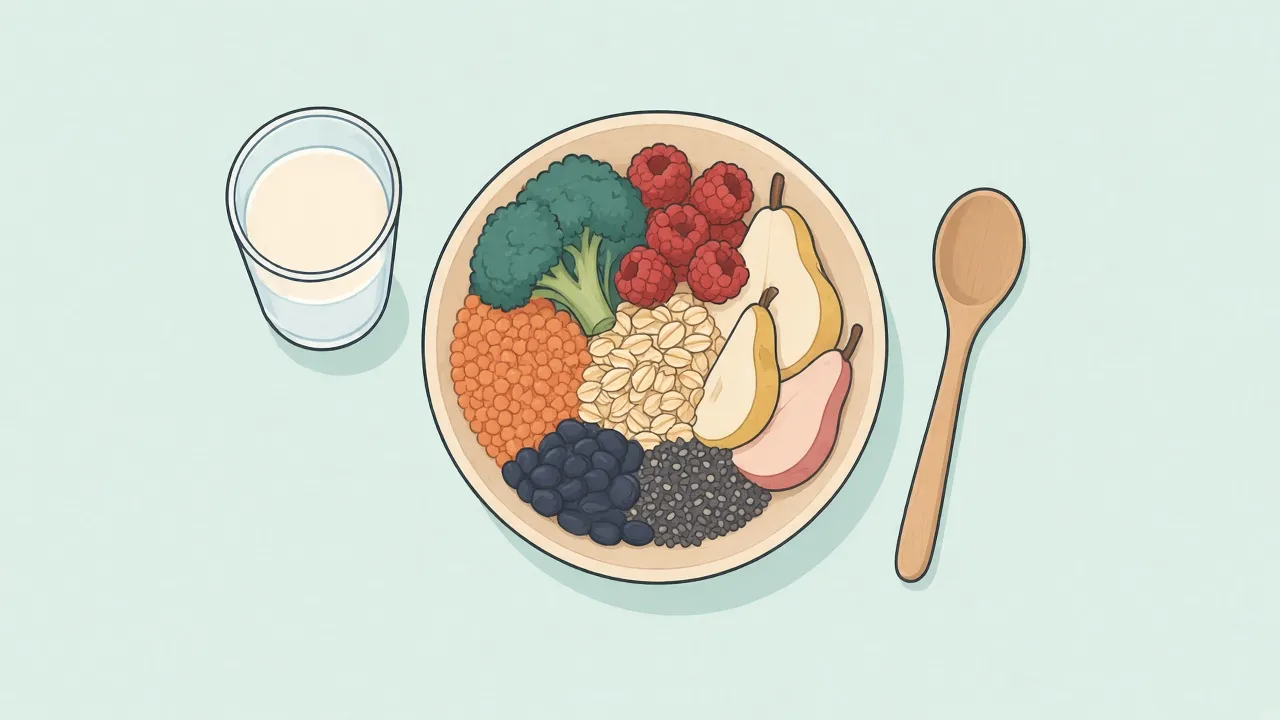
The gram amounts below are the ones the NIDDK prints, from federal food tables 1. Other foods are good sources too. The constipation diet page names whole wheat bread and pasta, oatmeal, lentils, black beans, chickpeas, oranges, carrots, broccoli, almonds, peanuts, and pecans, without listing grams 2. If a food is not in the table, read the package or use the calculator.
| Food and portion | Fiber |
|---|---|
| 1/2 cup high-fiber bran cereal | 14.0 grams |
| 1/2 cup cooked navy beans | 9.6 grams |
| 1 cup cooked green peas | 8.8 grams |
| 1 cup raspberries | 8.0 grams |
| 1/2 cup cooked pinto beans | 7.7 grams |
| 1 cup cooked sweet potato | 6.3 grams |
| 1 cup shredded wheat cereal | 6.2 grams |
| 1/2 cup cooked kidney beans | 5.7 grams |
| 1 cup cooked winter squash | 5.7 grams |
| 1 medium pear, with skin | 5.5 grams |
| 1 medium apple, with skin | 4.8 grams |
| 1 cup cooked collard greens | 4.8 grams |
| 1 medium potato, baked, with skin | 3.9 grams |
| 1/4 cup prunes | 3.1 grams |
A day that lands near the 25 to 35 gram target, using only those portions:
| Meal | Plate | Fiber |
|---|---|---|
| Breakfast | 1 cup shredded wheat and 1 medium pear with the skin | 11.7 grams |
| Lunch | 1/2 cup cooked kidney beans and 1 medium apple with the skin | 10.5 grams |
| Dinner | 1 medium baked potato with the skin and 1/2 cup cooked navy beans | 13.5 grams |
That day is about 36 grams. Use it once your gut is used to the extra fiber. Half a cup of high-fiber bran cereal alone is 14 grams. If your current day is closer to 10 or 15 grams, that one bowl is a big jump. Start with the pear or the apple.

Leave the skin on apples, pears, and potatoes. That is how the NIDDK portions are measured 1. Raspberries are 8 grams a cup if you want fruit instead of a second bean serving. A quarter cup of prunes is only 3.1 grams of fiber, so prunes are a small add unless you eat more of them. A constipation trial used 100 grams of prunes a day, which is well above a quarter cup, and that dose did help 11.
How to raise fiber without getting miserable
The NIDDK says to add fiber a little at a time so your gut can adjust 2. A 2022 review of 16 trials in adults with constipation explains why the pace matters. Fiber raised the chance of a response, and it increased gas. Stool frequency improved mainly when the supplement was over 10 grams a day and people stayed on it for at least 4 weeks. Psyllium and pectin were the fibers with a clear effect. Results varied a lot between studies 9.
A practical ramp, using the portions above:
- For the first few days, add one fruit with the skin. A medium pear is 5.5 grams. A medium apple is 4.8 grams.
- When gas is mild, add half a cup of beans at one meal. Kidney beans are 5.7 grams. Navy beans are 9.6 grams, so they are a bigger step.
- Keep that plate for a week before you add a third high-fiber food. The hemorrhoid trials that checked more than once usually looked again at about 6 weeks 5.
- If you are still short of about 25 grams, add a psyllium supplement rather than a second huge bowl of bran.
Psyllium is the supplement that matches the trials. In adults with chronic constipation, 5.1 grams of psyllium twice a day for two weeks raised stool water more than docusate sodium 100 mg twice a day. By week two, the psyllium group averaged 3.5 bowel movements a week and the docusate group averaged 2.9 10. A separate four-week trial used 12 grams of psyllium a day. Two green kiwifruit a day and 100 grams of prunes a day were tested alongside it. All three increased complete bowel movements and reduced straining. Bloating improved in the kiwifruit group. Side effects were most common with psyllium and least common with kiwifruit 11.
Kiwifruit and prunes are foods, so they sit on this page with the powder. They are options if a daily drink is the part you will skip. The bleeding results below are for fiber as a group. One constipation trial compared psyllium directly with a stool softener 10.
People who use an orange sugar-free psyllium powder often say it is easier to drink than they expected, as long as they finish the glass before it thickens. Some would rather skip the sweetener and coloring. A serving of orange fiber gummies is 5 grams of a blend, not psyllium, so one serving sits under the 10 gram supplemental dose that worked better in the constipation review 9. Powders, capsules, and gummies are compared on the fiber supplement page. How fiber stacks up against a stool softener or a laxative is in stool softener, fiber, or laxative, and short-term softeners are on the stool softener page.
Metamucil Sugar-Free Psyllium Powder, Orange
Best for: Most people starting fiber for hemorrhoids
The best-known psyllium powder and our top fiber pick. Psyllium is the fiber used in most of the hemorrhoid trials.
What recent buyers say
Reviews are strongly positive. It works, it tastes better than people expect, and a tub lasts. Recent buyers say it made them regular within a day or two, and they stress drinking plenty of water with it. The main complaint is the added sweetener and coloring, which some would rather avoid.
What buyers like
- Keeps people regular
- Orange flavor goes down easily
- Big tub is good value
Common complaints
- Some dislike the sweetener and coloring
- Thickens if you do not drink it quickly
Skip it if you prefer plain fiber with nothing added. Anthony's plain psyllium is the unflavored option.
Water, and the fiber plus water trial
Fiber without fluid can leave the stool thick. The NIDDK says water, fruit juice, and clear soups help fiber work, and that the right amount depends on your size, health, activity, and climate 12. Ask your clinician if you are on a fluid limit.
The useful trial is specific. Researchers in Rome randomized 117 adults with chronic constipation, ages 18 to 50. For two months both groups ate about 25 grams of fiber a day. One group drank what they wanted and averaged 1.1 liters a day. The other was told to drink 2 liters of mineral water and averaged 2.1 liters. Both groups had more bowel movements and used fewer laxatives. The higher-fluid group improved more on both counts. The authors’ conclusion was that 25 grams of fiber helps, and that raising fluid to 1.5 to 2.0 liters a day makes the effect larger 7. A 1998 trial of fiber plus extra water is the study to read if you want the design.

The colon and rectal surgeons’ patient page suggests 8 to 10 glasses a day and says coffee, tea, and alcohol should not be counted, because they tend to dry you out 4. The NHS piles page says to cut back on alcohol and on caffeine, including tea, coffee, and cola, to avoid constipation 16. A glass of water with each high-fiber meal is a simple way to move toward the 2 liter mark without measuring every sip. Softer stools still need a short toilet visit. Straining and long sits are covered in toilet habits for hemorrhoids. A walk after a meal is the activity piece, on the exercise guide.
Foods that tend to cause trouble
If constipation is what sets off your hemorrhoids, the NIDDK says to limit foods with little or no fiber: cheese, chips, fast food, ice cream, meat, and many frozen snacks and processed dinners 1. Meat can stay in the meal. The problem is a day built only from those foods, with no beans, fruit, or whole grains beside them. The same list appears on the constipation diet page, minus cheese and ice cream and plus the same processed meals 2.
Spicy food is the item people ask about most. A randomized crossover trial gave 50 people with grade 2 or 3 hemorrhoids a chili capsule or a placebo at lunch. Over the next 48 hours, scores for bleeding, swelling, pain, itching, and burning stayed low with both. The authors saw no reason to ban an occasional spicy meal 13. A randomized chili-pepper trial in hemorrhoids is that paper. The longer write-up, including what the trial did not test, is in does spicy food cause hemorrhoids.
A French survey of people already seeing a doctor for a flare found a different pattern. A spicy diet in the prior two weeks was much more common among patients than among comparison patients (odds ratio 4.95), and so was alcohol (odds ratio 1.99). The authors used a looser statistical cutoff than most trials (P under 0.1) 14. After hemorrhoid surgery, chili looks more troublesome. Sixty people were randomized. The group who ate 3 grams of chili powder a day in the first week had higher pain scores (14.60 versus 7.97) and higher burning scores (12.90 versus 7.82). Bleeding and itching were not clearly different. They also used more pain medicine and had more frequent stools 15. Skip the daily chili while a surgical wound is healing. An occasional spicy meal, outside of that week, is a separate question, and the 48-hour trial did not show harm.
What fiber trials found for bleeding
Two write-ups cover the same seven trials and the same 378 people. One is a 2006 meta-analysis of seven fiber trials in the American Journal of Gastroenterology 5. The other is a Cochrane review of laxatives for hemorrhoids, and the laxative in those trials was fiber 6. They are not two independent piles of patients.
Both found that fiber cut the risk of bleeding in half (relative risk 0.50). The confidence interval runs from 0.28 to 0.89, so the true effect could be as small as an 11 percent drop or as large as a 72 percent drop 56.
They differ slightly on overall symptoms. The journal paper said the risk of symptoms failing to improve fell by 47 percent (relative risk 0.53, interval 0.38 to 0.73) 5. The Cochrane review put that reduction at 53 percent (relative risk 0.47, interval 0.32 to 0.68) 6. The gap is how the same trials were pooled, not a second discovery. Studies that checked more than once, usually at about 6 weeks and at 3 months, stayed consistent 56.
Pain, itching, and prolapse leaned toward fiber in the journal paper, and the ranges were wide enough that no effect is still possible (relative risks 0.33, 0.71, and 0.79) 5. The Cochrane authors said the same thing in words: those results could fit a large benefit, and the pooled numbers still tended toward no clear effect 6. They also flagged two limits: the studies were only moderate in quality, and unpublished negative trials might be missing 6. Mild side effects looked more common with fiber, but that finding was uncertain (relative risk 6.0, interval 0.57 to 64.8) 5.
A 2021 trial of kiwifruit, prunes, or psyllium is the food comparison if constipation is the piece you are treating 11. A 2026 fiber survey in sedentary workers is the snapshot that found lower odds above 18.5 grams a day 17.

Bright red hemorrhoid bleeding: what is typical, what is not, why it still needs a check from age 45, and how fiber and banding help.
If you add one food this week, make it the pear or the apple, and drink a full glass of water with it. Recheck the gram total in the calculator after a few days, then add the beans.
Frequently asked questions
How much fiber is in common foods?
On the NIDDK chart, half a cup of cooked navy beans has 9.6 grams, a cup of raspberries has 8 grams, a cup of cooked green peas has 8.8 grams, and a medium pear with the skin has 5.5 grams. Half a cup of high-fiber bran cereal has 14 grams, which is a large jump if your usual day is low. Read the package, because bran cereals vary.
Can I use a fiber supplement instead of changing meals?
The hemorrhoid trials tested fiber. A constipation review saw clearer results above 10 grams a day of supplemental fiber, for at least 4 weeks, and psyllium was one of the fibers that helped. Food still helps you reach a full day of about 25 grams or more. Take powder with a full glass of water and follow the label.
Do fiber gummies work for hemorrhoids?
A serving of the orange Metamucil gummies is 5 grams of a fiber blend, not the psyllium used in the hemorrhoid trials. The constipation review saw better results above 10 grams a day of supplemental fiber. Some people who use gummies get gas, and the texture can clump in the jar. They are a backup if you will not drink a powder.
Will one spicy meal cause a hemorrhoid flare?
In a randomized trial, one chili dose at lunch did not change bleeding, pain, itching, burning, or swelling over the next 48 hours in people with grade 2 or 3 hemorrhoids. A survey did find spicy eating more often in the two weeks before a flare. After hemorrhoid surgery, daily chili powder increased pain and burning. If a spicy meal clearly bothers you, skip it while you are sore.
What if more fiber makes me bloated or constipated?
Gas was higher in fiber groups than in comparison groups in a 2022 review. Hold the new dose for several days before you add more, and drink fluid with it. In the fiber-plus-water trial, the people who stayed near 1 liter of fluid got less benefit from 25 grams of fiber than the people who drank about 2 liters. If stools get harder, add water before you add another high-fiber food.
Sources
- 1. Eating, Diet, & Nutrition for Hemorrhoids . National Institute of Diabetes and Digestive and Kidney Diseases (NIDDK) . Government
- 2. Eating, Diet, & Nutrition for Constipation . National Institute of Diabetes and Digestive and Kidney Diseases (NIDDK) . Government
- 3. Mott T, Latimer K, Edwards C Hemorrhoids: Diagnosis and Treatment Options . Am Fam Physician , 2018 ; 97(3):172-179 . Review
- 4. Hemorrhoids: Expanded Information . American Society of Colon and Rectal Surgeons . Guideline
- 5. Alonso-Coello P, Mills E, Heels-Ansdell D, et al. Fiber for the treatment of hemorrhoids complications: a systematic review and meta-analysis . Am J Gastroenterol , 2006 ; 101(1):181-188 . doi:10.1111/j.1572-0241.2005.00359.x Review
- 6. Alonso-Coello P, Guyatt G, Heels-Ansdell D, et al. Laxatives for the treatment of hemorrhoids . Cochrane Database Syst Rev , 2005 ; 2005(4):CD004649 . doi:10.1002/14651858.CD004649.pub2 Cochrane review
- 7. Anti M, Pignataro G, Armuzzi A, et al. Water supplementation enhances the effect of high-fiber diet on stool frequency and laxative consumption in adult patients with functional constipation . Hepatogastroenterology , 1998 ; 45(21):727-732 . Clinical trial
- 8. Quagliani D, Felt-Gunderson P Closing America's Fiber Intake Gap: Communication Strategies From a Food and Fiber Summit . Am J Lifestyle Med , 2017 ; 11(1):80-85 . doi:10.1177/1559827615588079 Review
- 9. van der Schoot A, Drysdale C, Whelan K, Dimidi E The Effect of Fiber Supplementation on Chronic Constipation in Adults: An Updated Systematic Review and Meta-Analysis of Randomized Controlled Trials . Am J Clin Nutr , 2022 ; 116(4):953-969 . doi:10.1093/ajcn/nqac184 Review
- 10. McRorie JW, Daggy BP, Morel JG, et al. Psyllium is superior to docusate sodium for treatment of chronic constipation . Aliment Pharmacol Ther , 1998 ; 12(5):491-497 . doi:10.1046/j.1365-2036.1998.00336.x Clinical trial
- 11. Chey SW, Chey WD, Jackson K, Eswaran S Exploratory Comparative Effectiveness Trial of Green Kiwifruit, Psyllium, or Prunes in US Patients With Chronic Constipation . Am J Gastroenterol , 2021 ; 116(6):1304-1312 . doi:10.14309/ajg.0000000000001149 Clinical trial
- 12. Peery AF, Sandler RS, Galanko JA, et al. Risk Factors for Hemorrhoids on Screening Colonoscopy . PLoS One , 2015 ; 10(9):e0139100 . doi:10.1371/journal.pone.0139100 Study
- 13. Altomare DF, Rinaldi M, La Torre F, et al. Red hot chili pepper and hemorrhoids: the explosion of a myth: results of a prospective, randomized, placebo-controlled, crossover trial . Dis Colon Rectum , 2006 ; 49(7):1018-1023 . doi:10.1007/s10350-006-0532-3 Clinical trial
- 14. Pigot F, Siproudhis L, Allaert FA. Risk factors associated with hemorrhoidal symptoms in specialized consultation . Gastroenterol Clin Biol , 2005 ; 29(12):1270-4 . doi:10.1016/s0399-8320(05)82220-1 Study
- 15. Gupta PJ Effect of red chili consumption on postoperative symptoms during the post-hemorrhoidectomy period: randomized, double-blind, controlled study . World J Surg , 2007 ; 31(9):1822-1826 . doi:10.1007/s00268-007-9148-6 Clinical trial
- 16. Piles (haemorrhoids) . NHS , 2026 . Government
- 17. Gao J, Li D, Liu J, et al. Dose-response association between dietary fiber intake and hemorrhoid risk among sedentary professionals: a cross-sectional study . Front Public Health , 2026 ; 14:1842474 . doi:10.3389/fpubh.2026.1842474 Study