Quick answer
A thrombosed hemorrhoid is a clot in an external hemorrhoid: a sudden, hard, tender lump. Severe pain in the first 72 hours is when doctors offer to remove it. After that, pain eases over days to a few weeks with soaks, a wrapped cold pack, and pain pills. Bleeding that does not stop, fever, or feeling faint needs urgent care.
Product links on this page go to Amazon. As an Amazon Associate I earn from qualifying purchases. No brand pays for a place on our lists. How we choose products
Key takeaways
- A thrombosed external hemorrhoid is a clot under the skin at the opening. Pain and swelling often peak around 48 hours and are at their worst in the first 2 to 3 days.
- In a chart review of 231 people, symptoms settled in an average of 3.9 days after the clot was cut out, and in an average of 24 days with non-surgical care. The groups were not randomized.
- After about 72 hours the clot starts to organize and the pain often eases. An operation at that point can hurt more than the clot that is already settling.
- In one trial, 0.3 percent nifedipine plus 1.5 percent lidocaine, applied every 12 hours for two weeks, relieved pain by day 7 in 86 percent of people, compared with 50 percent using lidocaine alone.
- Skip codeine, because it constipates. Skip ibuprofen if you are bleeding. Fever, bleeding that does not stop, or feeling faint needs urgent care.
On this page
A thrombosed hemorrhoid is a blood clot inside an external hemorrhoid. The external hemorrhoid is a cushion under the skin at the anal opening. The clot turns it into a lump that shows up fast and hurts out of proportion to its size. People often say they were fine in the morning and could not sit by evening.
The painless bleeding of an internal hemorrhoid is a different problem. This page is the sudden outside lump. The wider picture of outside swelling, itch, and skin tags is on external hemorrhoids. What follows is the clock: why the first 72 hours matter, what waiting looks like over the next one to three weeks, the ointment trial, and when to go in tonight.
What the clot feels like
NIDDK lists a blood clot in an external hemorrhoid as a complication of hemorrhoids 5. The symptoms of an external hemorrhoid are itching, a hard tender lump, and an ache that is worse with sitting. A clot is that lump at full volume: firm, sudden, and very sore to the touch. Sitting is the thing you cannot do.
Internal hemorrhoids that have not prolapsed usually do not hurt 6. The lining above the dentate line does not sense pain the way skin does 4. A sharp, tearing pain that hits during the bowel movement and then lingers is more the pattern of an anal fissure, a small tear. How those two differ is on hemorrhoid or anal fissure. If you are unsure, a look from a clinician settles it. The visit is short.
The ASCRS patient page notes that the skin over a clot can break and clotted blood can leak out 4. Heavy bleeding is a separate emergency. The red-flag list is at the end of this page.
Why the first 72 hours matter
Pain and swelling from a thrombosed external hemorrhoid tend to peak early. A review of hemorrhoid pain and thrombosis says pain and edema peak at about 48 hours. Excision in the first 72 hours can bring real relief for that reason. After 48 to 72 hours the clot organizes, the symptoms start to ease, and the pain of cutting the hemorrhoid out can be worse than the pain of the clot itself 1. The ASCRS patient page describes the same curve: pain often peaks about 48 to 72 hours after it starts and is largely resolving after roughly four or five days 4.
A 2014 review of hemorrhoid care calls excision and evacuation of the clot, ideally within 72 hours of the onset, the optimal management when the hemorrhoid is acutely thrombosed 12. A 2022 review of external hemorrhoidal thrombosis found the same tradition across coloproctology groups: surgery is considered when symptoms started within the last 48 to 72 hours, or when conservative care has failed. That review is frank about the evidence. No dedicated guideline exists. Both approaches can work. The 72-hour cutoff is clinical habit handed down over years, not a result from a large randomized trial 11.
What a chart review can show is speed. A chart review of 231 people with thrombosed external hemorrhoids looked at how they were treated. About half had the clot managed without surgery (51.5 percent) and about half had it excised (48.5 percent). The surgical group was already more likely to report pain or bleeding. Average time to symptom relief was 24 days without surgery and 3.9 days with excision. Average time until a new clot, among people who had one, was 7.1 months after conservative care and 25 months after excision. The authors’ conclusion was faster relief, fewer recurrences, and a longer gap before the next clot when the hemorrhoid was excised 2. Because the sicker-feeling patients were steered toward surgery, those averages are not a clean experiment. They are still the best before-and-after numbers we have.

If you are in severe pain and it has been less than about three days, call and ask for a same-day look. Tell them what time the lump started. If the pain is already clearly better and a clinician can pinch the lump without you jumping, the ASCRS patient page says non-surgical care is appropriate: warm baths, pain relief, and fiber 4.
If a procedure is offered in that early window, it is excision of the whole lump under local anesthetic, in the office or the emergency department. It rarely needs an operating room. Simply stabbing the lump and squeezing the clot out is not enough. A review notes that incision and drainage alone leaves clot behind and leads to more recurrence 1. Do not try either version at home. Why home draining goes wrong is covered in can you pop a hemorrhoid.
What the next one to three weeks look like if you wait
Waiting is a real plan once the peak has passed, or if you cannot get to a doctor in the first three days. The shape of recovery is more useful than a single “it lasts two weeks” line, because the studies measured different moments.
| Time from the start | What the sources describe |
|---|---|
| About 48 hours | Pain and swelling are at their peak 1. |
| 48 to 72 hours | Last stretch when excision is usually offered for severe pain 112. |
| Day 4 to 5 | Pain is largely easing for many people 4. |
| Day 7 | In one ointment trial, 86 percent had complete pain relief with nifedipine plus lidocaine, versus 50 percent with lidocaine alone 3. |
| Day 14 | In that same trial, the clot had resolved in 92 percent of the nifedipine group, versus 45.8 percent with lidocaine alone 3. |
| About 24 days | Average time to relief with non-surgical care in the 231-person chart review 2. |
So the first week is when the pain turns the corner for a lot of people, and the second and third weeks are when the lump itself shrinks. Twenty-four days is a little past three weeks. If you are not clearly better by the end of the first week, or the lump is larger, get seen. Do not wait out a month on the strength of an average.
A skin tag can remain after the body absorbs the clot. That leftover skin is usually painless. It is described on the external hemorrhoids page. Mention it if it stops you getting clean. Reopening a wound that is already healing is a separate decision.

Why external hemorrhoids hurt, itch, and swell, how long a flare usually lasts, and what helps with soreness and cleaning at home.
The nifedipine and lidocaine trial
A randomized trial of nifedipine ointment tested a prescription mix on 98 people with an acute thrombosed external hemorrhoid. Fifty people applied 0.3 percent nifedipine plus 1.5 percent lidocaine every 12 hours for two weeks. Forty-eight applied 1.5 percent lidocaine alone on the same schedule. Nifedipine is a medicine usually used for blood pressure. Here it was used on the skin.
After 7 days, 43 of 50 people (86 percent) in the combination group had complete pain relief, compared with 24 of 48 (50 percent) using lidocaine alone. Only 4 of 50 (8 percent) on the combination were still using oral pain pills, compared with 26 of 48 (54.1 percent) on lidocaine. At 14 days the clot had resolved in 46 of 50 (92 percent) versus 22 of 48 (45.8 percent). No one in the nifedipine group had a systemic side effect in the trial 3.
The trial was open, meaning people knew which ointment they had. That can color pain scores. The gap was still large. A 2022 review lists this lidocaine-nifedipine mix among the conservative options clinicians use, along with wait-and-see, flavonoid mixtures, and in some reports glyceryl trinitrate ointment or a botulinum injection 11. Those last two are specialist treatments, not a bathroom-cabinet plan.
This ointment is prescribed. Do not crush blood-pressure tablets into a cream. A store numbing cream is a different product, and it was the weaker arm of the trial when it was used alone. If you want something while you wait for a prescription, use the home steps below and ask a clinician about the combination ointment. Store options are compared on over-the-counter hemorrhoid treatment.
Pain control and home care while it settles
The fast relief plan for the next 48 hours overlaps with this. For a clot, keep the steps small and specific.
- Pain pills. Acetaminophen is the default. NIDDK also lists ibuprofen, naproxen, and aspirin 7. The NHS page on piles says not to take ibuprofen if you are bleeding, and not to take codeine, because codeine causes constipation 8. A hard stool the next morning is the last thing this lump needs.
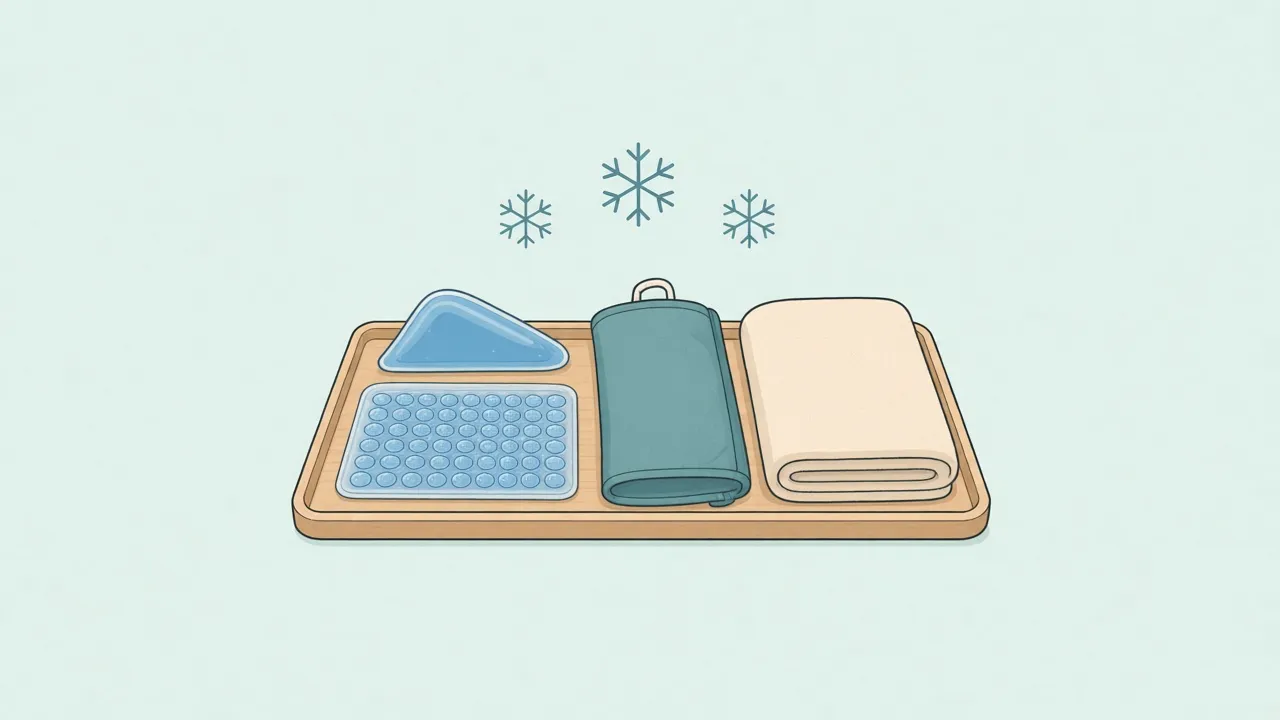
- A wrapped cold pack for the throbbing, for about 10 to 15 minutes at a time. The NHS suggests an ice pack wrapped in a towel 8. Buyers of a contoured hemorrhoid ice pack often say the cold lasts about 15 to 20 minutes and that the pack is more comfortable with a thin cloth around it. The best ice packs for hemorrhoids page compares shapes.
- A warm soak for the muscle ache, several times a day, in water that feels comfortable on your wrist 7. How long to sit and how to set the basin up is on how to take a sitz bath. Cold and heat do different jobs. The comparison is on ice or heat for hemorrhoids.
- Soft stools. Fiber, fluid, and a short-term stool softener if a clinician suggests one, so you are not straining over the lump. Straining and long toilet sits are on the cause list for hemorrhoids in general 6.
- Gentle cleaning. Pat dry. Skip scented wipes if they sting. The home-care menu beyond a clot is on hemorrhoid home remedies.
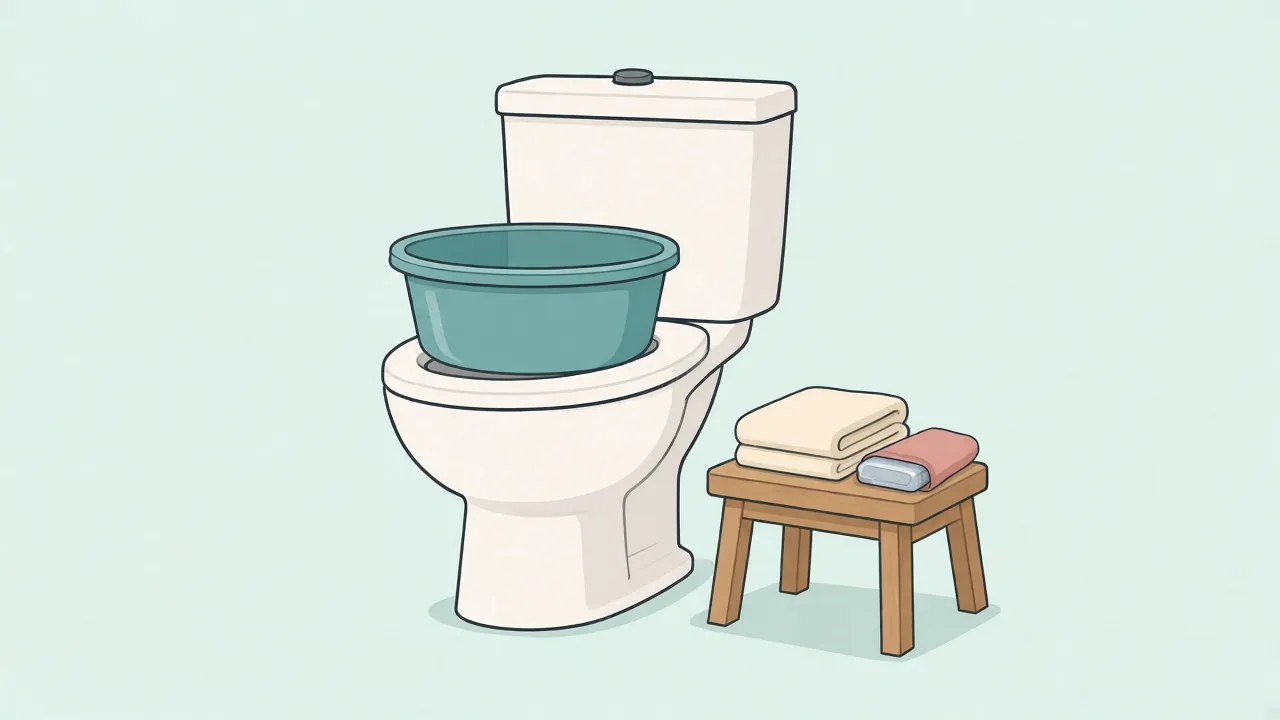
A basin that sits on the toilet is easier to face several times a day than a full bath when sitting down hurts. Buyers of a foldable sitz bath often mention that it stays steady and stores flat. People with wider hips sometimes find a standard basin narrow. Those tradeoffs are on the best sitz baths page.
Swelling and throbbing when you want relief without medicine
Most people, especially after childbirth or surgery
If you are pregnant, call your obstetric clinician the same day for a severe new lump. Do not start a prescription ointment, including nifedipine, until that clinician agrees. The external hemorrhoid page covers which store creams are limited to about a week.
When to go to urgent care
Go today, to a clinic that can do a procedure or to urgent care, if all three of these are true: the lump is hard and new, the pain is severe enough that you cannot sit, and it started less than about 72 hours ago. That is the window in which removal is most likely to be offered 1412. Bring a note of the hour it started.
Go to emergency care, or call emergency services, if the bleeding will not stop, there is a large amount of blood or large clots, or the pain is severe 8. MedlinePlus says to get help right away if you lose a lot of blood or you are bleeding and feel dizzy, lightheaded, or faint 9. NIDDK says to seek care right away for severe anal pain together with rectal bleeding, particularly if you also have abdominal pain, diarrhea, or fever 7.
A fever, or pain that is getting worse after day four instead of easing, is a reason to be seen promptly rather than to finish the week you had planned. Who to call in less dramatic cases, including bleeding that is small but new, is on when to see a doctor for hemorrhoids.
Colon cancer screening is recommended from age 45 for adults at average risk 10. A clot explains a sudden lump. A change in your stools over weeks still needs its own check. If the pain is already easing and there is no bleeding emergency, the home steps above are the plan through the next one to three weeks, with a check if day seven arrives and you are not clearly better 24.
Frequently asked questions
How do I know this lump is a thrombosed hemorrhoid?
It usually appears over a few hours, sits at the anal opening under the skin, and feels hard and very tender. Sitting hurts. Internal hemorrhoids more often bleed with little pain. A fissure causes a sharp tearing pain with the bowel movement. A doctor confirms the clot by looking.
Can a thrombosed hemorrhoid go away on its own?
Yes, most do. The American Society of Colon and Rectal Surgeons patient page says the pain often peaks around 48 to 72 hours and is largely easing after about four or five days. Full settling took an average of 24 days with non-surgical care in one chart review. A skin tag can remain after the clot is absorbed.
What is the 72-hour rule?
If you are in severe pain and the lump started less than about 72 hours ago, removing the clot usually brings faster relief than waiting. After that window, the pain of an excision can be worse than the pain of a clot that is already calming down. The cutoff comes from clinical practice. It has not been settled by a large randomized trial.
Can I lance the clot at home?
No. Simply opening the lump and letting the clot out is not enough, and it raises the chance the symptoms come back. Removal, when it is offered, is done with numbing medicine and takes out the clot and the skin over it. Home cutting risks bleeding and infection.
What pain medicine is safe?
Acetaminophen is the usual first pill. The NHS says to skip ibuprofen if the hemorrhoid is bleeding, and to skip codeine because codeine causes constipation. A prescribed ointment of nifedipine plus lidocaine helped more than lidocaine alone in one trial. Do not try to mix that ointment from blood-pressure pills.
When should I go to urgent care?
Go the same day if the pain is severe and the lump is less than about 72 hours old and you want removal considered. Go to emergency care for bleeding that does not stop, a large amount of blood, large clots, pain with fever, or bleeding with dizziness or fainting. Pain that is still getting worse after the first three days also needs a prompt look.
Sources
- 1. Sun Z, Migaly J Review of Hemorrhoid Disease: Presentation and Management . Clin Colon Rectal Surg , 2016 ; 29(1):22-29 . doi:10.1055/s-0035-1568144 Review
- 2. Greenspon J, Williams SB, Young HA, Orkin BA Thrombosed external hemorrhoids: outcome after conservative or surgical management . Dis Colon Rectum , 2004 ; 47(9):1493-1498 . doi:10.1007/s10350-004-0607-y Study
- 3. Perrotti P, Antropoli C, Molino D, et al. Conservative treatment of acute thrombosed external hemorrhoids with topical nifedipine . Dis Colon Rectum , 2001 ; 44(3):405-409 . doi:10.1007/BF02234741 Clinical trial
- 4. Hemorrhoids: Expanded Information . American Society of Colon and Rectal Surgeons . Guideline
- 5. Definition & Facts of Hemorrhoids . National Institute of Diabetes and Digestive and Kidney Diseases (NIDDK) . Government
- 6. Symptoms & Causes of Hemorrhoids . National Institute of Diabetes and Digestive and Kidney Diseases (NIDDK) . Government
- 7. Treatment of Hemorrhoids . National Institute of Diabetes and Digestive and Kidney Diseases (NIDDK) . Government
- 8. Piles (haemorrhoids) . NHS , 2026 . Government
- 9. Hemorrhoids: MedlinePlus Medical Encyclopedia . MedlinePlus, US National Library of Medicine . Government
- 10. US Preventive Services Task Force Screening for Colorectal Cancer: US Preventive Services Task Force Recommendation Statement . JAMA , 2021 ; 325(19):1965-1977 . doi:10.1001/jama.2021.6238 Guideline
- 11. Picciariello A, Rinaldi M, Grossi U, et al. Management and Treatment of External Hemorrhoidal Thrombosis. . Front Surg , 2022 ; 9:898850 . doi:10.3389/fsurg.2022.898850 Review
- 12. Fox A, Tietze PH, Ramakrishnan K. Anorectal conditions: hemorrhoids. . FP Essent , 2014 ; 419:11-9 . Review