Quick answer
Hemorrhoids are swollen anal cushions, the blood-vessel pads everyone has at the end of the rectum. Internal ones usually bleed without pain or slip out. External ones sit under the skin and hurt or itch. Most flares ease with fiber, shorter toilet time, and warm soaks. See a doctor for heavy bleeding, severe pain, or symptoms after a week.
Product links on this page go to Amazon. As an Amazon Associate I earn from qualifying purchases. No brand pays for a place on our lists. How we choose products
Key takeaways
- Everyone has anal cushions made of blood vessels and supporting tissue. A hemorrhoid is one of those cushions after it swells or slips downward.
- About 1 in 20 Americans has hemorrhoid symptoms, and about half of adults older than 50 do. On a screening exam, hemorrhoids showed up in 380 of 976 adults, and more than half of that group had no symptoms.
- In seven fiber trials with 378 people, fiber cut the risk of bleeding by about half and lowered the risk of symptoms that did not improve.
- Painless bright red blood with a bowel movement is the usual internal symptom. A hard, tender lump on the outside is more often an external hemorrhoid, sometimes with a clot.
- Doctors usually diagnose hemorrhoids with your history and an exam. Rectal bleeding still deserves a check, and colon cancer screening is recommended from age 45.
On this page
Hemorrhoids are swollen cushions of blood vessels and supporting tissue at the end of the rectum. You already have those cushions. They help seal the anal canal so stool and gas stay in until you mean to go. A hemorrhoid is what you get when a cushion swells, slips downward, or both.
Internal hemorrhoids usually show up as painless bright red blood, or as tissue that slips out during a bowel movement. External hemorrhoids sit under the skin at the opening. They itch, ache, and swell. This page covers both types, the four grades, how common hemorrhoids are, what brings a flare on, how doctors check them, and which treatments have evidence behind them.
Most people never need an operation. Home care is fiber, enough fluid, shorter time on the toilet, and a warm soak when you are sore. A doctor visit matters when bleeding is new or heavy, pain is severe, or a week of home care has not helped.
What hemorrhoids are
The American Society of Colon and Rectal Surgeons explains hemorrhoid anatomy for patients in plain terms: every person has hemorrhoidal tissue. It is made of blood vessels, connective tissue, and a small amount of muscle, in the anal canal and just outside it. Only a minority of people develop enlargement or symptoms 1.
A 1975 anatomical study described specialized cushions of tissue lining the anal canal. The author argued that piles are those cushions after they have been displaced 2. A later pressure study in adults without anal disease found that the cushions account for about 15 percent of resting anal pressure. They fill the gap inside the internal sphincter ring so the canal can close 3. Treatment is aimed at the cushion that has slipped or swollen, so the seal can keep working.
A review of how hemorrhoids develop and how they are graded defines them as the symptomatic enlargement and downward displacement of the normal anal cushions. The vessels in the cushion stretch, and the connective tissue that holds the cushion in place breaks down 4. The NIDDK definition and facts page describes the same problem from the outside: swollen, inflamed veins around the anus or in the lower rectum 5.
Internal and external hemorrhoids
Doctors divide hemorrhoids by a landmark called the dentate line, a boundary inside the anal canal. Above that line, the lining does not sense pain, touch, or temperature the way skin does. Those are internal hemorrhoids, and they are covered by the same kind of lining as the rectum. Below the line, the covering is skin, and it is very sensitive. Those are external hemorrhoids. Some people have mixed hemorrhoids, with tissue on both sides of the line 14.
That split is why two people can both say “hemorrhoids” and mean different problems. Internal hemorrhoids often bleed during a bowel movement and may slip out, called prolapse. If they have not prolapsed, they usually do not hurt. External hemorrhoids cause itching, a tender lump, and aching that is worse with sitting. Rubbing and extra wiping tend to make the outside symptoms worse. For many people, external symptoms ease within a few days 6.
A sudden hard lump that you cannot sit on is often a clot in an external hemorrhoid. That problem has its own time course, so it is covered on the thrombosed hemorrhoid page. The full symptom list, including mucus and a feeling that you are not empty, is on hemorrhoid symptoms. A soft, painless flap left after a flare is usually a skin tag, explained in anal skin tags. Itching on its own has several other causes, covered in itchy anus. If you know the condition as piles, the UK name, see piles: symptoms, causes and treatment.
The four grades of internal hemorrhoids
Surgeons grade internal hemorrhoids with the Goligher scale, which is based on prolapse, not on how much blood you see 4.
| Grade | What you notice | What is usually tried |
|---|---|---|
| 1 | Bleeding. The cushion does not come out. | Fiber, fluids, and toilet habits. An office procedure if bleeding keeps up. |
| 2 | The cushion comes out with straining and goes back by itself. | Fiber, then rubber band ligation for many people. |
| 3 | The cushion comes out and you have to push it back in. | Banding first for a lot of people. Surgery if banding fails or the prolapse is large. |
| 4 | The cushion stays out and will not go back in. | Surgery is the option usually discussed. |
Rubber band ligation, also called banding, is a clinic procedure. A doctor places a small band around the base of an internal hemorrhoid so the extra tissue loses its blood supply, shrinks, and falls off, most often within a week. A meta-analysis of hemorrhoid treatment trials recommended banding as the first procedure for grades 1 to 3. Hemorrhoidectomy, the operation that cuts the tissue out, had a better response rate in those trials, along with more pain and more complications, so the authors reserved it for people who did not improve after banding 17. The ASCRS patient page also lists hemorrhoidectomy as an option for grade 3 or 4 prolapse, for large external hemorrhoids, and for combined internal and external disease. Fewer than 10 percent of patients seen for symptomatic hemorrhoids need an operation 1.
Among adults who had hemorrhoids on a screening exam, grade 1 was by far the most common: 277 of 380 people (72.89 percent). Grade 2 accounted for 18.42 percent, grade 3 for 8.16 percent, and grade 4 for 0.53 percent 7.

Why internal hemorrhoids bleed with little pain, how grades 1 to 4 differ, and which treatment fits each grade of prolapse.
How common hemorrhoids are
The numbers depend on what was counted.
People who say they have hemorrhoids are a smaller group than people who have cushions that look enlarged on an exam. A 1990 analysis of U.S. survey and practice data estimated that 10 million Americans complained of hemorrhoids, a prevalence of 4.4 percent. Rates peaked between ages 45 and 65 and were unusual before age 20 8. NIDDK, citing a later clinical review, says hemorrhoids affect about 1 in 20 Americans, and about half of adults older than 50 have them 5. The ASCRS patient page uses a similar figure: roughly 5 percent of people develop symptoms from their hemorrhoids 1.
An exam finds more. In an Austrian colonoscopy screening study, 380 of 976 adults (38.93 percent) had hemorrhoids. Of those 380, 210 people (55.26 percent) reported no symptoms 7. A hemorrhoid noted on a colonoscopy report is often silent.
Care-seeking is somewhere in between. In the United States, hemorrhoids are the third most common outpatient gastrointestinal diagnosis, with nearly 4 million office and emergency visits a year 9.
What causes hemorrhoids
The supporting tissue in the cushions weakens with age, and repeated pressure pushes the cushions down. NIDDK lists the pressures that come up most often: straining, long sits on the toilet, chronic constipation or diarrhea, a low-fiber diet, age over 50, pregnancy, and frequent heavy lifting 56. A fuller look at each of those is on what causes hemorrhoids.
Constipation shows up in exam data. In 2,813 people who had a colonoscopy in a polyp-prevention trial, constipation was tied to a higher chance of hemorrhoids (odds ratio 1.43, 95 percent confidence interval 1.11 to 1.86). The highest intake of grain fiber was tied to a lower chance than the lowest intake (odds ratio 0.78, 95 percent confidence interval 0.62 to 0.98). In that same study, having ever been pregnant was not tied to hemorrhoids on the exam, and neither overweight nor obesity was 10.
An older U.S. survey found that hemorrhoids and constipation did not follow the same pattern by age, race, or income, which led the authors to question constipation as the cause 8. A later review from the same research group still called the cause speculative. Low fiber and constipation had been assumed for years and had not been well proved 9.
Pregnancy is different from “has ever been pregnant.” NIDDK lists pregnancy itself as a risk 5. A study that followed 280 pregnant women and examined them found hemorrhoids in 114 (40.7 percent), mostly in the third trimester and after birth 11. Relief studied for that window is covered on hemorrhoids during pregnancy.
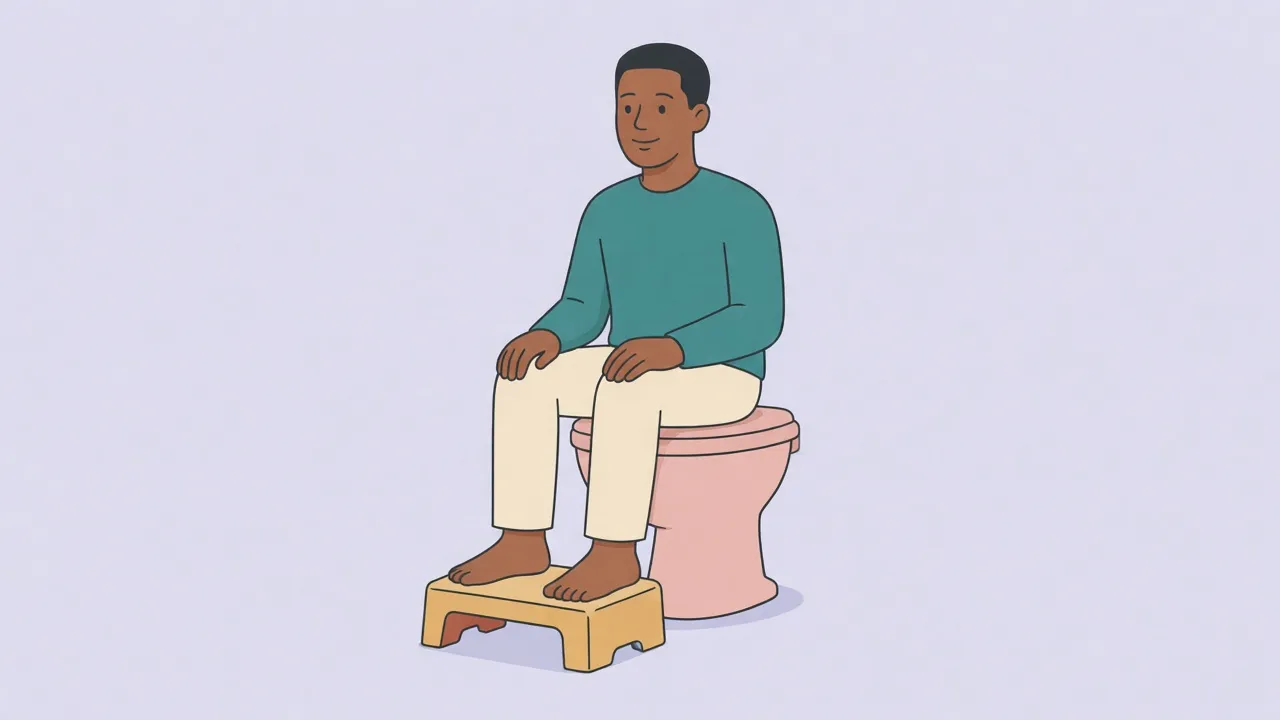
Time on the toilet is the trigger with the newest data. In a 2025 study of 125 adults having a screening colonoscopy, 43 percent had hemorrhoids on the exam, and 66 percent said they used a phone on the toilet. Phone users were younger. Among them, 37.3 percent spent more than five minutes per toilet visit, compared with 7.1 percent of people who did not use a phone. After adjustment for age, sex, body mass index, exercise, straining, and fiber, phone use on the toilet was tied to a 46 percent higher chance of hemorrhoids. The sample was 125 people. What changed most clearly was the time spent sitting 12.
Hemorrhoid symptoms
Symptoms follow the type.
Internal hemorrhoids, when they have not prolapsed, tend to cause bright red blood on the stool, on the paper, or in the bowl. You may also see tissue slip out. Prolapsed internal hemorrhoids can ache. External hemorrhoids cause itching, one or more hard tender lumps, and pain that is worse when you sit 6. The bleeding hemorrhoids page goes through how much blood is ordinary and which patterns are not.
A review of the research adds a caution: bleeding, pain, itching, seepage, prolapse, and mucus were reported equally often by patients who did not have hemorrhoids on evaluation and by patients who did 9. That is why the list is a reason for an exam, and why matching the story to what the doctor sees matters.
How doctors diagnose hemorrhoids
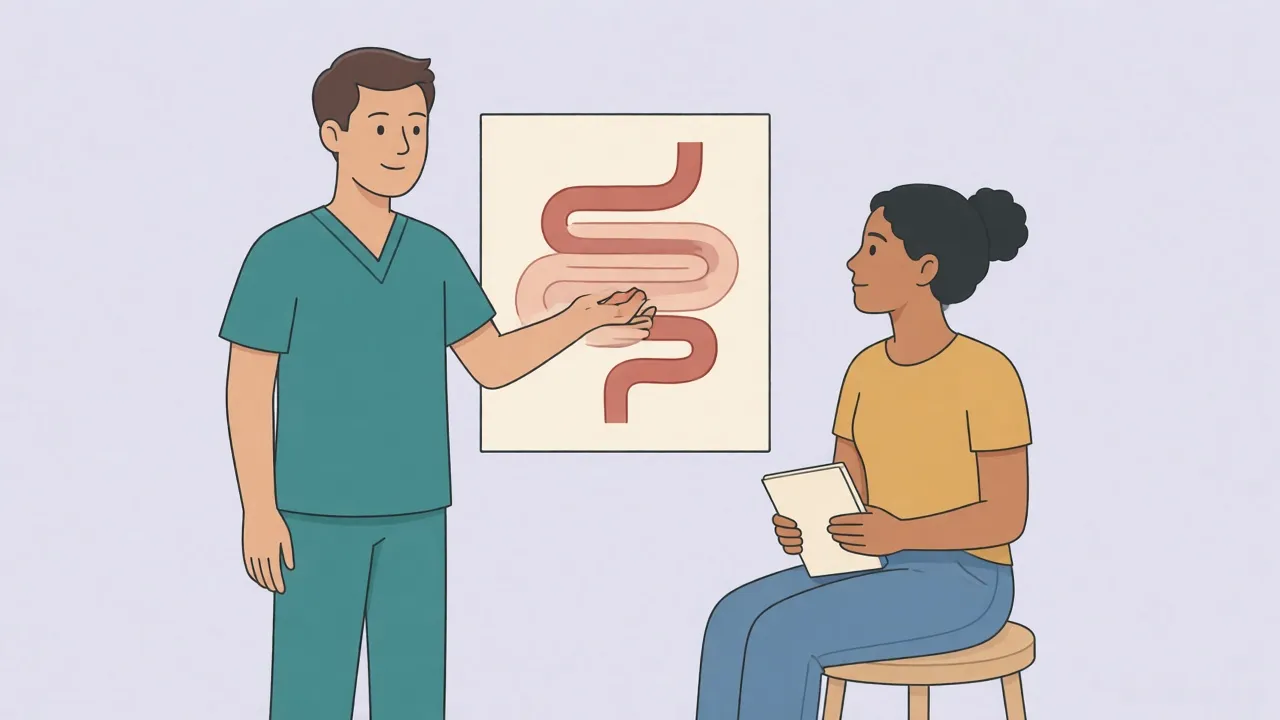
A doctor can often make the diagnosis from your history and a look at the area. NIDDK’s diagnosis of hemorrhoids page describes the visit. You will be asked about symptoms, what you eat, how long you sit, laxative or enema use, and other conditions. The exam looks for swelling, a prolapsed internal hemorrhoid, a clot in an external hemorrhoid, leakage, irritated skin, leftover skin tags, and an anal fissure, which is a small tear 13.
A gloved finger exam checks muscle tone and feels for tenderness, blood, and lumps. An anoscopy uses a short lighted tube to see the anal canal and the lower rectum. It is done in the office, and most people do not need anesthesia. If the doctor needs a longer look, a rigid proctoscope, a flexible sigmoidoscopy, or a colonoscopy comes next. Hemorrhoids are also found during colonoscopies done for other reasons 13.
Bleeding is the symptom that changes the plan. NIDDK says to contact a doctor if you have rectal bleeding at all, or if symptoms are still there after a week of home care 6. The US Preventive Services Task Force recommends colon cancer screening for adults age 45 to 75 at average risk, with a more selective decision from 76 to 85 14. Screening stays on that schedule when a hemorrhoid is found. The ASCRS patient information says other disease, including anal and colorectal cancer, has to be considered when the story does not fit 1. What happens at the appointment is spelled out on when to see a doctor for hemorrhoids. The signs that point away from hemorrhoids are covered in hemorrhoids or colon cancer.
What to try for hemorrhoid relief
NIDDK says you can most often treat hemorrhoids at home 15. The hemorrhoid treatment guide compares home care, store products, office procedures, and surgery. The steps below are the ones to start this week.
- Add fiber from food, and use a supplement if you are short of the target. NIDDK points to the Dietary Guidelines figure of 14 grams of fiber per 1,000 calories, which is 28 grams a day on a 2,000-calorie diet 18. The ASCRS patient page suggests a range of 20 to 35 grams a day, plus a supplement once or twice a day for many people 1. Drink water or other nonalcoholic drinks with the fiber so it can soften the stool. NIDDK says to ask how much to drink, because the amount depends on your health, your activity, and where you live 18.
- Do not strain, and do not stay on the toilet to read or scroll 15.
- Sit in a few inches of warm water, a sitz bath, several times a day if you are sore 15. A review of the sitz-bath literature found very little trial evidence that soaks treat anorectal disease. Use the soak for comfort while the fiber and toilet habits do the longer job 19.
- For mild pain, swelling, or itching on the outside, an over-the-counter cream, ointment, or suppository is reasonable. NIDDK says doctors usually suggest those products for about a week. Stop and check in if you get a rash or very dry skin, or if nothing has improved when the week is up 15. Follow the label. Pain pills such as acetaminophen, ibuprofen, naproxen, or aspirin are on the NIDDK list 15. NHS advice on piles is to skip ibuprofen when they are bleeding, and to skip codeine because it can cause constipation 21.
- If you are still bleeding or still uncomfortable after that week, make the appointment. Severely prolapsed or bleeding internal hemorrhoids may need a procedure even if home care helped a little 615.
Psyllium powders are a practical way to close a fiber gap when food is not enough. The best fiber supplements for hemorrhoids page compares powders, capsules, and gummies. Buyers of a standard orange psyllium powder often say it is easier to drink than they expected, if they drink it before it thickens, and they remind each other to take it with plenty of water.
Metamucil Sugar-Free Psyllium Powder, Orange
Best for: Most people starting fiber for hemorrhoids
The best-known psyllium powder and our top fiber pick. Psyllium is the fiber used in most of the hemorrhoid trials.
What recent buyers say
Reviews are strongly positive. It works, it tastes better than people expect, and a tub lasts. Recent buyers say it made them regular within a day or two, and they stress drinking plenty of water with it. The main complaint is the added sweetener and coloring, which some would rather avoid.
What buyers like
- Keeps people regular
- Orange flavor goes down easily
- Big tub is good value
Common complaints
- Some dislike the sweetener and coloring
- Thickens if you do not drink it quickly
Skip it if you prefer plain fiber with nothing added. Anthony's plain psyllium is the unflavored option.
Office procedures are for internal hemorrhoids that keep bleeding or prolapsing after home care. Besides banding, doctors use sclerotherapy (an injection that scars the hemorrhoid down), infrared coagulation (a short burst of heat), and electrocoagulation (a similar idea with electric current). All of these are meant to create a small scar that cuts off blood flow and shrinks the cushion. Only a doctor should do them. Do not try to band a hemorrhoid yourself 1517.
In the operating room, a hemorrhoidectomy removes large external hemorrhoids and prolapsing internal ones that have not responded to other care. Stapled hemorrhoidopexy uses a stapling device to remove a ring of internal tissue and pull a prolapsing hemorrhoid back up. Both are done with anesthesia 15.
How to keep hemorrhoids from coming back
The prevention list from NIDDK matches the treatment list, because the same pressures cause the next flare: enough fiber, enough fluid, no straining, no long toilet sits, and less routine heavy lifting 15. The daily version of that plan is on how to prevent hemorrhoids.
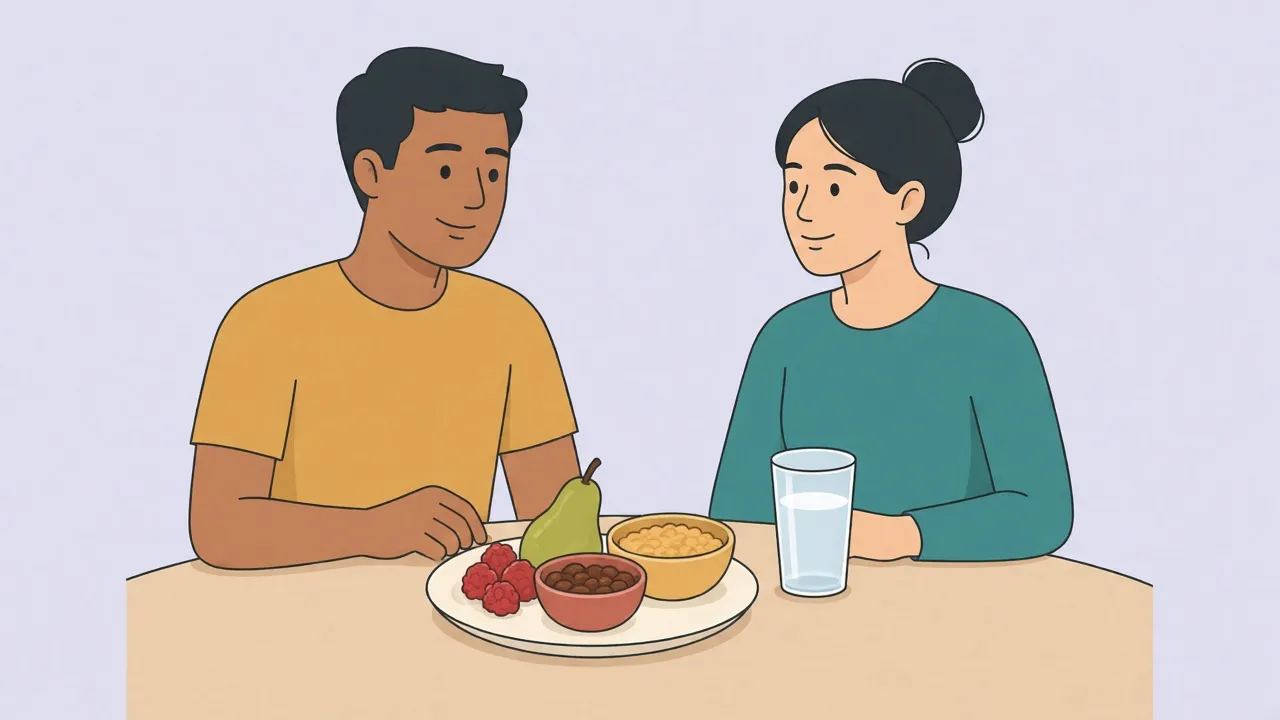
From the NIDDK diet table, a half cup of high-fiber bran cereal has 14 grams, a cup of raspberries has 8 grams, a half cup of cooked navy beans has 9.6 grams, and a medium pear with the skin has 5.5 grams 18. Cheese, chips, fast food, ice cream, and meat add almost none. If bleeding comes back after a quiet stretch, get it checked again. The next bleed can have a different cause.
When hemorrhoid symptoms need a doctor
Call this week if home care for seven days has not helped, or if you see rectal bleeding 6. Ongoing blood loss can lead to anemia, which NIDDK lists as a complication 5. Infection of a sore on an external hemorrhoid, a clot, a skin tag left after a clot dissolves, and a strangulated hemorrhoid (the anal muscle cuts off blood flow to a prolapsed internal hemorrhoid) are the other complications on that list 5.
Go in the same day for severe anal pain together with rectal bleeding, especially if you also have abdominal pain, diarrhea, or fever 15. MedlinePlus says to get help right away if you lose a lot of blood or you are bleeding and feel dizzy, lightheaded, or faint 20. NHS advice is emergency care for bleeding that does not stop, a large amount of blood, large clots, or severe pain 21.
Screening from age 45 is a B recommendation from the USPSTF for adults at average risk, and screening from 50 to 75 is an A recommendation 14. If you are pregnant, ask your obstetric clinician before you use a medicated cream. The pregnancy guide lists which options have been studied in that setting.
Every guide in understanding hemorrhoids
Frequently asked questions
Are hemorrhoids the same thing as piles?
Yes. Piles is the everyday word, and it is the word the NHS uses. Doctors say hemorrhoids. Both names mean the cushions at the end of the rectum have swollen or slipped down.
Can hemorrhoids turn into cancer?
Hemorrhoids do not turn into cancer. Bleeding and a change in bowel habits can also come from a polyp or a cancer, which is why new rectal bleeding should be checked. Adults 45 and older should stay up to date with colon cancer screening even when a hemorrhoid is visible.
Do hemorrhoids go away without treatment?
Many small flares settle with softer stools, shorter toilet sits, and time. External symptoms often ease within a few days. A hemorrhoid that keeps bleeding, keeps slipping out, or is still there after a week of home care needs a doctor rather than another week of waiting.
Should I stop exercising if I have hemorrhoids?
Ordinary walking can stay in the week. The patient guidance from colon and rectal surgeons includes exercise along with fiber and fluids. Heavy lifting and straining are on the list of pressures that make a flare more likely, so leave breath-holding lifts until sitting is comfortable again.
Is bright red blood on the paper always a hemorrhoid?
Bright red blood with a bowel movement is the most common hemorrhoid symptom, and it is often painless when the hemorrhoid is internal. The same blood can come from a small tear, inflammation, or a growth higher up. One look at the area is not enough to close the question if you are over 45, have never been screened, or the blood is dark, heavy, or mixed into the stool.
Sources
- 1. Hemorrhoids: Expanded Information . American Society of Colon and Rectal Surgeons . Guideline
- 2. Thomson WH The nature of haemorrhoids . Br J Surg , 1975 ; 62(7):542-552 . doi:10.1002/bjs.1800620710 Study
- 3. Lestar B, Penninckx F, Kerremans R The composition of anal basal pressure. An in vivo and in vitro study in man . Int J Colorectal Dis , 1989 ; 4(2):118-122 . doi:10.1007/BF01646870 Study
- 4. Lohsiriwat V Hemorrhoids: from basic pathophysiology to clinical management . World J Gastroenterol , 2012 ; 18(17):2009-2017 . doi:10.3748/wjg.v18.i17.2009 Review
- 5. Definition & Facts of Hemorrhoids . National Institute of Diabetes and Digestive and Kidney Diseases (NIDDK) . Government
- 6. Symptoms & Causes of Hemorrhoids . National Institute of Diabetes and Digestive and Kidney Diseases (NIDDK) . Government
- 7. Riss S, Weiser FA, Schwameis K, et al. The prevalence of hemorrhoids in adults . Int J Colorectal Dis , 2012 ; 27(2):215-220 . doi:10.1007/s00384-011-1316-3 Study
- 8. Johanson JF, Sonnenberg A The prevalence of hemorrhoids and chronic constipation. An epidemiologic study . Gastroenterology , 1990 ; 98(2):380-386 . doi:10.1016/0016-5085(90)90828-o Study
- 9. Sandler RS, Peery AF Rethinking What We Know About Hemorrhoids . Clin Gastroenterol Hepatol , 2019 ; 17(1):8-15 . doi:10.1016/j.cgh.2018.03.020 Review
- 10. Peery AF, Sandler RS, Galanko JA, et al. Risk Factors for Hemorrhoids on Screening Colonoscopy . PLoS One , 2015 ; 10(9):e0139100 . doi:10.1371/journal.pone.0139100 Study
- 11. Poskus T, Buzinskienė D, Drasutiene G, et al. Haemorrhoids and anal fissures during pregnancy and after childbirth: a prospective cohort study . BJOG , 2014 ; 121(13):1666-1671 . doi:10.1111/1471-0528.12838 Study
- 12. Ramprasad C, Wu C, Chang J, et al. Smartphone use on the toilet and the risk of hemorrhoids . PLoS One , 2025 ; 20(9):e0329983 . doi:10.1371/journal.pone.0329983 Study
- 13. Diagnosis of Hemorrhoids . National Institute of Diabetes and Digestive and Kidney Diseases (NIDDK) . Government
- 14. US Preventive Services Task Force Screening for Colorectal Cancer: US Preventive Services Task Force Recommendation Statement . JAMA , 2021 ; 325(19):1965-1977 . doi:10.1001/jama.2021.6238 Guideline
- 15. Treatment of Hemorrhoids . National Institute of Diabetes and Digestive and Kidney Diseases (NIDDK) . Government
- 16. Alonso-Coello P, Mills E, Heels-Ansdell D, et al. Fiber for the treatment of hemorrhoids complications: a systematic review and meta-analysis . Am J Gastroenterol , 2006 ; 101(1):181-188 . doi:10.1111/j.1572-0241.2005.00359.x Review
- 17. MacRae HM, McLeod RS Comparison of hemorrhoidal treatment modalities. A meta-analysis . Dis Colon Rectum , 1995 ; 38(7):687-694 . doi:10.1007/BF02048023 Review
- 18. Eating, Diet, & Nutrition for Hemorrhoids . National Institute of Diabetes and Digestive and Kidney Diseases (NIDDK) . Government
- 19. Tejirian T, Abbas MA Sitz bath: where is the evidence? Scientific basis of a common practice . Dis Colon Rectum , 2005 ; 48(12):2336-2340 . doi:10.1007/s10350-005-0085-x Review
- 20. Hemorrhoids: MedlinePlus Medical Encyclopedia . MedlinePlus, US National Library of Medicine . Government
- 21. Piles (haemorrhoids) . NHS , 2026 . Government