Quick answer
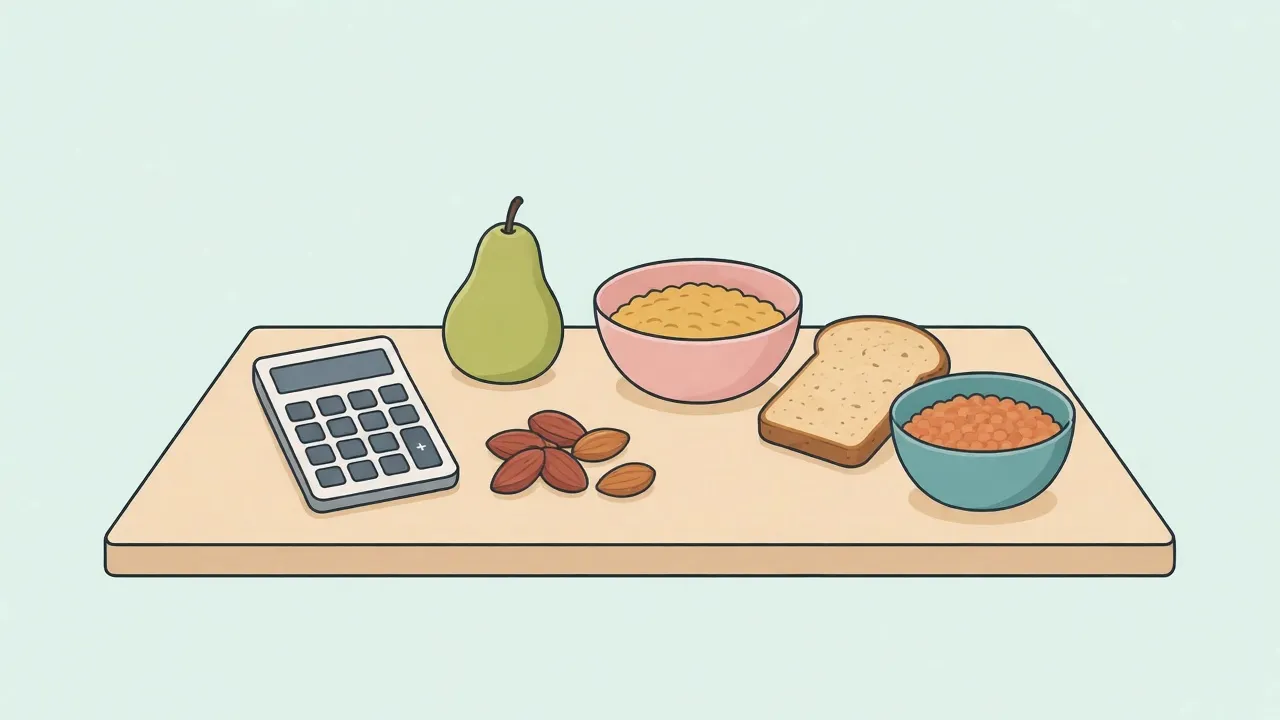
The fiber calculator adds up a typical day of fruit, vegetables, beans, grains, cereal, nuts, and psyllium, then compares it with an Adequate Intake for your age and sex. Women need about 21 to 25 grams, men about 30 to 38. Pregnancy uses 28 grams and breastfeeding 29. If you are short, raise fiber over two or three weeks and drink more water.
Product links on this page go to Amazon. As an Amazon Associate I earn from qualifying purchases. No brand pays for a place on our lists. How we choose products
Key takeaways
- The calculator uses Institute of Medicine Adequate Intakes: 25 grams for women 19 to 50, 21 grams after 51, 38 grams for men 19 to 50, and 30 grams for men 51 and older.
- If you select female and pregnant, the target switches to 28 grams. Breastfeeding uses 29 grams. Those options turn off if you select male.
- Food lines are round averages, about 3 to 7 grams a serving, so a pear with skin at 5.5 grams on the NIDDK list will not match the calculator's 4 gram fruit line exactly.
- In seven hemorrhoid trials, fiber cut the chance of bleeding by about half. Constipation trials saw more gas, and a clearer stool-frequency benefit above 10 grams a day of supplemental fiber for at least four weeks.
- Most Americans are short of these targets. ACOG cites about 15 grams a day as the usual intake, and one review put the share who meet fiber recommendations at about 5 percent.
On this page
The fiber calculator asks what you eat on a typical day, adds the grams, and shows the gap under your target. Fiber is the hemorrhoid treatment with the clearest trial record: a meta-analysis of seven trials found it cut the chance of bleeding by about half and cut the chance of symptoms that would not settle by about 47 percent 6. The hemorrhoid diet explains which foods carry that fiber. This page explains the numbers in the tool.
Most people who try it are short of the target. ACOG’s digestive FAQ says women are advised to eat 25 grams a day and that most Americans get about 15 grams 4. A review of the intake gap reported that only about 5 percent of people meet fiber recommendations 5.
The daily targets the calculator uses
The targets are Adequate Intakes from the Institute of Medicine’s 2005 report on fiber, published by the National Academies 1. The tool stores them like this:
| Who you are | Daily fiber target |
|---|---|
| Female, 19 to 50 | 25 grams |
| Female, 51 or older | 21 grams |
| Male, 19 to 50 | 38 grams |
| Male, 51 or older | 30 grams |
| Pregnant | 28 grams |
| Breastfeeding | 29 grams |
Pregnancy and breastfeeding replace the age target, and only when sex is set to female. If you select male, those two options switch off and the age target stays. A woman who is 51 and pregnant still sees 28 grams, not 21. A woman who is 22 and breastfeeding sees 29 grams, not 25.
A second way to set a target shows up on the NIDDK hemorrhoid diet page: 14 grams of fiber per 1,000 calories, so 28 grams on a 2,000 calorie diet 2. The NIDDK constipation page gives a band of 22 to 34 grams a day for adults, depending on age and sex 3. The American Society of Colon and Rectal Surgeons’ patient page on hemorrhoids suggests about 20 to 35 grams from food, including fruit and vegetables 9.
Those ranges overlap the calculator for many adults. They do not match it line for line. A man 19 to 50 is set at 38 grams here, which is above the 22 to 34 gram band on the constipation page. Use the calculator’s number as the Adequate Intake for your row. If a dietitian has given you a calorie-based number, that one can sit beside it.
How the calculator counts food
You tap plus or minus on seven lines. Each tap is one serving, up to 12. The grams are round averages the tool attributes to USDA FoodData Central, not a weighed food diary 8.
| Line | What counts as one serving | Grams added |
|---|---|---|
| Fruit | 1 piece, or 1 cup of berries | 4 |
| Vegetables | 1 cup cooked, or 2 cups of salad | 4 |
| Beans, lentils, or peas | 1/2 cup cooked | 7 |
| Whole grains | 1 slice of whole-wheat bread, or 1/2 cup oats or brown rice | 3 |
| High-fiber cereal | 1 bowl of bran cereal | 6 |
| Nuts or seeds | 1 small handful, about 1 ounce | 3 |
| Psyllium supplement | 1 standard dose | 3 |
The bar fills as a percent of your target and stops at 100 percent even if you go past it. At zero servings, it asks you to add foods. Once you are at or above the target, it tells you to keep drinking water and it clears the gap plan. Short of the target, it prints the gram gap and a short list: half a cup of beans (about 7 grams), a bran or oat cereal swap (about 6), a piece of fruit (about 4), another cup of vegetables (about 4), and a psyllium dose (about 3), stopping once the gap is covered.
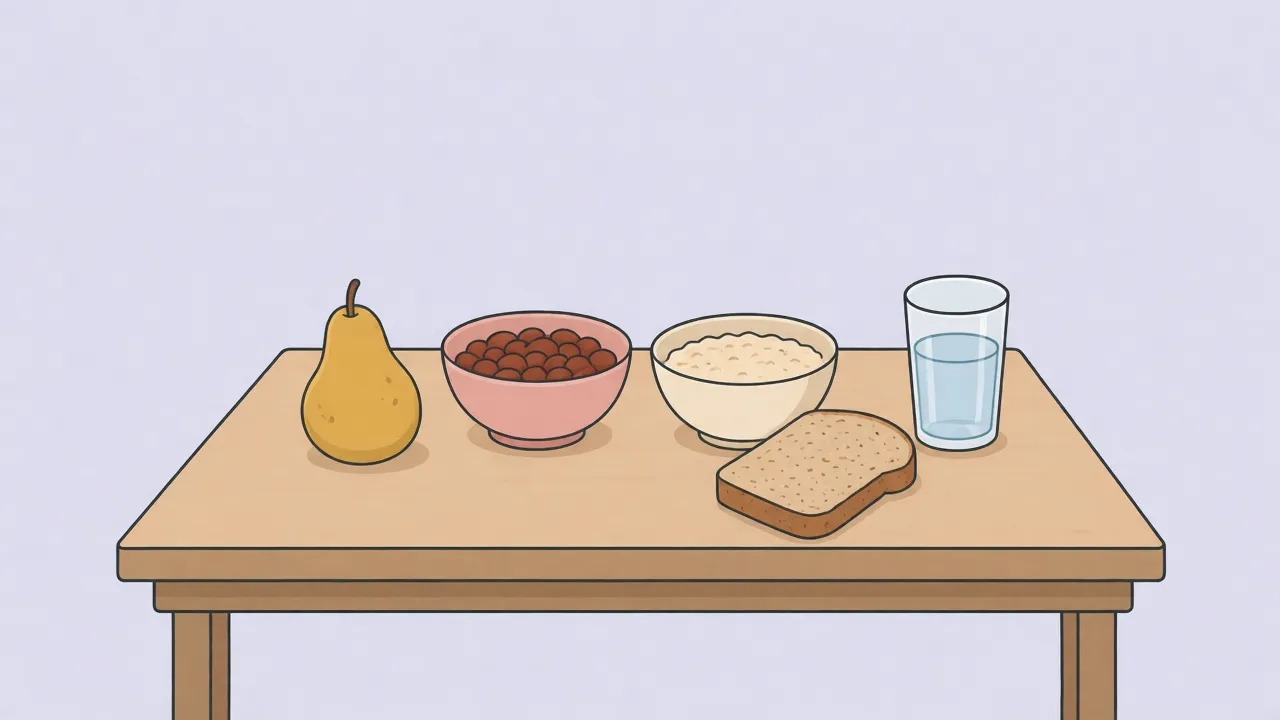
Those rounds are close to measured foods, and they are not the same number. On the NIDDK list, a medium pear with skin is 5.5 grams, a medium apple with skin is 4.8 grams, a cup of raspberries is 8 grams, and a quarter cup of prunes is 3.1 grams 2. A cup of cooked green peas is 8.8 grams, a baked potato with skin is 3.9 grams, and half a cup of beans runs from 5.7 grams (kidney) to 9.6 grams (navy), with pinto beans at 7.7 2. The calculator’s 7 gram bean line and 4 gram fruit line are built for a fast tally. If you are within a few grams of the target, a label or that NIDDK list is the better tie-breaker.
Foods with almost no fiber do not appear, so they add nothing. NIDDK says that if constipation is driving the hemorrhoids, go easy on cheese, chips, fast food, ice cream, meat, and many frozen or snack foods 2. You do not have to ban them. They will not move the bar.
Raising fiber over two or three weeks
The note under the result says to raise fiber over two or three weeks and to drink more water as you go, or bloating is likely. That matches the constipation page, which says to add fiber a little at a time so your body gets used to the change, and to drink liquids so the fiber can work 3.
A practical split when you are 10 to 15 grams short:
- Week 1: add one food from the gap list, such as half a cup of beans or a piece of fruit, and an extra glass of water at that meal.
- Week 2: add a second change, often a cereal swap or another cup of vegetables.
- Week 3: add the last item only if the gap is still there. If a supplement is part of the plan, start it in this week rather than on day one with every food change at once.
Gas is common while this is happening. A 2022 meta-analysis of 16 constipation trials (1,251 people) found more flatulence in fiber groups than in control groups. About 66 percent of people on fiber improved, versus about 41 percent on the control. Stool frequency and consistency improved, with the frequency benefit showing up at supplemental doses above 10 grams a day and when people stayed on the fiber for at least 4 weeks. Psyllium and pectin were the types with a clear effect. The trials differed a lot from one another, so the size of the benefit is less certain than the direction 7.
Give a new fiber habit most of a month before you decide it failed. The two-to-three-week ramp is so the increase is tolerable. The four-week mark is when the constipation trials were able to see a change in how often people went.
When a supplement makes sense
Food comes first in the gap list for a reason. The hemorrhoid trials used fiber as the treatment, and several of them used a supplement to reach the dose, but you do not need a powder on day one if beans and fruit will close a 7 gram gap 6.
A supplement is the practical choice when the gap is larger than a couple of food swaps, when you will not eat those foods, or when you are traveling and the servings will not happen. The calculator counts one psyllium dose as about 3 grams 8. The constipation meta-analysis saw the stool-frequency benefit above 10 grams a day of supplemental fiber 7. One small dose will not close a 15 gram gap, and it may not match the dose those trials used. Read the label for grams per serving. Powders and capsules differ. The best fiber supplements for hemorrhoids page compares plain psyllium, smoother powders, and capsules.
Take the supplement with a full glass of water. Start with one serving a day during week 2 or 3 of the ramp, then increase only if the label’s daily amount is still under your gap and your stomach has settled. People who want a stool softener instead, or as a short bridge, can read stool softener, fiber, or laxative. Fiber is the one the hemorrhoid trials support for bleeding. A softener is a different drug, used for a short time when a hard stool is the immediate problem.
In pregnancy the calculator’s target is 28 grams 1. The food rules are the same. Check with your obstetric provider before a supplement if you are pregnant or breastfeeding. The pregnancy guide covers why constipation matters so much in those months: hemorrhoids during pregnancy.
Most people starting fiber for hemorrhoids
People who want plain fiber with nothing added
Psyllium capsules on a budget
What the calculator does not know
It does not know your calories, your height, or whether a dietitian has capped fiber because of a narrowing in the bowel or a flare of inflammatory bowel disease. It does not log meals. A day of tapping is a sketch of a usual day, so a holiday weekend or a stomach bug will throw it off. Run it on a boring weekday.
Fiber does not replace a check for bleeding. The symptom pattern that needs a clinician is on bleeding hemorrhoids. Daily habits beyond the plate, including toilet time and walking, are on how to prevent hemorrhoids.

The hemorrhoid diet: daily fiber targets, high-fiber meals by the gram, how to add fiber slowly, and foods linked to flares.
Frequently asked questions
Why is my target 25 grams when a friend was told 28?
The calculator uses Adequate Intakes by age and sex, so a woman 19 to 50 sees 25 grams. A 2,000 calorie diet on the NIDDK hemorrhoid diet page is 28 grams, because that page also quotes 14 grams per 1,000 calories. Pregnancy in the calculator is 28 grams. The two systems land close for many adults and are not meant to be identical.
What happens if I am already over my target?
The bar stops at 100 percent and the note says to keep drinking water. Extra fiber is not a prize. Large jumps are what tend to cause gas and cramping. Stay near the target with fluids rather than stacking supplements on a diet that is already there.
Can I count a salad, or only cooked vegetables?
The vegetable line is about 4 grams for 1 cup cooked or for 2 cups of salad. A big handful of lettuce alone is less dense than a cup of peas or sweet potato. If you live on leafy salad, use the cooked-vegetable line only when the portion is actually that large.
Does the calculator work for constipation that is not from hemorrhoids?
The targets are general fiber Adequate Intakes, not a hemorrhoid-only dose. Fiber supplements have trial evidence for chronic constipation, especially psyllium at higher doses for several weeks. The hemorrhoid trials are a separate, smaller set that mainly tracked bleeding and whether symptoms settled.
I hate the texture of psyllium drinks. Does the gap plan still apply?
Yes. The plan lists beans, a higher-fiber cereal, fruit, and vegetables before it mentions a psyllium dose. If you do use a supplement, capsules and smoother powders are on the fiber supplement page. Read the label for grams per dose, because one small dose is only about 3 grams in this calculator.
Sources
- 1. Institute of Medicine Dietary Reference Intakes for Energy, Carbohydrate, Fiber, Fat, Fatty Acids, Cholesterol, Protein, and Amino Acids . The National Academies Press , 2005 . Government
- 2. Eating, Diet, & Nutrition for Hemorrhoids . National Institute of Diabetes and Digestive and Kidney Diseases (NIDDK) . Government
- 3. Eating, Diet, & Nutrition for Constipation . National Institute of Diabetes and Digestive and Kidney Diseases (NIDDK) . Government
- 4. Problems of the Digestive System (patient FAQ) . American College of Obstetricians and Gynecologists . Guideline
- 5. Quagliani D, Felt-Gunderson P Closing America's Fiber Intake Gap: Communication Strategies From a Food and Fiber Summit . Am J Lifestyle Med , 2017 ; 11(1):80-85 . doi:10.1177/1559827615588079 Review
- 6. Alonso-Coello P, Mills E, Heels-Ansdell D, et al. Fiber for the treatment of hemorrhoids complications: a systematic review and meta-analysis . Am J Gastroenterol , 2006 ; 101(1):181-188 . doi:10.1111/j.1572-0241.2005.00359.x Review
- 7. van der Schoot A, Drysdale C, Whelan K, Dimidi E The Effect of Fiber Supplementation on Chronic Constipation in Adults: An Updated Systematic Review and Meta-Analysis of Randomized Controlled Trials . Am J Clin Nutr , 2022 ; 116(4):953-969 . doi:10.1093/ajcn/nqac184 Review
- 8. FoodData Central . US Department of Agriculture, Agricultural Research Service . Government
- 9. Hemorrhoids: Expanded Information . American Society of Colon and Rectal Surgeons . Guideline