Quick answer
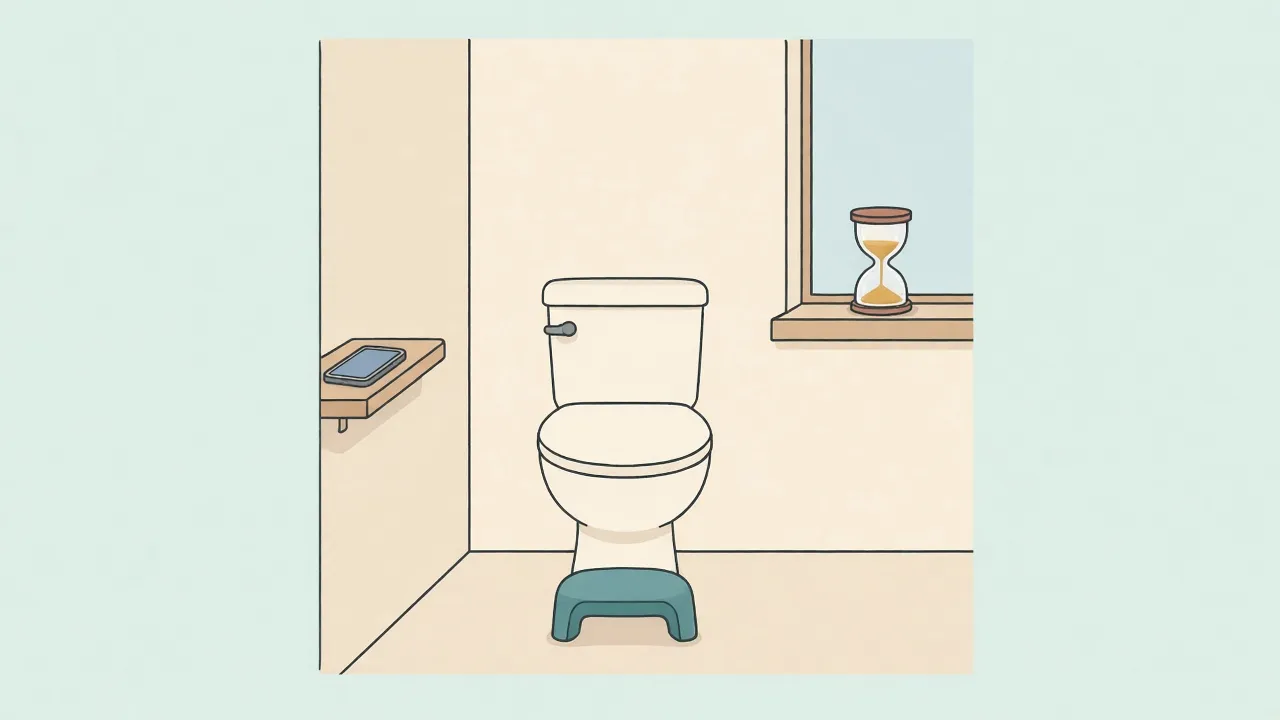
Do not strain, and do not sit long. Go when the urge hits, put your feet on a stool so your knees rise, and leave the phone outside the bathroom. In a 2025 study, phone users were much more likely to sit longer than five minutes. Pat dry instead of rubbing.
Product links on this page go to Amazon. As an Amazon Associate I earn from qualifying purchases. No brand pays for a place on our lists. How we choose products
Key takeaways
- In a 2025 colonoscopy survey, 37.3 percent of people who used a phone on the toilet sat longer than five minutes, compared with 7.1 percent of people who did not.
- A survey of 500 adults found toilet reading was common and lasted longer, and the extra hemorrhoids in that group were not a statistically clear difference.
- A full squat shortened straining compared with sitting in 28 volunteers, and a footstool in a later study lowered the odds of straining to about a fourth.
- Among 22 people who could not empty while sitting for an x-ray, 11 emptied after leaning forward, the way you sit when you rest your elbows on your knees.
- Follow-up surveys of bidet users did not find more new hemorrhoids, and one of them found more irritated skin around the anus in men who used a bidet often.
On this page
Toilet habits that help hemorrhoids are simple to name and easy to skip. Do not strain. Do not sit there long. Go when the urge hits. Raise your feet. Clean without rubbing. The NIDDK hemorrhoid treatment page lists no straining and no long toilet sits next to fiber and fluids, both for treatment and for prevention 1.
This page is the bathroom half of that plan. It covers straining, phone and reading time, answering the urge, the footstool studies, and gentle cleaning, including a short look at bidets. Fiber targets and meals are on the hemorrhoid diet. The full set of daily habits is on the prevention overview.
Straining and long sits are also on the NIDDK cause list 3. Changing them will not erase a hemorrhoid that is already prolapsed. It removes two of the pushes that keep a flare going.
Stop pushing
The NHS piles page says not to push hard, and not to stay longer than you need 2. If a bowel movement is not moving, stand up. Walk back later when the urge returns. Forcing a dry stool is the habit both pages tell you to drop 12.
Softer stool makes that easier. The diet page has the gram targets. A hard push to force the stool is the straining those pages tell you to skip 12. If it will not move, stand up.
Phones, reading, and how long you sit
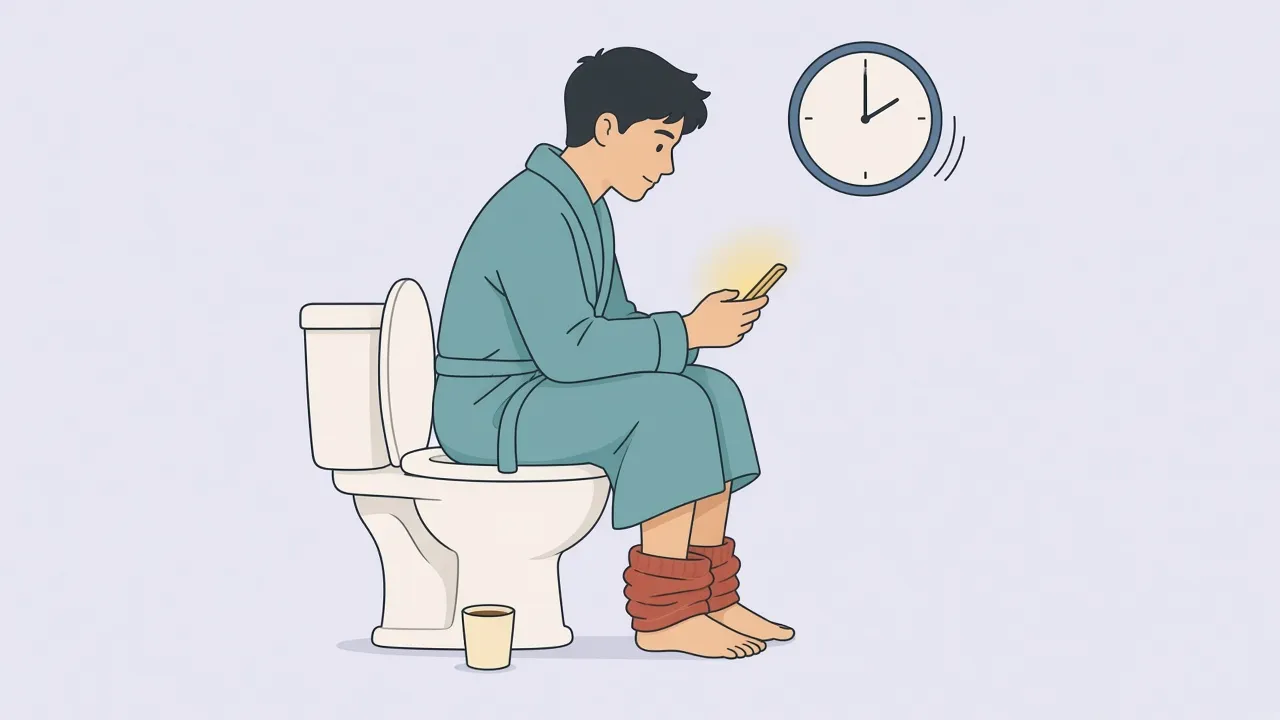
A 2025 colonoscopy survey of smartphone use on the toilet at Beth Israel Deaconess asked 125 adults about toilet time and then looked for hemorrhoids during screening 5. Forty-three percent had hemorrhoids. Sixty-six percent used a phone on the toilet. Phone users were younger (mean age 55.4 versus 62.1).
The time gap was large. Among phone users, 37.3 percent sat more than five minutes per visit. Among people who did not use a phone, 7.1 percent sat that long. After accounting for age, sex, body mass index, exercise, straining, and fiber, phone use was tied to a 46 percent higher chance of hemorrhoids. The most common phone activities were reading news (54.3 percent) and social media (44.4 percent) 5.
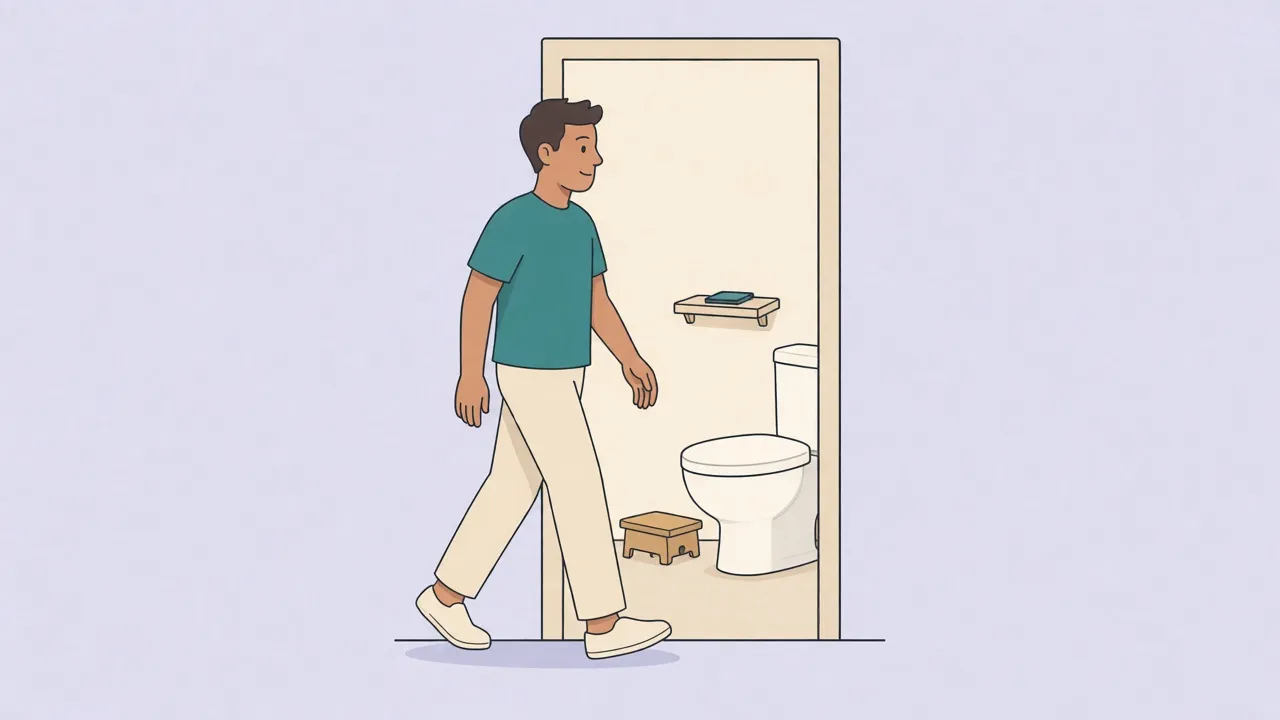
That 46 percent figure comes from one survey of 125 people. It is not a trial that took phones away and watched hemorrhoids shrink. It does show that the phone and the clock travel together. The phone-on-the-toilet article walks through the limits. The habit to copy tonight is physical: leave the phone in another room.
Reading was studied earlier, with a softer result. A survey of 500 Israeli adults found that 52.7 percent read on the toilet 6. Readers stayed significantly longer. Men, younger adults, and people with more education were more likely to be in that group. They did not have a different stool type or stool frequency. They called themselves less constipated (8.0 percent versus 13.7 percent) and reported more hemorrhoids (23.6 percent versus 18.2 percent). Neither of those gaps was statistically significant. The authors called toilet reading a common habit people do for fun 6.
Read the two studies side by side. Both found extra time. Only the phone study found a hemorrhoid link that survived adjustment, and it was smaller and newer. Five minutes was that study’s long-visit mark, not an official limit. The NIDDK does not give a number of minutes. It says not to sit for long periods 1. If you need an article or a feed to get through the visit, you have already stayed too long.
Go when the urge comes
The NHS says not to ignore the urge to poo 2. The NIDDK constipation treatment page says to use the bathroom as soon as you feel the need, and to give yourself enough time without turning that into a long sit 4.
The same page suggests a regular time, often 15 to 45 minutes after breakfast, because eating starts the colon moving 4. Sit then if you feel something. If you do not, get up and go to work. Waiting until you are desperate, then pushing, is the pattern the cause list describes 3.
People who take codeine for pain should know the NHS warning: codeine can cause constipation, which sends you back to straining 2. Acetaminophen is on the NIDDK pain list 1. The NHS says not to take ibuprofen if the hemorrhoids are bleeding 2. Follow the label.
Feet up: what three posture studies found
Sitting on a high toilet folds the hips in a way that makes you push harder. Three studies looked at this from different angles. They did not test the same position, and only one of them used a footstool.
A full squat
Sikirov asked 28 healthy volunteers, ages 17 to 66, with normal bowel habits, to time six bowel movements in each of three positions. One was a standard toilet seat 41 to 42 centimeters high. One was a lower seat, 31 to 32 centimeters. One was a squat. Time to a feeling of satisfactory emptying, and the effort people reported, dropped sharply in the squat compared with both sitting positions (P less than 0.0001). The paper’s conclusion was that sitting takes excessive expulsive effort compared with squatting 7. A 2003 comparison of straining in three positions reports that result. The abstract does not give the times in seconds, so those exact stopwatch numbers are not something to quote from the summary.
A footstool
Modi and colleagues gave 52 healthy adults a defecation posture device, the kind of stool that lifts your feet. Mean age was 29, and 40.1 percent were women. They tracked bowel movements for two weeks without the device and two weeks with it: 735 movements without it and 384 with it. At the start, 44.2 percent said they strained, 28.8 percent felt they did not empty, and 55.8 percent had seen blood on the paper in the past year. With the device, the odds of feeling empty were higher (odds ratio 3.64) and the odds of straining were much lower (odds ratio 0.23, about a fourth). Sits without the device lasted about 1.25 times as long 8. A 2019 footstool study in healthy adults is the full report. These were not patients recruited for hemorrhoids. The blood-on-paper number is a reminder that many people in a “healthy” group already have some bleeding.
A forward lean
Takano and Sands studied what they called the Thinker position: sitting and bending the chest toward the knees. They enrolled 22 people who could not empty barium paste while sitting for a defecography x-ray. Seventeen were women. The average age was 56, with a range of 22 to 76. In the lean, the anorectal angle opened from 113 degrees to 134 degrees, the pelvic floor descended from 7.1 centimeters to 9.3 centimeters, and the puborectalis muscle measured longer (12.9 centimeters to 15.2 centimeters). Eleven of the 22 could then empty completely 9. A 2016 study of the Thinker position is that x-ray paper. Everyone in it had already failed to empty while upright and sitting. It is evidence about a stuck bowel movement on an x-ray, in people who had already failed to empty while sitting.
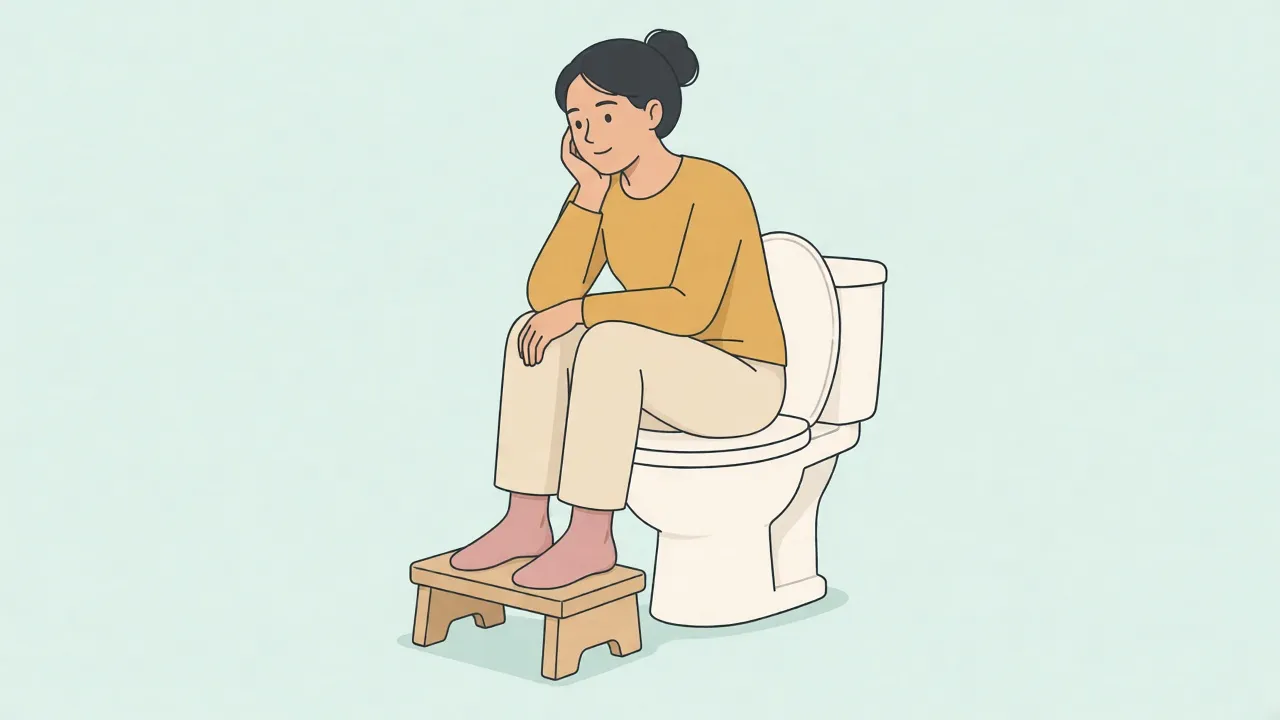
Put the pieces together on a normal toilet. Feet on a stool, knees up, chest leaning a little forward, elbows on the thighs. That borrows the footstool from Modi and the lean from Takano. It is not the full squat Sikirov measured. Breathe. If a minute or two passes with nothing, stand up.
People who use a 7 inch toilet stool often say bowel movements take less effort and less time. The complaint that comes up most is height. A comfort-height toilet can leave a short stool too low to lift the knees. The stool is a footrest. Standing on it is how some of them crack. Heights for tall toilets, travel, and shared bathrooms are on the toilet stool comparison.
Squatty Potty Original, 7 inch
Best for: Standard-height toilets and first-time users
The original toilet stool and still the most reviewed. It raises your knees above your hips, the position tested in the posture studies.
What recent buyers say
Buyers say it makes bowel movements quicker and easier, and some describe big changes after years of constipation. Height is the most common problem, because the right size depends on your toilet. One reviewer's stool cracked after they put weight in the middle.
What buyers like
- Makes going easier and faster
- Sturdy and easy to clean
- Tucks under the toilet
Common complaints
- Height may not suit your toilet
- Can crack if you stand on it
Skip it if you have a tall, comfort-height toilet. An adjustable or 9 inch stool fits better.
Gentle cleaning, and a short word on bidets
Too much rubbing or cleaning around the anus can make symptoms worse 3. The NHS says to keep the area clean and dry, and to pat rather than rub 2. A soft rinse can do the job of the first wipe, so the paper only dries. Picks for sore skin are on the hemorrhoid wipes page. If a wipe stings or the itch spreads, stop it.
Bidets get a longer article of their own: is a bidet good for hemorrhoids. The short version from the studies is calmer than the ads.
A one-year web survey of 7,637 adults in Japan found that hemorrhoids were more common among people who already used a bidet, and that new hemorrhoids during the follow-up year were not clearly more common. The authors read the “already have them” pattern as reverse causation: people with hemorrhoids buy the bidet, the bidet does not clearly create the hemorrhoids. New symptoms of bacterial vaginitis were higher in bidet users, with small numbers 10. A one-year bidet survey is that paper.
A three-year follow-up of the same kind of panel, 10,305 people at the start, again found no significant rise in new hemorrhoids with habitual bidet use. Men who used a bidet often were more likely to report newly irritated skin around the anus (adjusted risk ratio 1.36) 11.
A 2021 review from a Japanese colorectal surgeon says a bidet can add comfort and may help constipation, and that excessive use can feed anal itching. The advice in that paper: if you itch, clean less. If you leak stool, stop the bidet and let a doctor judge the leakage without the spray masking it. Shared hospital bidets can carry bacteria on the nozzle, which matters for people with weak immune systems 12.
For home use during a flare, keep the pressure low and the spray brief, then pat dry. Strong spray on sore skin matches the “excessive cleaning” warning better than it matches the comfort claim. Setups with a gentle stream are compared on the bidet page. A rinse bottle is the option if you rent and cannot install a seat.
Heavy lifting and breath-holding in the gym are the other version of straining. Those workouts are on the exercise guide.
When the bathroom habit is not the whole problem
A shorter sit will not explain every bleed. Bright red blood on the paper is common with hemorrhoids, and it still needs a look when it is new, heavy, or paired with other symptoms.
What causes hemorrhoids: straining, constipation, toilet time, pregnancy, fiber, lifting, and weight, including where studies disagree.
Leave the phone in the other room on the next visit. Feet on the stool, a short sit without a hard push, then stand up if nothing happens. Pat dry. That is the whole bathroom plan.
Frequently asked questions
Is five minutes the longest I should sit?
Five minutes is the cutoff a 2025 colonoscopy survey used, not a rule from a guideline. Phone users were much more likely to pass that mark, and phone use still lined up with hemorrhoids after other habits were accounted for. If nothing is happening, stand up and try again later. The NIDDK simply says not to sit for long periods.
Does reading on the toilet cause hemorrhoids?
In a survey of 500 Israeli adults, 52.7 percent read on the toilet and those readers stayed longer. They reported hemorrhoids a bit more often, 23.6 percent versus 18.2 percent, and that gap was not statistically significant. Stool type and frequency did not differ. The habit that looks riskier in a later study is the phone, because the time difference was larger and the hemorrhoid link remained after adjustment.
What height should a toilet stool be?
The posture studies did not publish one winning height in inches. A full squat was compared with sitting on a seat about 41 to 42 centimeters high and a lower seat about 31 to 32 centimeters high. A footstool raises your feet instead of lowering the seat. A 7 inch stool is the usual pick for a standard toilet. A taller toilet often needs a taller or adjustable stool.
Should I wipe or rinse?
Pat dry instead of rubbing. The NHS gives that advice, and the NIDDK says too much rubbing can make symptoms worse. A gentle rinse can replace some of the wiping. Follow-up surveys did not find that bidet users developed more new hemorrhoids. Excessive spraying can itch, so keep the pressure low and the spray short.
Is it harmful to hold a bowel movement?
The NIDDK says to use the bathroom as soon as you feel the need, and the NHS says not to ignore the urge. A regular try 15 to 45 minutes after breakfast is the bowel-training step on the NIDDK constipation treatment page, because eating starts the colon moving. If the urge passes and nothing happens, get up rather than forcing it.
Sources
- 1. Treatment of Hemorrhoids . National Institute of Diabetes and Digestive and Kidney Diseases (NIDDK) . Government
- 2. Piles (haemorrhoids) . NHS , 2026 . Government
- 3. Symptoms & Causes of Hemorrhoids . National Institute of Diabetes and Digestive and Kidney Diseases (NIDDK) . Government
- 4. Treatment for Constipation . National Institute of Diabetes and Digestive and Kidney Diseases (NIDDK) , 2018 . Government
- 5. Ramprasad C, Wu C, Chang J, et al. Smartphone use on the toilet and the risk of hemorrhoids . PLoS One , 2025 ; 20(9):e0329983 . doi:10.1371/journal.pone.0329983 Study
- 6. Goldstein O, Shaham Y, Naftali T, et al. Toilet reading habits in Israeli adults . Neurogastroenterol Motil , 2009 ; 21(3):291-295 . doi:10.1111/j.1365-2982.2008.01204.x Study
- 7. Sikirov D Comparison of straining during defecation in three positions: results and implications for human health . Dig Dis Sci , 2003 ; 48(7):1201-1205 . doi:10.1023/a:1024180319005 Study
- 8. Modi RM, Hinton A, Pinkhas D, et al. Implementation of a Defecation Posture Modification Device: Impact on Bowel Movement Patterns in Healthy Subjects . J Clin Gastroenterol , 2019 ; 53(3):216-219 . doi:10.1097/MCG.0000000000001143 Study
- 9. Takano S, Sands DR Influence of body posture on defecation: a prospective study of 'The Thinker' position . Tech Coloproctol , 2016 ; 20(2):117-121 . doi:10.1007/s10151-015-1402-6 Study
- 10. Kiuchi T, Asakura K, Nakano M, Omae K Bidet toilet use and incidence of hemorrhoids or urogenital infections: A one-year follow-up web survey . Prev Med Rep , 2017 ; 6:121-125 . doi:10.1016/j.pmedr.2017.02.008 Study
- 11. Asakura K, Nakano M, Omae K Relationship between bidet toilet use and haemorrhoids and urogenital infections: a 3-year follow-up web survey . Epidemiol Infect , 2018 ; 146(6):763-770 . doi:10.1017/S0950268818000584 Study
- 12. Tsunoda A Bidet Toilet Use May Cause Anal Symptoms and Nosocomial Infection . J Anus Rectum Colon , 2021 ; 5(4):335-339 . doi:10.23922/jarc.2021-027 Review