Quick answer
A 2025 colonoscopy study found smartphone use on the toilet was linked to a 46% higher chance of hemorrhoids, after accounting for age, sex, body size, exercise, straining, and fiber. Phone users were more likely to sit more than five minutes. A 2009 survey of toilet reading found longer sits, but the hemorrhoid difference was small and not significant.
Product links on this page go to Amazon. As an Amazon Associate I earn from qualifying purchases. No brand pays for a place on our lists. How we choose products
Key takeaways
- In the 2025 study of 125 adults, 66% used a smartphone on the toilet. Among phone users, 37.3% sat more than five minutes, compared with 7.1% of people who did not use a phone.
- Hemorrhoids were seen on colonoscopy in 43% of that group. The phone link remained after the researchers adjusted for straining and fiber intake.
- A 2009 survey of 500 adults found toilet reading in 52.7%. Readers sat longer. Self-reported hemorrhoids were 23.6% versus 18.2%, and that gap was not significant.
- Neither study assigned people to use a phone or leave it outside. They cannot prove that quitting the phone will prevent hemorrhoids.
- A footstool study in healthy adults shortened bowel movements and reduced straining. It did not measure hemorrhoids.
On this page
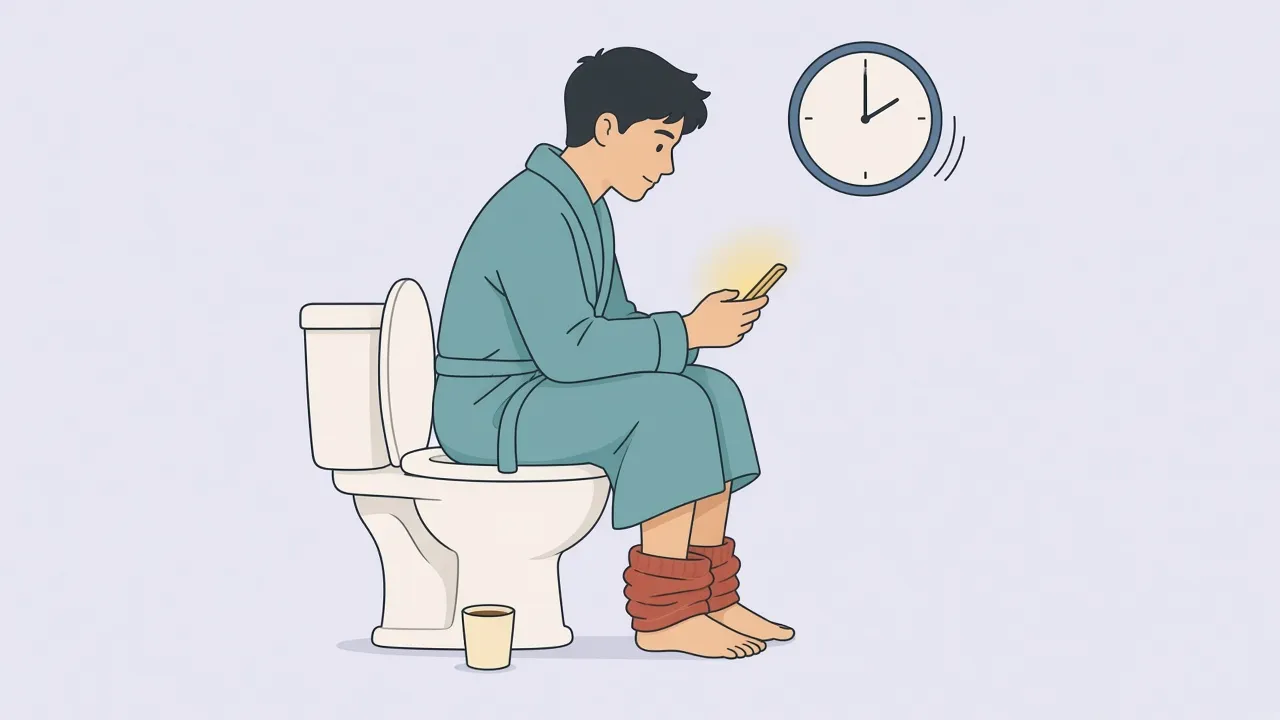
Scrolling can stretch a toilet sit, and longer sits show up with hemorrhoids in the newest study. In 2025, researchers at Beth Israel Deaconess Medical Center asked 125 adults having a screening colonoscopy about phone use on the toilet. People who used a phone were more likely to have hemorrhoids, and they were much more likely to sit more than five minutes 1.
A 2009 survey of toilet reading found the same extra time and a smaller hemorrhoid gap that did not clear statistical testing 2. NIDDK lists sitting on the toilet for long periods as one cause of hemorrhoids, next to straining and a low-fiber diet 3. The phone is a reason to stay. The toilet habits that help hemorrhoids are about how long you stay and whether you strain.
This page goes through what those two studies found, what they cannot prove, and a routine you can use tonight.
What the 2025 smartphone study found
The study was cross-sectional. Adults coming in for screening colonoscopy filled out questions on phone habits, Rome IV bowel symptoms, straining, fiber, and activity. Two endoscopists, who did not know the survey answers, rated whether hemorrhoids were present 1.
Of 125 adults, 43% had hemorrhoids on the exam. Two thirds (66%) used a smartphone on the toilet. Phone users were younger than non-users (mean age 55.4 versus 62.1). The time gap was large: 37.3% of phone users spent more than five minutes per toilet visit, compared with 7.1% of people who did not use a phone there (p = 0.006) 1.
In a model that adjusted for age, sex, BMI, exercise, straining, and fiber intake, smartphone use on the toilet was associated with a 46% increased risk of hemorrhoids (p = 0.044). The most common activity was reading news (54.3%), then social media (44.4%). The authors’ conclusion is careful: prolonged engagement with a smartphone while using the toilet may be associated with a higher prevalence of hemorrhoids 1.
You can read the open paper: Smartphone use on the toilet and the risk of hemorrhoids 1.
What the 2009 toilet reading study found
Before smartphones were the default distraction, researchers in Israel asked 500 adults about reading or playing games on the toilet. Toilet reading involved 52.7% of them. The profile skewed male, younger, secular, more educated, and white-collar. Readers spent significantly more time in the toilet. Stool type and how often they went did not differ 2.
Readers were less likely to call themselves constipated (8.0% versus 13.7%) and more likely to report hemorrhoids (23.6% versus 18.2%). Neither difference was statistically significant. The authors called toilet reading a common, benign habit, more for fun than because of a medical problem, and they noted the longer time 2. The abstract is on PubMed.
That survey used self-report. Nobody looked with a scope. Hemorrhoids on a questionnaire and hemorrhoids on a colonoscopy are not the same measurement, which is one reason the 2009 gap can be small while the 2025 gap is not.
What these findings do not prove
Both studies watched habits that already existed. Neither one assigned people to scroll or to leave the phone outside and then counted new hemorrhoids. A link in a single snapshot can run in more than one direction. People who already have trouble emptying may sit longer and pick up the phone while they wait. The 2025 model did adjust for straining and fiber and still found a phone link, which makes “they were only constipated” a weaker explanation. It does not turn the result into proof that the phone itself damages the veins 1.
The samples are narrow. The phone study is 125 adults at one Boston hospital, booked for screening colonoscopy, so they were old enough to be screened and well enough to have the test. Phone users were younger, and age was in the model, but other unmeasured habits could still differ 1. The reading study is 500 Israeli adults and a questionnaire 2.
“Hemorrhoids on colonoscopy” includes people who feel fine. In a separate screening study of 976 adults, 38.93% had hemorrhoids and 55.26% of those people reported no symptoms 12. A higher chance of a finding on the scope is not the same as a higher chance of a painful flare. The 2025 paper does not say that putting the phone away will shrink a hemorrhoid you already have.
There is also no tested minute limit that prevents hemorrhoids. The five-minute mark is the cutoff the 2025 researchers used when they compared groups 1. NIDDK says not to sit on the toilet for long periods, without naming a number of minutes 34. The NHS piles page says not to spend more time than you need, and not to push too hard 5.
What other studies say about toilet time and straining
People who already have troublesome hemorrhoids do report harder, longer trips to the bathroom. In a Swedish study, 100 patients with grade 3 or 4 hemorrhoids were compared with 200 population controls and 100 orthopedic patients. Bowel frequency was the same. Only 37% of the hemorrhoid patients described their bowel movements as normal, versus 55% and 67% of the control groups. Bloating was reported by up to 37%, versus 18% and 26%. Abdominal pain with emptying was reported by 34%, versus 3% and 5%. Excessive straining, a feeling of incomplete emptying, and repeated toilet visits were significantly more common in the hemorrhoid group 6. That fits a longer sit. It does not isolate phones, and these were people with prolapsing disease, not a general population.
Constipation and hemorrhoids do not move in lockstep across every dataset. A classic U.S. epidemiology paper found hemorrhoid complaints peaking from ages 45 to 65, while constipation climbed after 65 and was more common in different demographic groups. The authors argued that the two conditions do not behave like a simple cause and effect 7. A later colonoscopy study of 2,813 people still found constipation tied to higher odds of hemorrhoids (odds ratio 1.43). The highest intake of grain fiber had lower odds than the lowest (odds ratio 0.78) 8. Straining and hard stool are worth fixing. They are not the whole story, which is why a phone habit can matter even in a model that already includes straining 1.
Posture changes the effort, in small studies of emptying rather than of hemorrhoids.
Sikirov asked 28 healthy volunteers to time bowel movements in three positions: a standard toilet seat (41 to 42 cm high), a lower seat (31 to 32 cm), and a squat. Six bowel movements were recorded in each position. Time to a feeling of satisfactory emptying, and the effort people reported, dropped sharply in the squat compared with both sitting positions (p < 0.0001) 9. The abstract does not give the times in seconds, so there is no honest “squatting saves X seconds” figure to quote.
Modi and colleagues gave 52 healthy adults (mean age 29, 40.1% women) a defecation posture modification device, a footstool that raises the knees. They logged 1,119 bowel movements: 735 without the device and 384 with it. With the device, the odds of feeling empty were higher (odds ratio 3.64) and the odds of straining were lower (odds ratio 0.23). Without it, bowel movements lasted 1.25 times as long. At the start, 55.8% had noticed blood on the paper in the past year, so this was not a group free of anal symptoms. The study did not count hemorrhoids as an outcome 10.
Takano and Sands studied the “Thinker” position, leaning forward, in 22 patients who could not pass barium paste while sitting during a defecography test. Eleven of the 22 emptied completely in the forward lean. The anorectal angle was wider (134 degrees versus 113). These were people already failing to empty, not a random sample 11.
Fiber still has the clearest symptom data once hemorrhoids are already there. A meta-analysis of seven trials found fiber roughly halved the chance of persistent bleeding 13. That is a treatment result, separate from the question of what caused the hemorrhoid. The hemorrhoid causes page puts straining, constipation, long sits, pregnancy, and lifting in one place. How to prevent hemorrhoids is the daily version.
A simple toilet routine
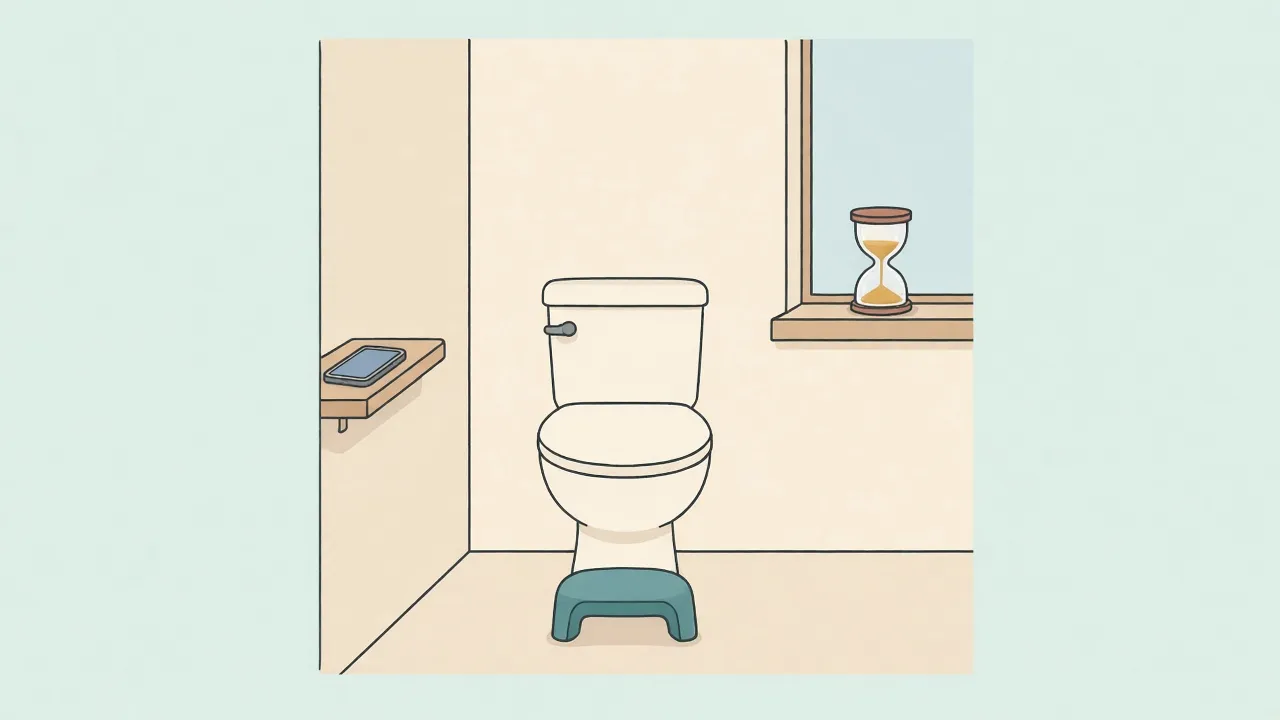
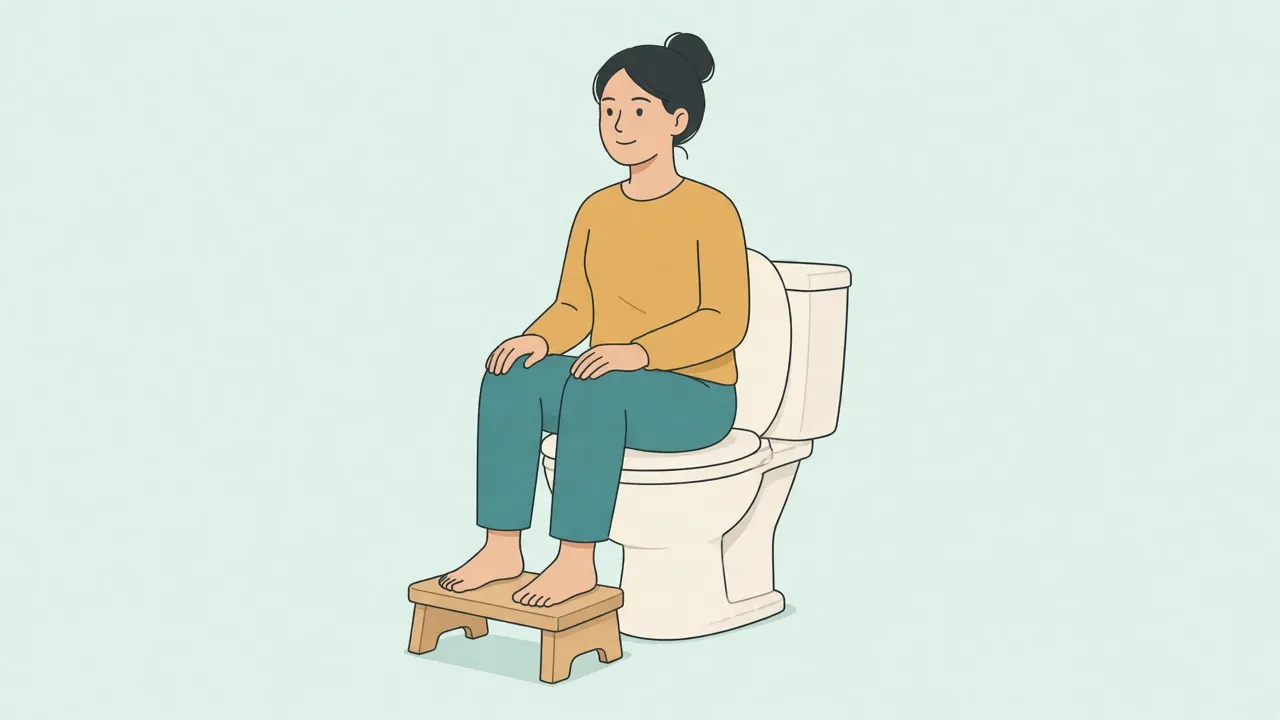
Use this order. It follows the limits above: short sits from NIDDK and the NHS, a higher knee position from the posture studies, and fiber if stool is hard.
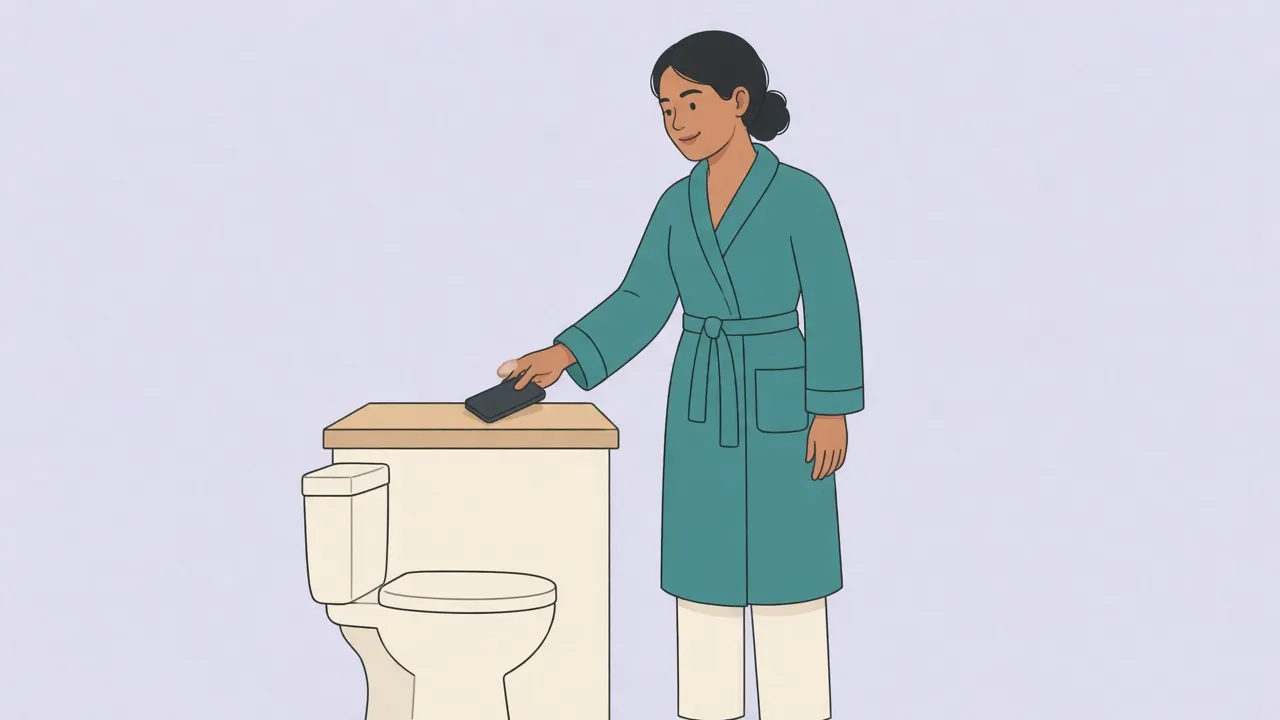
- Leave the phone, book, or game on the counter before you sit. The 2025 time gap was the clearest finding in that paper 1.
- Go when you feel the urge. The NHS says not to ignore it and not to push hard 5.
- If a footstool fits in the bathroom, put your feet on it so your knees are higher than your hips. Expect a shorter, easier sit, based on the volunteer studies, not a cure 910.
- Pass stool, clean, and stand up. If nothing is happening, get up and walk. Come back when the urge returns. More than five minutes was common among phone users and uncommon among everyone else in the 2025 study 1.
- Clean without scrubbing. Pat dry. Long wiping sessions are another way a sit grows, and sore skin itches more afterward. Details are in the toilet habits guide.
- If stools are hard or you strain most days, add fiber and water. The fiber calculator shows how far a normal day is from your target. People in the fiber trials were usually checked at 6 weeks and at 3 months 13.
A simple stool is enough for most standard toilets. Taller toilets and travel versions are on the best toilet stools page.
Squatty Potty Original, 7 inch
Best for: Standard-height toilets and first-time users
The original toilet stool and still the most reviewed. It raises your knees above your hips, the position tested in the posture studies.
What recent buyers say
Buyers say it makes bowel movements quicker and easier, and some describe big changes after years of constipation. Height is the most common problem, because the right size depends on your toilet. One reviewer's stool cracked after they put weight in the middle.
What buyers like
- Makes going easier and faster
- Sturdy and easy to clean
- Tucks under the toilet
Common complaints
- Height may not suit your toilet
- Can crack if you stand on it
Skip it if you have a tall, comfort-height toilet. An adjustable or 9 inch stool fits better.
Toilet habits for hemorrhoids: less straining, shorter sits, a footstool, and gentle cleaning, based on the posture studies.
If a flare is already painful, shorter sits will not replace the rest of home care. Warm soaks, fiber, and the first-week plan are in can hemorrhoids go away on their own.
The US Preventive Services Task Force recommends screening starting at age 45 for adults at average risk 14. A long phone habit does not explain dark blood, weight loss, or a change in stool caliber.
Tonight’s version is short. Phone on the counter, feet up if you have a stool, stand up when you are finished, and treat hard stools with fiber and water 145.
Frequently asked questions
How long is too long to sit on the toilet?
Guidelines say not to sit longer than you need, and they do not publish a minute limit. In the 2025 phone study, more than five minutes was the cutoff that separated phone users from everyone else. A practical routine is to sit, pass stool without straining, clean, and stand up. If nothing happens, get up and try later.
Does reading a book on the toilet cause hemorrhoids?
A 2009 survey found toilet reading in about half of adults, and readers spent more time in the bathroom. They reported hemorrhoids a bit more often, 23.6% versus 18.2%, but that difference was not statistically significant. The authors called reading a common habit tied to longer sits. A book can stretch a sit the same way a phone can.
Will a toilet stool prevent hemorrhoids?
A footstool has not been shown to prevent hemorrhoids in a trial. In healthy adults, a posture device shortened bowel movements and reduced straining, and a squatting study found less effort than sitting on a standard toilet. Less strain and a shorter sit match the habits hemorrhoid guides recommend. That is the reason to try one, not a promise that it stops hemorrhoids.
I already scroll on the toilet. What should I change first?
Leave the phone on the counter before you sit. Go when you feel the urge, keep your feet up if a stool fits, and stand when you are done. If stools are hard, add fiber and water. Those steps target the time and the strain, which are the parts the studies actually measured.
Does the 2025 study mean my hemorrhoids came from my phone?
It cannot say that for any one person. It was a single snapshot of 125 adults at one hospital, and 43% had hemorrhoids on colonoscopy, including people who may have had no symptoms. Phone users were also younger. The result is a link with longer sits, not proof of cause.
Sources
- 1. Ramprasad C, Wu C, Chang J, et al. Smartphone use on the toilet and the risk of hemorrhoids . PLoS One , 2025 ; 20(9):e0329983 . doi:10.1371/journal.pone.0329983 Study
- 2. Goldstein O, Shaham Y, Naftali T, et al. Toilet reading habits in Israeli adults . Neurogastroenterol Motil , 2009 ; 21(3):291-295 . doi:10.1111/j.1365-2982.2008.01204.x Study
- 3. Symptoms & Causes of Hemorrhoids . National Institute of Diabetes and Digestive and Kidney Diseases (NIDDK) . Government
- 4. Treatment of Hemorrhoids . National Institute of Diabetes and Digestive and Kidney Diseases (NIDDK) . Government
- 5. Piles (haemorrhoids) . NHS , 2026 . Government
- 6. Johannsson HO, Graf W, Pahlman L Bowel habits in hemorrhoid patients and normal subjects . Am J Gastroenterol , 2005 ; 100(2):401-6 . doi:10.1111/j.1572-0241.2005.40195.x Study
- 7. Johanson JF, Sonnenberg A The prevalence of hemorrhoids and chronic constipation. An epidemiologic study . Gastroenterology , 1990 ; 98(2):380-386 . doi:10.1016/0016-5085(90)90828-o Study
- 8. Peery AF, Sandler RS, Galanko JA, et al. Risk Factors for Hemorrhoids on Screening Colonoscopy . PLoS One , 2015 ; 10(9):e0139100 . doi:10.1371/journal.pone.0139100 Study
- 9. Sikirov D Comparison of straining during defecation in three positions: results and implications for human health . Dig Dis Sci , 2003 ; 48(7):1201-1205 . doi:10.1023/a:1024180319005 Study
- 10. Modi RM, Hinton A, Pinkhas D, et al. Implementation of a Defecation Posture Modification Device: Impact on Bowel Movement Patterns in Healthy Subjects . J Clin Gastroenterol , 2019 ; 53(3):216-219 . doi:10.1097/MCG.0000000000001143 Study
- 11. Takano S, Sands DR Influence of body posture on defecation: a prospective study of 'The Thinker' position . Tech Coloproctol , 2016 ; 20(2):117-121 . doi:10.1007/s10151-015-1402-6 Study
- 12. Riss S, Weiser FA, Schwameis K, et al. The prevalence of hemorrhoids in adults . Int J Colorectal Dis , 2012 ; 27(2):215-220 . doi:10.1007/s00384-011-1316-3 Study
- 13. Alonso-Coello P, Mills E, Heels-Ansdell D, et al. Fiber for the treatment of hemorrhoids complications: a systematic review and meta-analysis . Am J Gastroenterol , 2006 ; 101(1):181-188 . doi:10.1111/j.1572-0241.2005.00359.x Review
- 14. US Preventive Services Task Force Screening for Colorectal Cancer: US Preventive Services Task Force Recommendation Statement . JAMA , 2021 ; 325(19):1965-1977 . doi:10.1001/jama.2021.6238 Guideline