Quick answer
Internal hemorrhoids sit above the dentate line, so they usually cause painless bleeding or tissue that slips out. Grade 1 stays inside. Grade 4 stays out. Fiber is the first treatment for early grades. Banding is the usual office procedure through grade 3. Surgery is discussed for grade 4 and for grade 3 that keeps coming back.
Product links on this page go to Amazon. As an Amazon Associate I earn from qualifying purchases. No brand pays for a place on our lists. How we choose products
Key takeaways
- Internal hemorrhoids are enlarged cushions above the dentate line. The lining there does not feel pain the way skin does, which is why bleeding is often painless until the tissue prolapses.
- On a screening exam, about 73 percent of hemorrhoids were grade 1, about 18 percent grade 2, about 8 percent grade 3, and under 1 percent grade 4.
- A meta-analysis of procedure trials recommended rubber band ligation first for grades 1 to 3, and reserved hemorrhoidectomy for people who did not improve after banding.
- In a Cochrane review, surgery cleared grade 3 symptoms more reliably than banding and caused more pain. For grade 2, the two approaches looked similar.
- The band usually falls off within a week. Mild ache for 1 to 3 days is common. Bleeding that appears 10 to 14 days later, or fever, needs a doctor.
On this page
Internal hemorrhoids are swollen cushions inside the anal canal, above a boundary called the dentate line. They are the usual reason for bright red blood on the paper with little or no pain. If you also have a tender lump you can feel at the opening, that is a different problem, covered on the external hemorrhoids page. The shared overview of both types is on hemorrhoids.
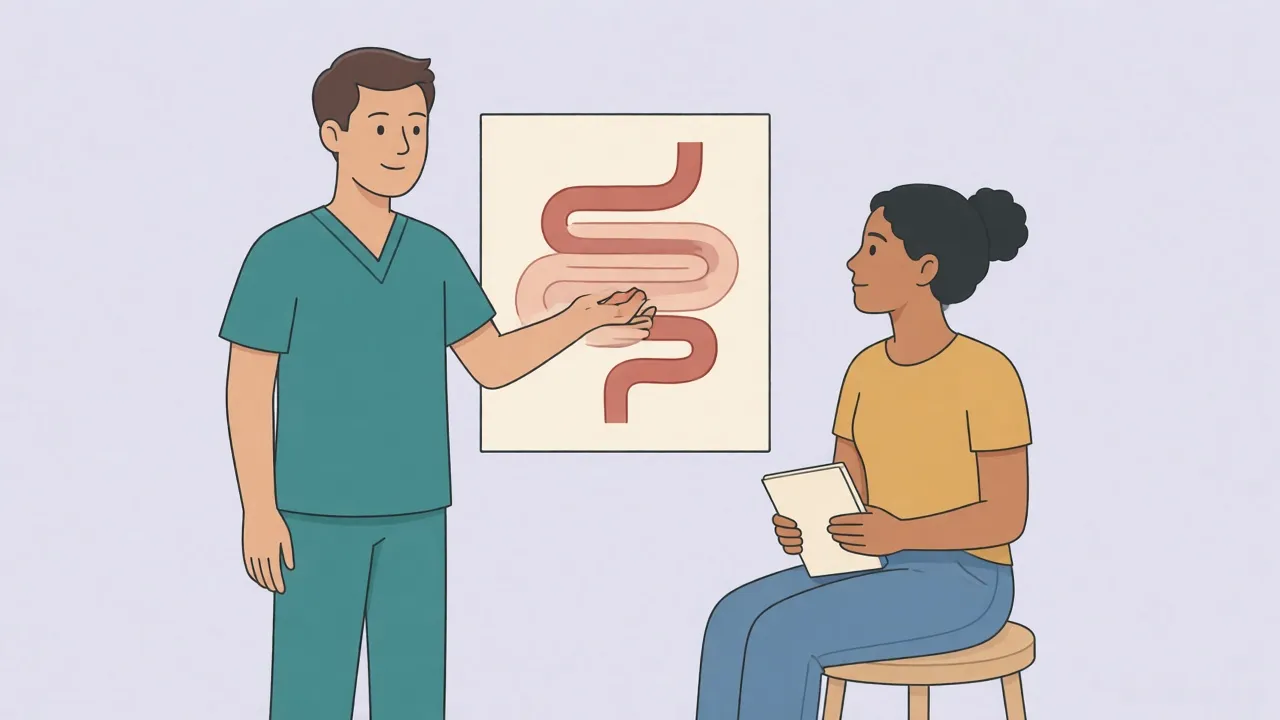
Doctors grade internal hemorrhoids from 1 to 4 by whether the tissue stays inside or slips out. The grade is what decides between fiber, an office procedure, and surgery. This page walks through the grades, what each one feels like, and which treatment the trials and guidelines line up with.
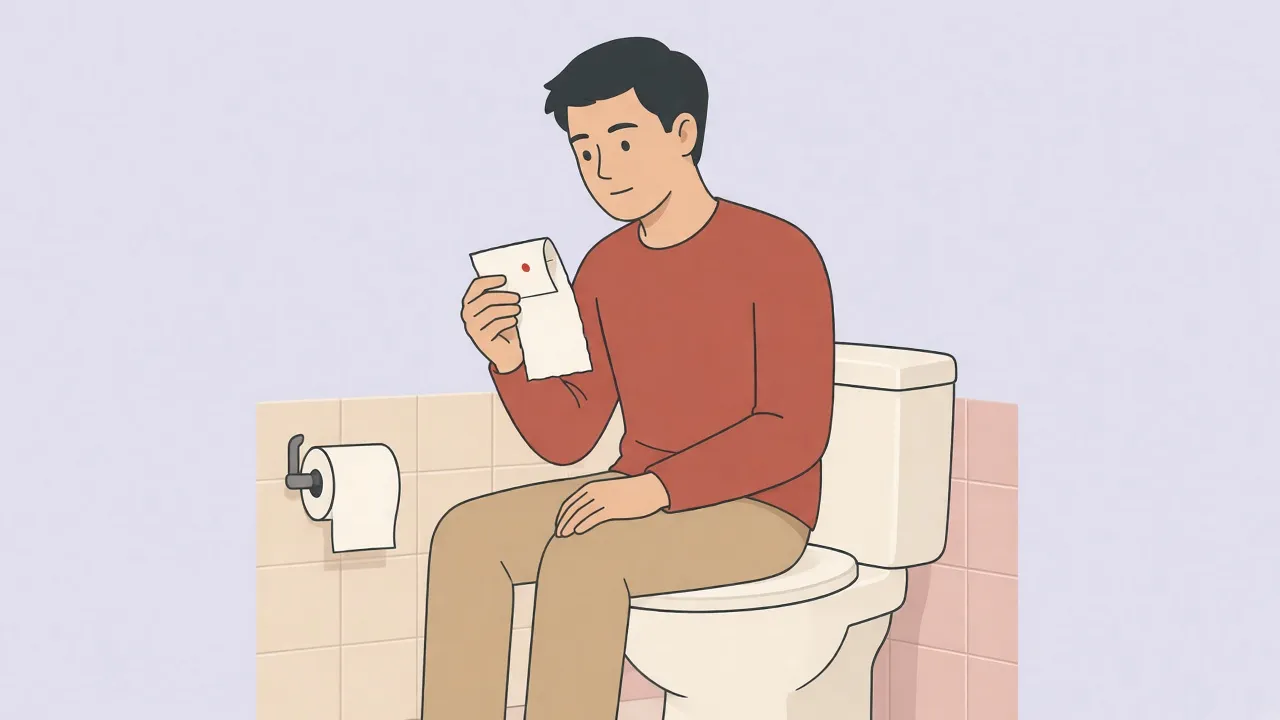
Most internal hemorrhoids are grade 1 or 2. In a screening colonoscopy study, 277 of 380 people with hemorrhoids (72.89 percent) were grade 1, and 70 (18.42 percent) were grade 2. Grade 3 accounted for 31 people (8.16 percent) and grade 4 for 2 people (0.53 percent) 4.
Why internal hemorrhoids bleed and rarely hurt
The lining above the dentate line does not sense touch, pain, stretch, or temperature the way skin does. External hemorrhoids are covered by skin, which is why they ache. Internal hemorrhoids are covered by mucosa, the same family of lining as the rectum, which is why a bleed can be the only clue 2.
A review of hemorrhoid grading and treatment defines hemorrhoids as normal anal cushions that have enlarged and moved downward. Internal ones start in the vascular cushion above the dentate line. The most common symptom in that review is rectal bleeding with a bowel movement 1. NIDDK describes the same bleed as bright red blood on the stool, on the toilet paper, or in the bowl. A hemorrhoid that has fallen through the opening is called prolapse. Internal hemorrhoids that have not prolapsed are most often not painful. Once they prolapse, they may ache 3.
Bleeding from an internal hemorrhoid is usually a streak or a few drops with the stool, not a bowl full of blood. How to tell an expected streak from bleeding that needs a same-week visit is on bleeding hemorrhoids.

The four grades
The Goligher scale grades internal hemorrhoids by prolapse 1.
| Grade | What happens during a bowel movement | Pain |
|---|---|---|
| 1 | The cushion bleeds. It does not come out. | Usually none. |
| 2 | It comes out with straining and slides back in on its own. | Often mild. Fullness is common. |
| 3 | It comes out and stays out until you push it back in. | Aching, mucus, and trouble staying clean. |
| 4 | It stays out. You cannot push it back in. | Can be constant. If the muscle traps it, the pain is severe. |
Grade 4 also includes acutely thrombosed, incarcerated internal hemorrhoids, and circumferential prolapse that is stuck and clotted 1. That is an emergency pattern, not a lump you watch for a week.
You can click through the same four grades here. The pictures are a simple side view, not a drawing of your body.
A doctor confirms the grade with your story and an exam. NIDDK’s diagnosis page describes a look at the outside, a gloved finger exam, and often anoscopy, a short lighted tube that shows the anal canal and lower rectum. Most people do not need anesthesia for that look 14. The grade is not something you should assign from blood volume alone. A heavy bleed can still be grade 1. A grade 3 hemorrhoid can bleed very little.

Hemorrhoid procedures compared: banding, sclerotherapy, infrared, artery ligation, and surgery, with pain, recurrence, and recovery.
What to do for grade 1 and grade 2
Start with softer stools. A 2006 meta-analysis of seven fiber trials in 378 people with symptomatic hemorrhoids found a lower risk of symptoms that did not improve (relative risk 0.53) and about half the risk of bleeding (relative risk 0.50). The estimates for prolapse, pain, and itching were too wide to show a clear effect 10. So fiber is the bleeding treatment with the best evidence. It is a weak bet, on its own, for tissue that keeps slipping out.
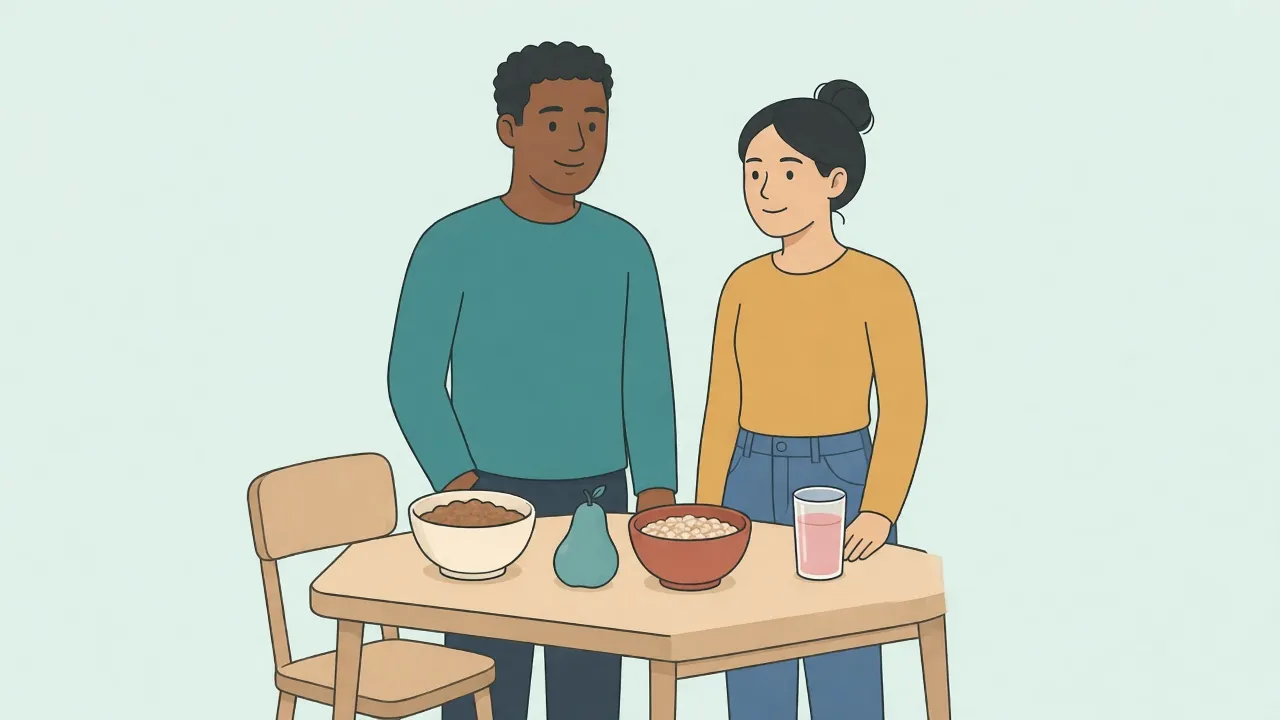
NIDDK suggests fiber from food or a supplement such as psyllium, enough nonalcoholic fluid, no straining, and no long sits on the toilet 9. The best fiber supplements for hemorrhoids page compares powders and capsules. A standard psyllium powder is the usual first tub. Buyers often say to drink it before it thickens, and to take it with plenty of water.
Metamucil Sugar-Free Psyllium Powder, Orange
Best for: Most people starting fiber for hemorrhoids
The best-known psyllium powder and our top fiber pick. Psyllium is the fiber used in most of the hemorrhoid trials.
What recent buyers say
Reviews are strongly positive. It works, it tastes better than people expect, and a tub lasts. Recent buyers say it made them regular within a day or two, and they stress drinking plenty of water with it. The main complaint is the added sweetener and coloring, which some would rather avoid.
What buyers like
- Keeps people regular
- Orange flavor goes down easily
- Big tub is good value
Common complaints
- Some dislike the sweetener and coloring
- Thickens if you do not drink it quickly
Skip it if you prefer plain fiber with nothing added. Anthony's plain psyllium is the unflavored option.
If bleeding continues, the next step is an office procedure. A meta-analysis of hemorrhoid treatment trials recommended rubber band ligation as the first procedure for grades 1 to 3. Banding worked better than sclerotherapy, an injection that scars the cushion, and people who had sclerotherapy or infrared coagulation were more likely to need another treatment. Hemorrhoidectomy, the operation that cuts the tissue out, had a better response than banding and also more pain and more complications. The authors kept surgery for people who did not improve after banding 5.
A family-medicine review reached a similar split. Rubber band ligation was described as the most effective office procedure for grades 1, 2, and 3. Surgery was described as the next step after office treatment failed, and also as initial care for some grade 3 and grade 4 hemorrhoids 8.
A Cochrane review of banding versus excisional surgery looked at this by grade. For grade 2, prolapse that goes back by itself, one small trial found no clear difference in symptom clearance (32 patients, relative risk 1.07). For grade 3, prolapse that needs a push, surgery did better (two trials, 116 patients, relative risk 1.23). Surgery also caused more postoperative pain (relative risk 1.94) and fewer people needed a repeat procedure after surgery. The authors’ practical line was banding for grade 2, and surgery for grade 3 or for a hemorrhoid that returns after banding. The trials were small and the methods were weak, so treat that split as a guide, not a rule 6.
What to do for grade 3 and grade 4
Grade 3 is the grade where reasonable doctors disagree, and the disagreement is in the trials. Banding is still offered first to many people, because a 2016 trial of artery ligation versus banding found that a course of banding can be enough, even though a single banding session recurs more often.
That trial enrolled people with grade 2 and grade 3 hemorrhoids. At one year, 87 of 176 people (49 percent) in the banding group had a recurrence, compared with 48 of 161 (30 percent) after Doppler-guided hemorrhoidal artery ligation. The gap was mostly extra procedures: 32 percent after banding had another procedure, versus 14 percent after ligation. Pain the day after the procedure averaged 3.4 out of 10 after banding and 4.6 after ligation. Serious events that needed a hospital stay were more common after ligation. The authors wrote that many patients would rather repeat a banding than have the more invasive operation 11.
Grade 4 is outside that banding-first pattern. The tissue stays out and cannot be replaced. A 2016 review lists surgery as the initial treatment for symptomatic grade 4 hemorrhoids, and as an option for symptomatic grade 3 and for thrombosed internal hemorrhoids 7. The ASCRS patient page lists hemorrhoidectomy for grade 3 or 4 prolapse, for large external hemorrhoids, and for combined internal and external disease. Fewer than 10 percent of people seen for symptomatic hemorrhoids need an operation 2.
If you and your surgeon are choosing between traditional excision and stapled hemorrhoidopexy, the eTHoS trial is the large comparison. It randomized 777 adults referred for surgery for grade 2 to 4 hemorrhoids. Stapled surgery was less painful in the first weeks. Over 24 months, quality of life was better after traditional excision (mean difference on the EQ-5D area-under-curve of 0.073, favoring excision). Serious adverse events occurred in 24 of 338 people (7 percent) after stapling and 33 of 352 (9 percent) after excision. The authors’ conclusion was to consider traditional excision over stapling when an operation is the plan 12. Recovery week by week belongs to the surgery timeline on the procedures pages, not to a guess from this one.
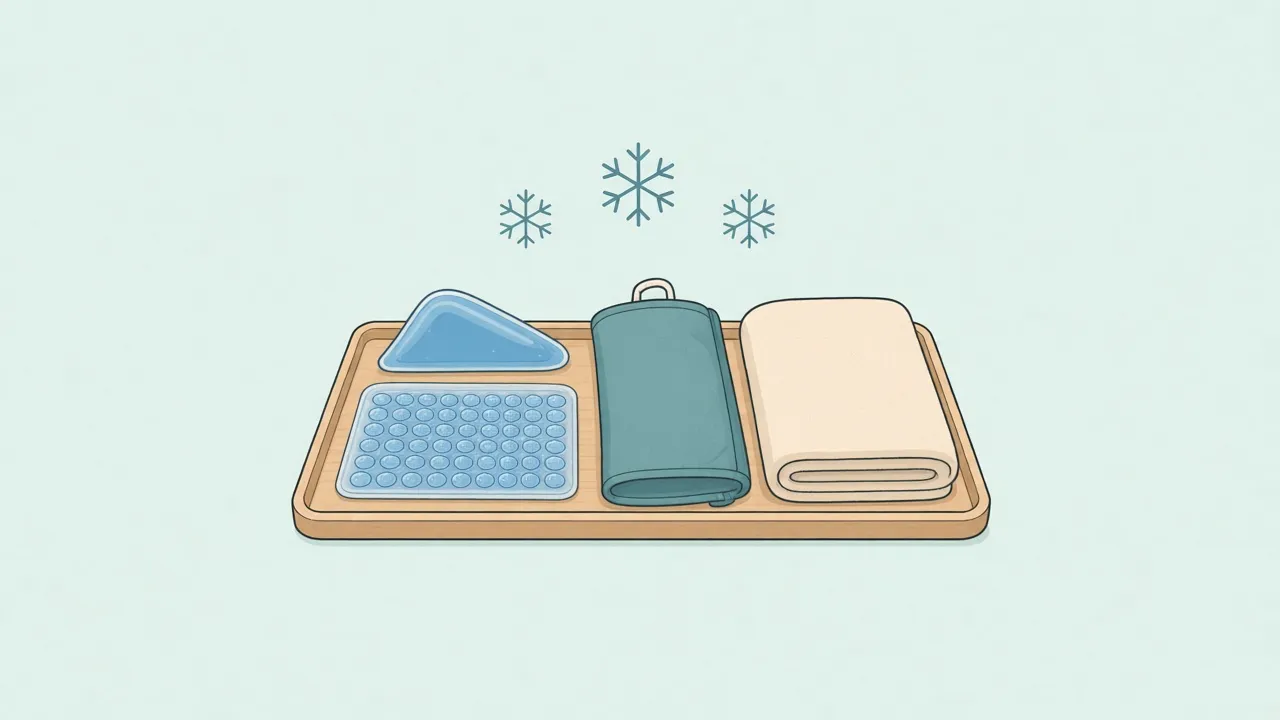
A prolapsed internal hemorrhoid that has become trapped and clotted is not a home banding project. A clinical review describes first care for prolapsed, strangulated hemorrhoids as stool softeners, pain relief, rest, warm soaks, and ice packs until the acute swelling settles, with banding or excision of whatever remains later 8. Go in the same day if the pain is severe and the tissue will not go back.
Putting a prolapsed hemorrhoid back
The NHS says you can gently push a pile back inside if you can 16. That fits grade 2, which returns on its own, and grade 3, which returns with a push. It does not fit grade 4, which stays out by definition 1.
Use a clean finger, a little lubricant if you have it, and stop if the pain spikes or the tissue will not stay in. The step-by-step, including when to quit, is on pushing a prolapsed hemorrhoid back in. Wash your hands before and after. If it prolapses again with every stool, that pattern is the reason to talk about banding rather than to keep pushing it back for months.
What banding feels like afterward
Only a clinician should place a band. NIDDK is explicit that you should never try this yourself. The band cuts off blood flow, the tissue shrivels, and it falls off most often within a week. A small scar holds the remaining cushion in place 9. The ASCRS patient page puts the fall-off at roughly 5 to 7 days, sometimes with a small amount of bleeding that day. One to three bands may be placed per visit, and more than one visit is common. A dull ache or pressure for 1 to 3 days is usual, and acetaminophen or ibuprofen is what that page suggests for it. People taking warfarin (Coumadin), heparin, or clopidogrel (Plavix) may not be candidates 2.
A review of banding complications calls mild pain the most common problem. Bleeding that starts later, normally 10 to 14 days after the band, is the complication to plan for, and the risk is higher on antiplatelet or anticoagulant medicine. Major problems, including bleeding that will not stop, urinary retention, and pelvic infection, are uncommon. The same review notes that deaths from infection after banding have been reported, which is why fever, spreading pain, or feeling seriously ill after a band is a same-day call, not a wait-until-Monday symptom 13. What the visit itself is like is on rubber band ligation: what to expect.
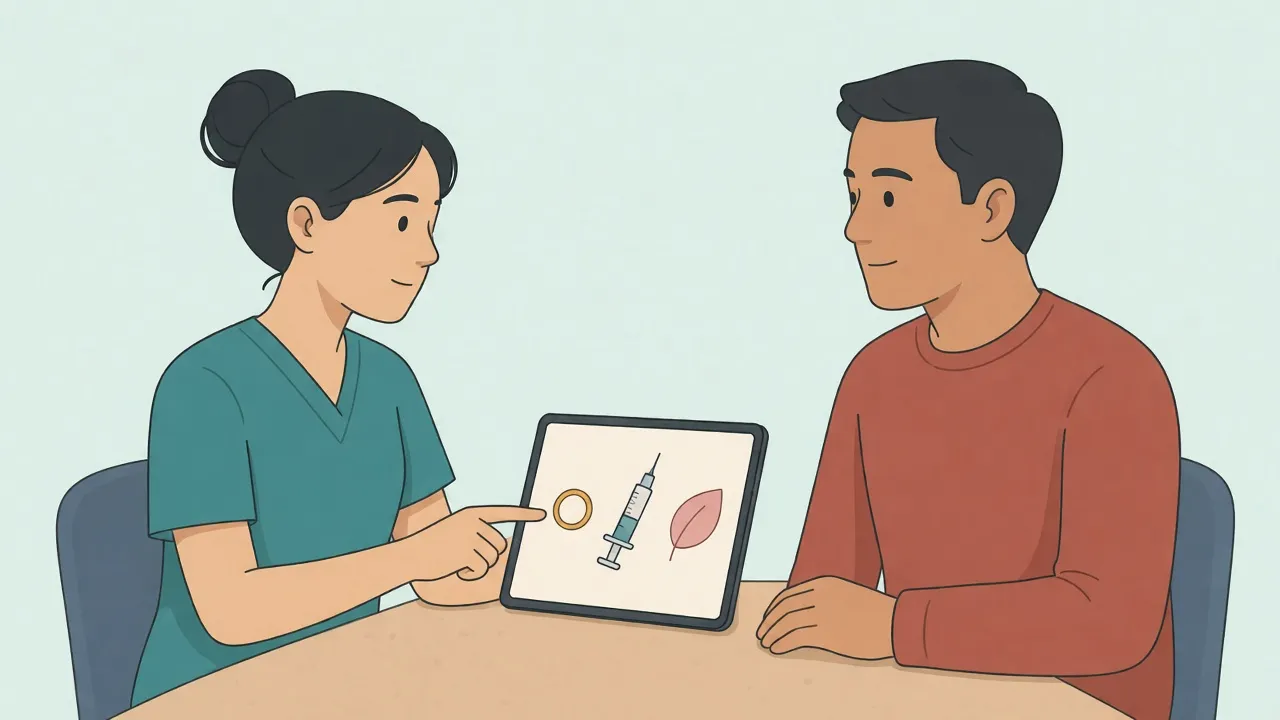
Creams and suppositories are for mild symptoms while you wait for fiber to work, or while a band settles. NIDDK says doctors usually suggest store products for about a week 9. They do not replace banding for a hemorrhoid that keeps prolapsing. The full menu of home care, office procedures, and operations is on hemorrhoid treatment. Our picks of the best hemorrhoid suppositories cover the options for internal swelling.
When internal bleeding needs a doctor
NIDDK says to get care if rectal bleeding is happening, or if a week of home treatment has not helped 3. An exam is how the doctor tells an internal hemorrhoid from a fissure, a polyp, or inflamed bowel 14. Bleeding, pain, itching, seepage, prolapse, and mucus were reported equally often by people with hemorrhoids and by people without them in a review of the symptom research 17.
The US Preventive Services Task Force recommends colon cancer screening starting at age 45 for adults at average risk, through age 75, with an individual decision from 76 to 85 15. If you are 45 or older and not up to date, ask for screening at the same visit. Who to call, and what the appointment includes, is on when to see a doctor for hemorrhoids. If you are bleeding and unsure what else it could be, read how to tell hemorrhoids from colon cancer.
If home care has quieted the bleeding and the tissue stays inside, keep the fiber going. The trials that measured bleeding more than once, usually at six weeks and at three months, kept showing the same fiber result over that stretch 10. A return of blood after a quiet month is a new symptom. Get it looked at rather than adding another week of cream.
Frequently asked questions
Can internal hemorrhoids hurt?
Internal hemorrhoids that stay inside usually do not hurt, because the lining above the dentate line does not sense pain the way skin does. They can ache once they slip out. A sudden severe pain with a hard lump at the opening is more often a clot in an external hemorrhoid, or a tear, than a typical internal hemorrhoid.
How is the grade decided?
The grade describes prolapse, not how much blood you see. Grade 1 bleeds and stays in. Grade 2 comes out and returns on its own. Grade 3 has to be pushed back. Grade 4 stays out. A doctor assigns it by asking what happens at home and by looking, often with a short scope.
How many banding visits will I need?
The ASCRS patient page says one to three bands may be placed at a visit, and several short visits are sometimes needed. There is little formal recovery for most people. A dull ache or a feeling of pressure for 1 to 3 days is common and is usually handled with acetaminophen or ibuprofen, unless you have been told to avoid those.
Can grade 4 internal hemorrhoids be banded?
Banding is the procedure recommended first for grades 1 to 3. Grade 4 means the tissue stays outside and cannot be pushed back, and surgery is the option usually discussed. A doctor who can see the tissue is the person who decides. Forcing a stuck hemorrhoid back in is not the home plan.
What if I take a blood thinner?
You may not be a candidate for banding. People on antiplatelet or anticoagulant medicine have a higher chance of bleeding after a band, including bleeding that shows up 10 to 14 days later. Tell the doctor every blood thinner you take before anyone schedules a procedure.
Will fiber alone fix a prolapsed internal hemorrhoid?
Fiber has the clearest trial evidence for bleeding and for symptoms that were not improving. The same review could not show a clear effect on prolapse. If tissue keeps coming out, fiber is still worth doing, and it is often paired with banding or with surgery depending on the grade.
Sources
- 1. Lohsiriwat V Hemorrhoids: from basic pathophysiology to clinical management . World J Gastroenterol , 2012 ; 18(17):2009-2017 . doi:10.3748/wjg.v18.i17.2009 Review
- 2. Hemorrhoids: Expanded Information . American Society of Colon and Rectal Surgeons . Guideline
- 3. Symptoms & Causes of Hemorrhoids . National Institute of Diabetes and Digestive and Kidney Diseases (NIDDK) . Government
- 4. Riss S, Weiser FA, Schwameis K, et al. The prevalence of hemorrhoids in adults . Int J Colorectal Dis , 2012 ; 27(2):215-220 . doi:10.1007/s00384-011-1316-3 Study
- 5. MacRae HM, McLeod RS Comparison of hemorrhoidal treatment modalities. A meta-analysis . Dis Colon Rectum , 1995 ; 38(7):687-694 . doi:10.1007/BF02048023 Review
- 6. Shanmugam V, Thaha MA, Rabindranath KS, et al. Rubber band ligation versus excisional haemorrhoidectomy for haemorrhoids . Cochrane Database Syst Rev , 2005 ; (3):CD005034 . doi:10.1002/14651858.CD005034.pub2 Cochrane review
- 7. Sun Z, Migaly J Review of Hemorrhoid Disease: Presentation and Management . Clin Colon Rectal Surg , 2016 ; 29(1):22-29 . doi:10.1055/s-0035-1568144 Review
- 8. Fox A, Tietze PH, Ramakrishnan K. Anorectal conditions: hemorrhoids. . FP Essent , 2014 ; 419:11-9 . Review
- 9. Treatment of Hemorrhoids . National Institute of Diabetes and Digestive and Kidney Diseases (NIDDK) . Government
- 10. Alonso-Coello P, Mills E, Heels-Ansdell D, et al. Fiber for the treatment of hemorrhoids complications: a systematic review and meta-analysis . Am J Gastroenterol , 2006 ; 101(1):181-188 . doi:10.1111/j.1572-0241.2005.00359.x Review
- 11. Brown SR, Tiernan JP, Watson AJM, et al. Haemorrhoidal artery ligation versus rubber band ligation for the management of symptomatic second-degree and third-degree haemorrhoids (HubBLe): a multicentre, open-label, randomised controlled trial . Lancet , 2016 ; 388(10042):356-364 . doi:10.1016/S0140-6736(16)30584-0 Clinical trial
- 12. Watson AJM, Hudson J, Wood J, et al. Comparison of stapled haemorrhoidopexy with traditional excisional surgery for haemorrhoidal disease (eTHoS): a pragmatic, multicentre, randomised controlled trial . Lancet , 2016 ; 388(10058):2375-2385 . doi:10.1016/S0140-6736(16)31803-7 Clinical trial
- 13. Albuquerque A Rubber band ligation of hemorrhoids: A guide for complications . World J Gastrointest Surg , 2016 ; 8(9):614-620 . doi:10.4240/wjgs.v8.i9.614 Review
- 14. Diagnosis of Hemorrhoids . National Institute of Diabetes and Digestive and Kidney Diseases (NIDDK) . Government
- 15. US Preventive Services Task Force Screening for Colorectal Cancer: US Preventive Services Task Force Recommendation Statement . JAMA , 2021 ; 325(19):1965-1977 . doi:10.1001/jama.2021.6238 Guideline
- 16. Piles (haemorrhoids) . NHS , 2026 . Government
- 17. Sandler RS, Peery AF Rethinking What We Know About Hemorrhoids . Clin Gastroenterol Hepatol , 2019 ; 17(1):8-15 . doi:10.1016/j.cgh.2018.03.020 Review