Quick answer
You can gently push a prolapsed internal hemorrhoid back inside if it is soft and it goes in without force. The NHS says to do this if you can. Stop if it will not go back, if the pain is severe, or if the tissue looks dark or smells foul. A trapped hemorrhoid can lose its blood supply and needs same-day care.
Product links on this page go to Amazon. As an Amazon Associate I earn from qualifying purchases. No brand pays for a place on our lists. How we choose products
Key takeaways
- The NHS tells people to gently push a pile back inside if they can, and to use an ice pack wrapped in a towel or a warm bath for discomfort.
- Grade 2 prolapse slips out and returns on its own. Grade 3 is the grade you have to push back. Grade 4 will not go back in.
- A prolapsed internal hemorrhoid that is stuck, severely painful, and leaking foul discharge may be strangulated. A surgical review says urgent hemorrhoidectomy is usually required.
- For grade 3 hemorrhoids, surgery clears symptoms more often than banding and causes more pain. A 2025 review still lists banding as the first office procedure for grades 1 to 3 that have not settled with fiber and less straining.
- Most prolapsed internal hemorrhoids go away without home treatment, according to NIDDK, but severe prolapse or bleeding may need a procedure.
On this page
Yes, if the lump is a prolapsed internal hemorrhoid and it will go back with gentle pressure. The NHS page on piles tells people to gently push a pile back inside if they can 1. That is ordinary advice for tissue that has slipped out and is still soft.
Stop if it will not go, if the pain is severe, or if there is a foul smell. An internal hemorrhoid can become strangulated when the prolapsed part stays out long enough for the blood supply to suffer. A review of anorectal emergencies says people with acute thrombosis and strangulation usually have a hemorrhoid that is stuck out and very painful, sometimes with foul-smelling discharge if the surface is dying. Manual reduction might ease pain and congestion, and urgent hemorrhoidectomy is usually required 2.
This page is the home version of a gentle reduction, the signs that mean you should not keep trying, what the prolapse grades mean, and the treatments used for grade 3 and grade 4 disease. How the four grades are defined is also in internal hemorrhoids.
How to gently push a prolapsed hemorrhoid back in
Do this only for a soft lump that has come down from inside and that you have reduced before, or that starts to go back as soon as you press. Wash your hands first.
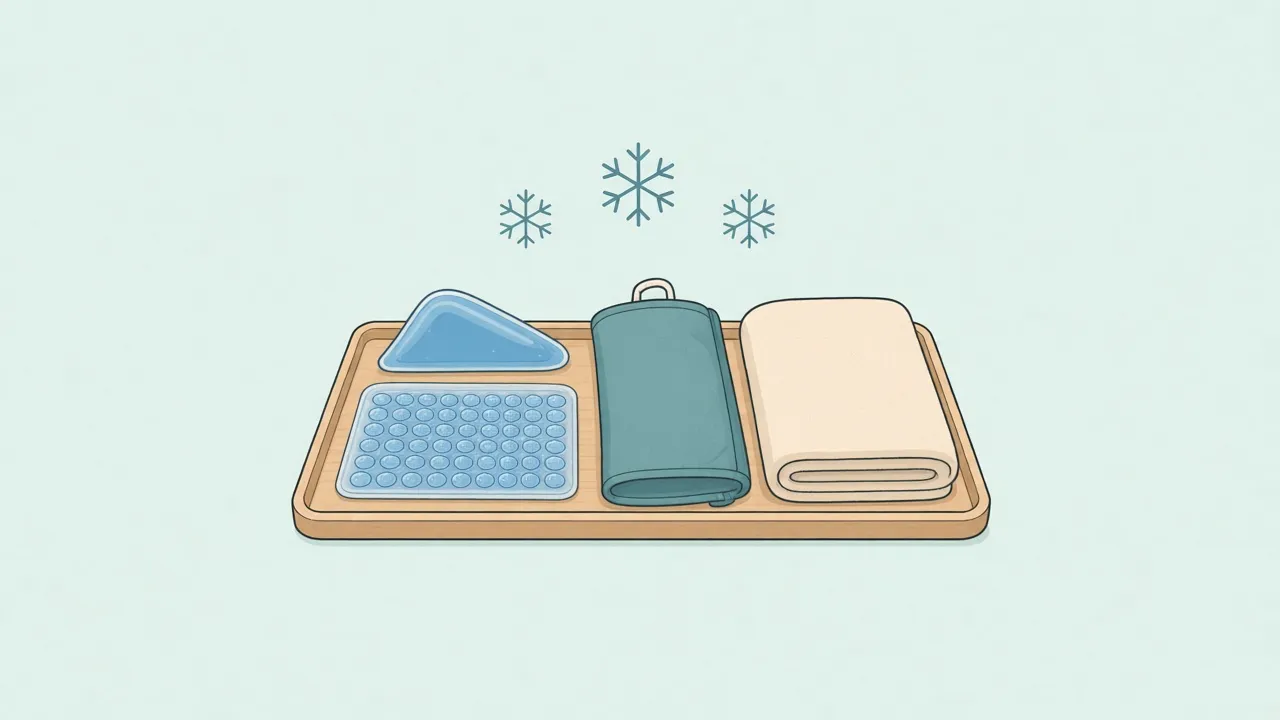
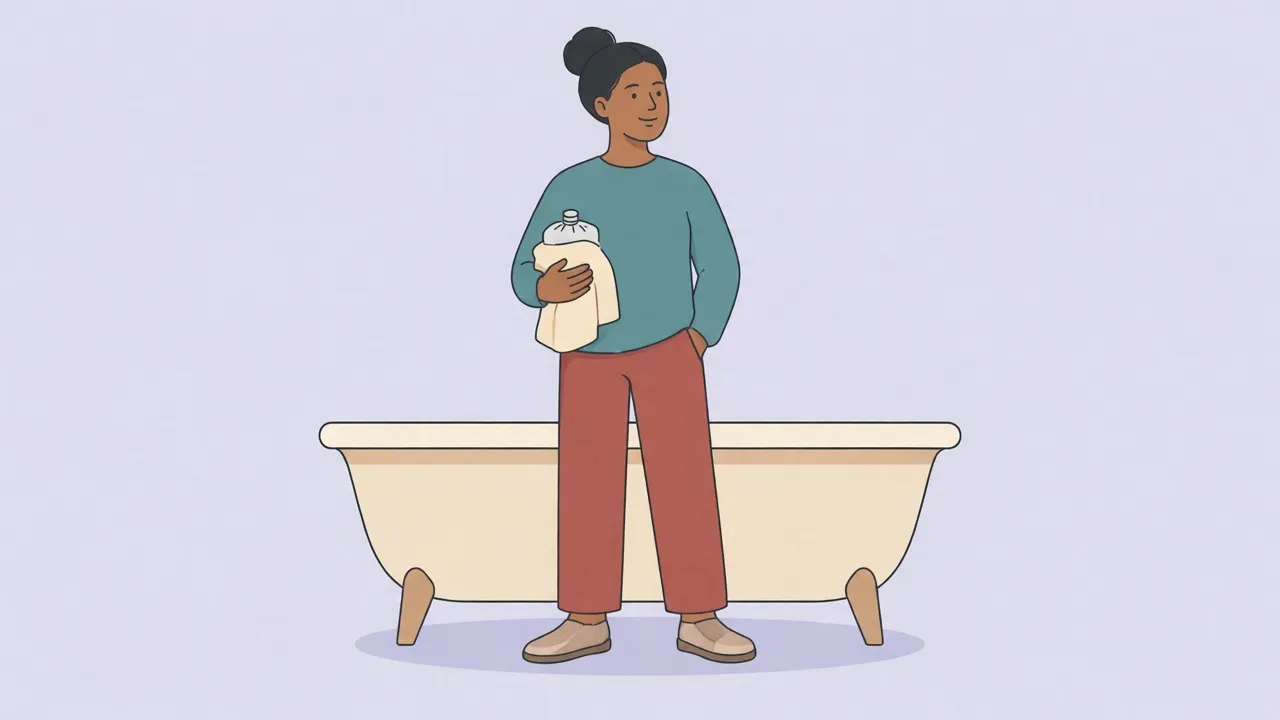
- Ease the swelling before you push, if the lump is sore. The NHS suggests an ice pack wrapped in a towel, or a warm bath, for discomfort, itching, and pain 1. Give the ice or the bath a few minutes. Keep the towel around the ice.
- Pat the area dry. The same NHS advice says to keep the skin clean and dry and to pat rather than rub 1.
- Gently push the pile back inside if you can. Use a clean finger and steady pressure toward the inside. Stop the moment it will not move or the pain jumps.
- Once it is in, stay off the toilet. Do not sit longer than you need to, and do not strain 1. Straining is what pushes the cushion back out.
- If it will not stay in, or you cannot get it in at all, stop the attempts and use the warning list below.
The NIDDK treatment page says most prolapsed internal hemorrhoids go away without home treatment, and that severely prolapsed or bleeding internal hemorrhoids may need medical care 4. Pushing one back is a way to be comfortable tonight. It does not change the grade.
Metamucil Sugar-Free Psyllium Powder, Orange
Best for: Most people starting fiber for hemorrhoids
The best-known psyllium powder and our top fiber pick. Psyllium is the fiber used in most of the hemorrhoid trials.
What recent buyers say
Reviews are strongly positive. It works, it tastes better than people expect, and a tub lasts. Recent buyers say it made them regular within a day or two, and they stress drinking plenty of water with it. The main complaint is the added sweetener and coloring, which some would rather avoid.
What buyers like
- Keeps people regular
- Orange flavor goes down easily
- Big tub is good value
Common complaints
- Some dislike the sweetener and coloring
- Thickens if you do not drink it quickly
Skip it if you prefer plain fiber with nothing added. Anthony's plain psyllium is the unflavored option.
When not to push a hemorrhoid back in
Some lumps should not be pressed on at home.
An external hemorrhoid is already outside. It arises below the dentate line and causes pain when it is engorged or thrombosed (filled with a clot) 3. Pushing it will not park it inside the rectum. A sudden very painful lump at the opening is often that clot. The first 72 hours matter for whether a clinician offers to remove the clot. That decision is covered in thrombosed hemorrhoid and in external hemorrhoids.
A strangulated internal hemorrhoid is the other case. The review cited above describes an acute, irreducible, painful hemorrhoid. If the mucosa is dying, there may be foul-smelling discharge. Manual reduction by a clinician might reduce pain and tissue congestion. The usual treatment is urgent surgery, done with anesthesia, sometimes after the hemorrhoid is compressed to bring the swelling down 2. That compression step is an operating-room note, not a home technique. You should not keep kneading a black, purple, or exquisitely painful mass in the bathroom.
Bleeding changes the plan too. NIDDK says to seek medical care right away for severe anal pain and rectal bleeding, particularly with abdominal pain, diarrhea, or fever 4. The NHS says to go to emergency care if there is a lot of blood or you see large clots, and to get urgent help if your temperature is very high or you feel hot, cold, shivery, and generally unwell 1.
Screening is on the list because blood on the paper is common with hemorrhoids and also common with polyps. The US Preventive Services Task Force recommends colorectal cancer screening starting at age 45 12. If that applies to you, mention it when you are seen. More on the amount of blood is in bleeding hemorrhoids, and the full “do I need a doctor today” list is in when to see a doctor.
What prolapse grade means
Doctors sort internal hemorrhoid prolapse into four grades. A 2025 review of hemorrhoidal disease uses this version 3:
| Grade | What you notice | What it does when you stop straining |
|---|---|---|
| 1 | Bleeding or fullness inside. You may not see a lump | Stays up in the anal canal |
| 2 | Tissue comes out with a bowel movement | Goes back by itself |
| 3 | Tissue comes out and stays out until you help | Needs you to push it back in |
| 4 | Tissue stays out | Will not reduce |
A Cochrane review uses the same plain definitions for the two grades people mix up: grade 2 is prolapse that reduces spontaneously when you stop straining, and grade 3 is prolapse that needs manual reduction 5.
Grade 3 is the one this page’s main question is about. You can reduce it, and it comes back out later, often with the next hard stool. Grade 4 means home pushing has already failed: the tissue will not go back. Strangulation is the emergency on top of that, when the blood supply is in trouble and the pain is severe, sometimes with a foul smell 2.
Treatment for grade 3 and grade 4 hemorrhoids
First-line care is the same at every grade: more dietary fiber and water, and less straining 3. Phlebotonics, a group that includes flavonoid pills, reduce bleeding, rectal pain, and swelling in that review, and symptoms come back in up to 80% of people within 3 to 6 months after the pills stop 3. Fiber has a separate hemorrhoid evidence base. In seven trials, fiber lowered the risk of symptoms that failed to improve (relative risk 0.53) and the risk of bleeding (relative risk 0.50) 11.
Grade 3
If fiber and straining habits are not enough, office procedures are next for grades 1 to 3. The 2025 review calls rubber band ligation the first procedure in that group. It describes banding as resolving symptoms in 89% of patients, with repeat banding needed in up to 20% 3. What the visit feels like, and the bleeding window around days 10 to 14, is in rubber band ligation: what to expect.
Trials that compare banding with surgery for this grade are less rosy about a single banding. The Cochrane review of banding versus hemorrhoidectomy found surgery more likely to bring complete remission for grade 3 hemorrhoids (relative risk 1.23, two trials, 116 patients). For grade 2, one small trial found no clear difference. Surgery caused more pain (relative risk 1.94) and more delayed complications. Fewer people needed a repeat treatment after surgery. The authors suggested banding for grade 2, and excision for grade 3 or for recurrence after banding. They also said the three trials were poor quality 5.
A 1995 meta-analysis had recommended banding as the first treatment for grades 1 to 3, and hemorrhoidectomy if banding failed, because surgery worked better and hurt more 6. A 2021 review of eight trials agreed that symptom control favored hemorrhoidectomy and pain favored banding, then said the studies were too uneven to name a single best treatment for grade 2 or 3 9.
The HubBLe trial mixed grade 2 and grade 3 and compared one course of banding with hemorrhoidal artery ligation. At one year, recurrence was 49% after banding and 30% after artery ligation, mostly because 32% of the banding group needed another procedure. Banding hurt less on day 1 and day 7 10.
HOLLAND compared banding (up to two sessions) with excisional hemorrhoidectomy in adults with grade 3 hemorrhoids. In 79 patients with outcome data, recurrence was 33.5 percentage points lower after surgery (95% confidence interval 15.3% to 51.7%), and surgery gained a small amount of quality-adjusted life (difference 0.08). The sample is small 8.
A large retrospective series found similar banding success across degrees of hemorrhoids, with a trend toward failure when four or more bands were required 7. That supports trying banding for prolapse that can be reduced. It does not make banding the right tool for a strangulated pile.
Put together for grade 3: reduce it gently when you can, start fiber and shorter toilet sits, and expect a conversation about banding first. If prolapse keeps returning after banding, surgery is the treatment with better long-term symptom control and a harder recovery. The operation’s first weeks are mapped in the hemorrhoidectomy recovery timeline. The menu of procedures is in hemorrhoid procedures and the treatment overview.
Grade 4
Grade 4 prolapse is irreducible 3. If it is also acutely painful, swollen, and possibly foul-smelling, treat it as strangulation. Urgent hemorrhoidectomy is usually required. A clinician may still try to reduce it, under anesthesia, as part of that operation 2. Do not spend the evening trying to reproduce that at home.
If the tissue is out and irreducible but you are not in severe pain, you still need an examination. Another week of pushing will not tuck a grade 4 hemorrhoid back in. The 2025 review recommends excisional hemorrhoidectomy for grade 3 to 4 prolapse, thrombosis, or mixed disease that does not improve with less invasive approaches, and it cites recurrence after excision of about 2% to 10%, with a longer recovery of 9 to 14 days 3.
NIDDK describes hemorrhoidectomy for large external hemorrhoids and for prolapsing internal hemorrhoids that do not respond to other treatments, and stapled surgery as a way to pull prolapsing internal tissue back up. Both are done with anesthesia 4. The NHS says that if office treatments do not work, or the piles are large, surgery may be needed, and you are usually asleep 1.

What hemorrhoid symptoms look and feel like, from bleeding and itching to a lump, how internal and external types differ, and which signs need a doctor.
A soft grade 3 hemorrhoid can be nudged back in. A grade 4 hemorrhoid that will not move, or any prolapsed hemorrhoid with severe pain, dark tissue, or a foul smell, needs a doctor the same day 12.
Frequently asked questions
Will a prolapsed hemorrhoid go back in by itself?
Sometimes. Grade 2 prolapse comes out and returns on its own once you stop straining. Grade 3 stays out until you push it back. Grade 4 does not go back. If yours used to return on its own and now it stays out, the grade may have changed, and that is worth a visit.
Is a prolapsed hemorrhoid the same as an external hemorrhoid?
No. A prolapsed internal hemorrhoid is tissue from inside the anal canal that has slipped out. An external hemorrhoid starts under the skin outside. Pushing on an external lump will not tuck it up inside. A sudden hard, blue, very painful lump is often a clot in an external hemorrhoid.
Can I use ice before I try to push it back?
Yes. The NHS lists an ice pack wrapped in a towel, and a warm bath, as ways to ease discomfort from piles. Either can make a swollen lump easier to handle. Wrap the ice. Bare ice on skin is how people get a cold burn.
What if it comes straight back out?
That is common if the next thing you do is strain on the toilet. Keep the sit short, do not strain, and work on softer stools with fiber and fluid. If it will not stay in at all, you are in grade 4 territory, and home pushing has reached its limit.
Do grade 4 hemorrhoids always need surgery?
Strangulated grade 4 disease, with severe pain and tissue that may be dying, usually needs an urgent operation. A grade 4 hemorrhoid that is irreducible but not acutely strangulated is also the group where surgeons discuss excision, especially if simpler care has already failed. Banding is aimed at grades 1 to 3.
Sources
- 1. Piles (haemorrhoids) . NHS , 2026 . Government
- 2. Lohsiriwat V Anorectal emergencies. . World J Gastroenterol , 2016 ; 22(26):5867-5878 . doi:10.3748/wjg.v22.i26.5867 Review
- 3. Ashburn JH Hemorrhoidal Disease: A Review. . JAMA , 2025 . doi:10.1001/jama.2025.13083 Review
- 4. Treatment of Hemorrhoids . National Institute of Diabetes and Digestive and Kidney Diseases (NIDDK) . Government
- 5. Shanmugam V, Thaha MA, Rabindranath KS, et al. Rubber band ligation versus excisional haemorrhoidectomy for haemorrhoids . Cochrane Database Syst Rev , 2005 ; (3):CD005034 . doi:10.1002/14651858.CD005034.pub2 Cochrane review
- 6. MacRae HM, McLeod RS Comparison of hemorrhoidal treatment modalities. A meta-analysis . Dis Colon Rectum , 1995 ; 38(7):687-694 . doi:10.1007/BF02048023 Review
- 7. Iyer VS, Shrier I, Gordon PH Long-term outcome of rubber band ligation for symptomatic primary and recurrent internal hemorrhoids. . Dis Colon Rectum , 2004 ; 47(8):1364-1370 . doi:10.1007/s10350-004-0591-2 Study
- 8. van Oostendorp JY, Dekker L, van Dieren S, et al. Cost-Effectiveness of Rubber Band Ligation Versus Hemorrhoidectomy for the Treatment of Grade III Hemorrhoids: Analysis Using Evidence From the HOLLAND Randomized Controlled Trial. . Dis Colon Rectum , 2025 ; 68(9):1100-1111 . doi:10.1097/DCR.0000000000003832 Clinical trial
- 9. Dekker L, Han-Geurts IJM, Rorvik HD, et al. Rubber band ligation versus haemorrhoidectomy for the treatment of grade II-III haemorrhoids: a systematic review and meta-analysis of randomised controlled trials. . Tech Coloproctol , 2021 ; 25(6):663-674 . doi:10.1007/s10151-021-02430-x Review
- 10. Brown SR, Tiernan JP, Watson AJM, et al. Haemorrhoidal artery ligation versus rubber band ligation for the management of symptomatic second-degree and third-degree haemorrhoids (HubBLe): a multicentre, open-label, randomised controlled trial . Lancet , 2016 ; 388(10042):356-364 . doi:10.1016/S0140-6736(16)30584-0 Clinical trial
- 11. Alonso-Coello P, Mills E, Heels-Ansdell D, et al. Fiber for the treatment of hemorrhoids complications: a systematic review and meta-analysis . Am J Gastroenterol , 2006 ; 101(1):181-188 . doi:10.1111/j.1572-0241.2005.00359.x Review
- 12. US Preventive Services Task Force Screening for Colorectal Cancer: US Preventive Services Task Force Recommendation Statement . JAMA , 2021 ; 325(19):1965-1977 . doi:10.1001/jama.2021.6238 Guideline