Quick answer
Bright red blood on the paper or in the bowl is the usual hemorrhoid bleed. Dark stools, heavy bleeding, weight loss, or a change in bowel habits need a prompt visit. Have a clinician check it. Screening starts at age 45. Fiber cut bleeding risk in trials, and banding is the usual office treatment.
Product links on this page go to Amazon. As an Amazon Associate I earn from qualifying purchases. No brand pays for a place on our lists. How we choose products
Key takeaways
- Typical hemorrhoid bleeding is bright red, shows up with a bowel movement, and lands on the paper, the stool, or in the bowl. It usually does not cause anemia.
- A meta-analysis of seven fiber trials found the risk of bleeding was about half as high with fiber (relative risk 0.50). Follow-up in those trials was usually 6 weeks and 3 months.
- A Cochrane review of phlebotonics, a group that includes flavonoid pills, found less bleeding than control treatment, and the authors flagged weak study methods. A narrower review of one flavonoid fraction called the bleeding evidence low quality.
- In the HubBLe trial, 49% of people had hemorrhoids again one year after a single rubber band ligation (87 of 176), mostly because they needed another procedure. Pain the next day was lower than after artery ligation.
- The US Preventive Services Task Force recommends colorectal cancer screening for average-risk adults from age 45 to 75. Bleeding is a symptom, so it is a reason to be seen even before that age.
On this page
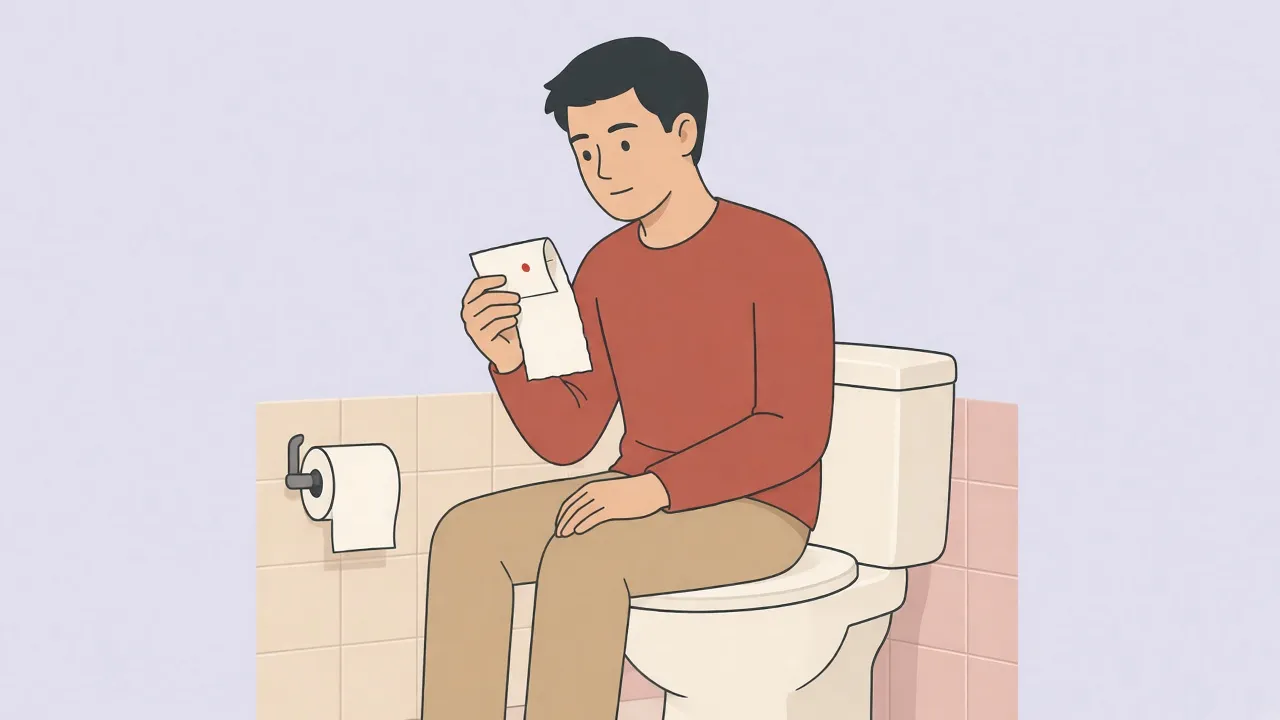
Bright red blood on the toilet paper, on the stool, or in the bowl is the bleeding pattern people mean by hemorrhoid bleeding. It usually shows up as you pass stool. Internal hemorrhoids, which sit in the lining just inside the anus, are the type that bleed this way, often with little or no pain. How that differs from an external lump is on internal hemorrhoids.
That pattern is common. It is also the pattern of a fissure, a polyp, and some colorectal cancers. The NIDDK symptoms page says rectal bleeding can be a sign of Crohn’s disease, ulcerative colitis, or cancer of the colon or rectum, and that any bleeding from the rectum is a reason to talk to a doctor 1. This page is about what the blood usually looks like, which patterns fall outside that, why a clinician should check the blood, and the treatments that have reduced bleeding in trials: fiber, flavonoid pills, and rubber band ligation.
What typical hemorrhoid bleeding looks like
The most common hemorrhoid symptom is rectal bleeding with a bowel movement 4. The blood is bright red 1. The ASCRS description of internal hemorrhoids says it may be on the paper, dripping into the bowl, or streaked on the stool, and that it can be quite brisk. The same page says not everyone with internal hemorrhoids has much bleeding 2.
Pain is the split that helps at home. Internal hemorrhoids that have not prolapsed (slipped out) most often do not hurt 1. A family physician review describes the bleed as streaks on the stool, and says it rarely causes anemia 3. A full symptom-by-symptom sort, including the clot and the fissure, is on hemorrhoid symptoms.
| What you see | How it usually fits a hemorrhoid | What to do |
|---|---|---|
| Bright red streak on the paper or stool, little pain | The common internal pattern 13 | Book a non-urgent visit, and start fiber |
| Bright red drip into the bowl, then it stops | Can still be an internal hemorrhoid. ASCRS calls this brisk 2 | Same visit, sooner if it repeats daily |
| Blood only when you also have tearing pain | More like a fissure than a painless internal hemorrhoid | Still get it seen if it lasts past a week |
| Dark brown or black stool | Not the hemorrhoid pattern 5 | Prompt visit |
| Bleeding that will not stop, clots, or you feel faint | Not a home-care bleed 7 | Same-day care |
What is not a typical hemorrhoid bleed
Color is the first split. Fresh hemorrhoid blood is red because the source is at the opening. The American Cancer Society list of colorectal cancer symptoms includes rectal bleeding with bright red blood, and also blood that makes the stool look dark brown or black. It includes a change in bowel habits lasting more than a few days, a feeling that you still need to go after you have gone, and weight loss you did not plan. The Society notes that hemorrhoids can cause some of these symptoms, and that you should still see a doctor so the cause can be found 5.
Amount is the second split. A streak is the pattern in the clinical reviews 3. Losing a lot of blood, or bleeding and feeling dizzy, lightheaded, or faint, is a reason for immediate help 7. Iron deficiency anemia can follow long-term blood loss, even though a typical streak rarely causes it 37.
A third split is everything that arrives with the blood. Fever, abdominal pain, and signs of anemia are red flags when bleeding might be written off as hemorrhoids 3. A change in stool caliber or a new constipation or diarrhea that lasts is on the cancer symptom list even when the blood looks red 5. How these signs compare, and what studies found about bleeding and cancer at different ages, is on hemorrhoids or colon cancer.

Why the blood should not be labeled at home
People attach anal bleeding to hemorrhoids because that is the story they have heard. Sandler and Peery point out that the symptoms blamed on hemorrhoids, bleeding included, also show up in people who do not have them on exam 8. A cushion on a colonoscopy report and a streak of blood are not the same fact.
Screening is a separate decision from this bleed, and it has a starting age. The US Preventive Services Task Force recommendation says screening for colorectal cancer has a moderate net benefit for adults 45 to 49 (a B recommendation) and a substantial net benefit for adults 50 to 75 (an A recommendation) 6. In the Task Force’s summary, colorectal cancer was the third leading cause of cancer death for both men and women, with about 52,980 deaths projected in the United States in 2021. About 10.5% of new cases were in people younger than 50, and the incidence in adults 40 to 49 had risen by almost 15% from 2000-2002 to 2014-2016 6.
Screening is for adults who do not already have symptoms. Bleeding is a symptom. NIDDK says to seek care for rectal bleeding even when you are younger than the age when routine screening starts 1. If you are 45 or older and you have never been screened, the bleed is a reason to do both: see someone about the blood, and get the screening you are due for. What the visit includes, from the gloved exam to a possible colonoscopy, is on when to see a doctor for hemorrhoids.
Fiber is the treatment with the clearest effect on bleeding
The home treatment that has been measured against bleeding is fiber. A 2006 meta-analysis pooled seven randomized trials, 378 patients, of fiber versus a non-fiber control. The risk of bleeding was about half in the fiber group (relative risk 0.50, 95% CI 0.28 to 0.89). The risk of symptoms that did not improve fell by 47% (relative risk 0.53, 95% CI 0.38 to 0.73). Studies that checked more than once, usually at 6 weeks and at 3 months, saw the same direction of effect. Pain, itching, and prolapse had results compatible with a benefit and also with no benefit, because the confidence intervals were wide 9. The meta-analysis of those seven fiber trials is the paper behind the “about half” figure.

NIDDK’s treatment page says to eat high-fiber foods, consider a fiber supplement such as psyllium, drink liquids, and avoid straining and long toilet sits 13. Build the food side with the hemorrhoid diet and check a normal day on the fiber calculator. If you are choosing a product, start with the notes on fiber supplements. Fiber, a stool softener, and a laxative are not the same tool. The comparison is on stool softener, fiber, or laxative.
Flavonoid pills during a flare
Phlebotonics are a mixed group of plant compounds, including flavonoids, used for vein symptoms. A 2012 Cochrane review included 24 studies. Twenty of them, with 2,344 people, compared a phlebotonic with a control. Bleeding was less common on the phlebotonic (odds ratio 0.12, 95% CI 0.04 to 0.37). Itching, discharge, and overall symptom scores also favored the drugs. The authors said the methods of the trials were limited and that stronger trials were still needed 10.
A tighter 2018 review looked only at micronized purified flavonoid fraction (MPFF). Ten trials, 1,164 people, were included. A pool of three trials favored MPFF on the bleeding outcome (relative risk 1.46, 95% CI 1.10 to 1.93). Other symptoms did not show a clear difference versus placebo. The authors rated the bleeding evidence as low quality because there were few trials and the results were inconsistent, and they said MPFF should not be routine without better research 11.
One later trial is more concrete about time. Giannini and colleagues randomized 134 people with an acute hemorrhoid flare: 66 received a mix of diosmin, troxerutin, and hesperidin, and 68 received placebo. Pain, bleeding, and the share of people who still had swelling or a clot were lower after 12 days on the flavonoid mix. After 6 days, that group also used fewer paracetamol tablets 12.
A U.S. review notes that these supplements are used widely in other countries and are not approved by the FDA as a hemorrhoid treatment 3. They are a flare option to discuss, after fiber, if you want a pill with some trial data and you accept that the evidence is uneven. Product notes are on hemorrhoid pills.
Most people starting fiber for hemorrhoids
Adults who want to try a flavonoid supplement during flare-ups
Rubber band ligation for bleeding that keeps returning
When fiber and time do not stop internal bleeding, the office procedure with the most use is rubber band ligation (banding). A doctor places a small band at the base of the internal hemorrhoid. The band cuts off the blood supply. The banded part shrivels and falls off, most often within a week. Scar forms and the hemorrhoid usually shrinks. NIDDK says only a doctor should do this. It is not a home treatment 13.
Banding is aimed at internal hemorrhoids, including ones that bleed or slip out. It is the office treatment clinicians reach for first in grades 1 to 3 because it holds up better than the other office options 3. The full comparison with sclerotherapy, infrared coagulation, and surgery is on hemorrhoid procedures.
The HubBLe trial compared a single banding session with hemorrhoidal artery ligation in people with grade 2 or 3 hemorrhoids. Of 337 people with one-year results, 87 of 176 in the banding group (49%) and 48 of 161 in the artery-ligation group (30%) had recurrence. The gap was mostly extra procedures: 32% of the banding group had another hemorrhoid procedure, versus 14% after artery ligation. Pain the day after the procedure was lower after banding (mean 3.4 versus 4.6 on a 10-point scale). Serious complications were less common after banding 14. The Lancet report of that trial is the source for those one-year numbers. The authors noted that patients might prefer a course of repeat banding to the more invasive operation 14.
A review of banding complications says mild pain and mild bleeding are common. A second bleed often shows up 10 to 14 days later, when the banded tissue sloughs. People on antiplatelet or anticoagulant medicine have a higher risk of serious bleeding 15. Mention those medicines when the procedure is booked. The week-by-week feel of the procedure is on rubber band ligation: what to expect.
What to do this week
- Write down the color, whether it only happens with a bowel movement, and whether you felt faint. Take that note to the visit.
- Start a daily fiber habit and drink enough liquid that the stool softens over the next several days. The bleeding trials looked out to 6 weeks and 3 months, so give the habit time if the bleed is a streak and you have a visit booked 913.
- If you are 45 or older and you are not up to date on screening, say that when you call 6.
- If the blood is dark, heavy, or comes with faintness, fever, or weight loss, do not wait for the fiber to work 57.
- Leave banding, shots, and surgery to the clinician. The home version of a band does not exist in any guideline 13.
Where this bleed sits among the other treatments, from creams to surgery, is on the hemorrhoid treatment page.
Frequently asked questions
How much blood from a hemorrhoid is usual?
A streak on the paper, a streak on the stool, or a small amount in the bowl is the pattern doctors describe. Some internal hemorrhoids bleed briskly enough to drip. A bowl full of blood, clots, or bleeding that does not stop is not the usual pattern and needs same-day care.
Can hemorrhoids turn the stool black?
Hemorrhoid blood is bright red, because it is fresh and close to the opening. Stool that looks dark brown or black is on the symptom list for colorectal cancer and for bleeding higher in the gut. That color needs a prompt visit, even if you also have hemorrhoids.
Do I need a colonoscopy for one streak of blood?
You need a clinician to decide, because a streak can be a hemorrhoid, a tear, a polyp, or a cancer. Average-risk screening starts at 45 even when you feel well. Under 45, red flags such as weight loss, a change in bowel habits, or a family history of colorectal cancer push the decision toward a full look at the colon.
How soon does fiber stop the bleeding?
The fiber trials that showed less bleeding usually checked people at about 6 weeks and again at 3 months. Fiber is a daily habit, not a same-day stop. If bleeding is heavy today, fiber is not the treatment to wait on.
What happens to the band after rubber band ligation?
A doctor places a band at the base of an internal hemorrhoid. The banded part loses its blood supply, shrivels, and usually falls off within a week. A smaller bleed can show up 10 to 14 days later as the tissue sloughs. Tell the doctor if you take a blood thinner before you book the procedure.
Are flavonoid pills a substitute for fiber?
They are aimed at a flare, not at the stool that keeps irritating the cushion. The best bleeding result for fiber comes from several trials. Flavonoid results are more mixed, and these pills are not an FDA-approved hemorrhoid drug. Most people should fix fiber and toilet habits first, then ask about a flavonoid pill if bleeding is still a problem.
Sources
- 1. Symptoms & Causes of Hemorrhoids . National Institute of Diabetes and Digestive and Kidney Diseases (NIDDK) . Government
- 2. Hemorrhoids: Expanded Information . American Society of Colon and Rectal Surgeons . Guideline
- 3. Mott T, Latimer K, Edwards C Hemorrhoids: Diagnosis and Treatment Options . Am Fam Physician , 2018 ; 97(3):172-179 . Review
- 4. Lohsiriwat V Hemorrhoids: from basic pathophysiology to clinical management . World J Gastroenterol , 2012 ; 18(17):2009-2017 . doi:10.3748/wjg.v18.i17.2009 Review
- 5. Colorectal Cancer Signs and Symptoms . American Cancer Society . Reference
- 6. US Preventive Services Task Force Screening for Colorectal Cancer: US Preventive Services Task Force Recommendation Statement . JAMA , 2021 ; 325(19):1965-1977 . doi:10.1001/jama.2021.6238 Guideline
- 7. Hemorrhoids: MedlinePlus Medical Encyclopedia . MedlinePlus, US National Library of Medicine . Government
- 8. Sandler RS, Peery AF Rethinking What We Know About Hemorrhoids . Clin Gastroenterol Hepatol , 2019 ; 17(1):8-15 . doi:10.1016/j.cgh.2018.03.020 Review
- 9. Alonso-Coello P, Mills E, Heels-Ansdell D, et al. Fiber for the treatment of hemorrhoids complications: a systematic review and meta-analysis . Am J Gastroenterol , 2006 ; 101(1):181-188 . doi:10.1111/j.1572-0241.2005.00359.x Review
- 10. Perera N, Liolitsa D, Iype S, et al. Phlebotonics for haemorrhoids . Cochrane Database Syst Rev , 2012 ; (8):CD004322 . doi:10.1002/14651858.CD004322.pub3 Cochrane review
- 11. Aziz Z, Huin WK, Badrul Hisham MD, et al. Efficacy and tolerability of micronized purified flavonoid fractions (MPFF) for haemorrhoids: A systematic review and meta-analysis . Complement Ther Med , 2018 ; 39:49-55 . doi:10.1016/j.ctim.2018.05.011 Review
- 12. Giannini I, Amato A, Basso L, et al. Flavonoids mixture (diosmin, troxerutin, hesperidin) in the treatment of acute hemorrhoidal disease: a prospective, randomized, triple-blind, controlled trial . Tech Coloproctol , 2015 ; 19(6):339-345 . doi:10.1007/s10151-015-1302-9 Clinical trial
- 13. Treatment of Hemorrhoids . National Institute of Diabetes and Digestive and Kidney Diseases (NIDDK) . Government
- 14. Brown SR, Tiernan JP, Watson AJM, et al. Haemorrhoidal artery ligation versus rubber band ligation for the management of symptomatic second-degree and third-degree haemorrhoids (HubBLe): a multicentre, open-label, randomised controlled trial . Lancet , 2016 ; 388(10042):356-364 . doi:10.1016/S0140-6736(16)30584-0 Clinical trial
- 15. Albuquerque A Rubber band ligation of hemorrhoids: A guide for complications . World J Gastrointest Surg , 2016 ; 8(9):614-620 . doi:10.4240/wjgs.v8.i9.614 Review