Quick answer
The symptom checker sorts your answers into home care, a doctor's appointment, or same-day care. It asks about bleeding, pain, itching, a lump, and warning signs such as heavy bleeding, black stools, fever, or weight loss. It cannot diagnose hemorrhoids. If you feel faint or bleeding is heavy, skip it and get care now.
Key takeaways
- The checker is three short steps: your symptoms, any warning signs, then age or family history, how long this has lasted, and when a lump started.
- Heavy bleeding, dizziness, black or maroon stools, or fever produces a same-day result. A painful lump from the last three days produces a call-soon result.
- A home-care result means your answers look like common hemorrhoid symptoms without those warning signs, and the suggestion is to try home steps for about a week.
- Nothing you tap is stored or sent. The checker cannot examine you, and it cannot tell a hemorrhoid from a fissure, a polyp, or a less common cause of bleeding.
On this page
The hemorrhoid symptom checker is a short set of questions. It matches what you tap to one of three kinds of guidance: try home care for about a week, book a clinician visit, or get care today. A clinician still has to make the diagnosis. If you already know the bleeding is heavy or you feel faint, skip the form and use the warning list further down.
Most people open it because of bright red blood, itching, a lump, or pain with a bowel movement. Those can be hemorrhoids. The NIDDK symptoms page says external hemorrhoid symptoms often ease within a few days, and that you should see a clinician if they are still there after a week of home care or if you are bleeding from the rectum 1. The checker sorts your answers onto one of those paths. What each hemorrhoid symptom means is the longer read if you want it before you start.
How to use the symptom checker
There are three steps. A bar at the top shows how far you are. You can go back and change an answer before you finish. Nothing is saved.
Step 1. Check every symptom you have. The list is bright red blood on the paper or in the bowl, pain or burning, sharp tearing pain during a bowel movement, itching, a tender lump at the edge of the anus, something that slips out and goes back, and mucus or a feeling of not being empty. Leave a box empty if it does not fit.
Step 2. Warning signs. Heavy bleeding, clots, or bleeding that will not stop. Feeling dizzy, faint, or short of breath. Black, tarry, or maroon stools. Fever, pus, or pain that keeps getting worse. Weight loss you cannot explain. A change in bowel habits lasting more than a few weeks. The last choice is “None of these.” Picking “None of these” clears the other boxes, and picking any warning sign clears “None of these,” so the form does not let you say both.
Step 3. Three short questions. Are you 45 or older, or does colorectal cancer run in your family? How long has this been going on: under a week, 1 to 3 weeks, or more than 3 weeks or it keeps coming back? If you have a painful lump, did it start in the last 3 days, or longer ago? Skip the lump question if you do not have a lump.
Then press “See my guidance.” The result stays on the page until you press “Start again.”

What the three results mean
The checker reads your answers in a set order. Same-day problems come first. A brand-new painful lump comes next. Other reasons to book a visit come after that. If none of those are present, you get a home-care plan.
Get medical care today
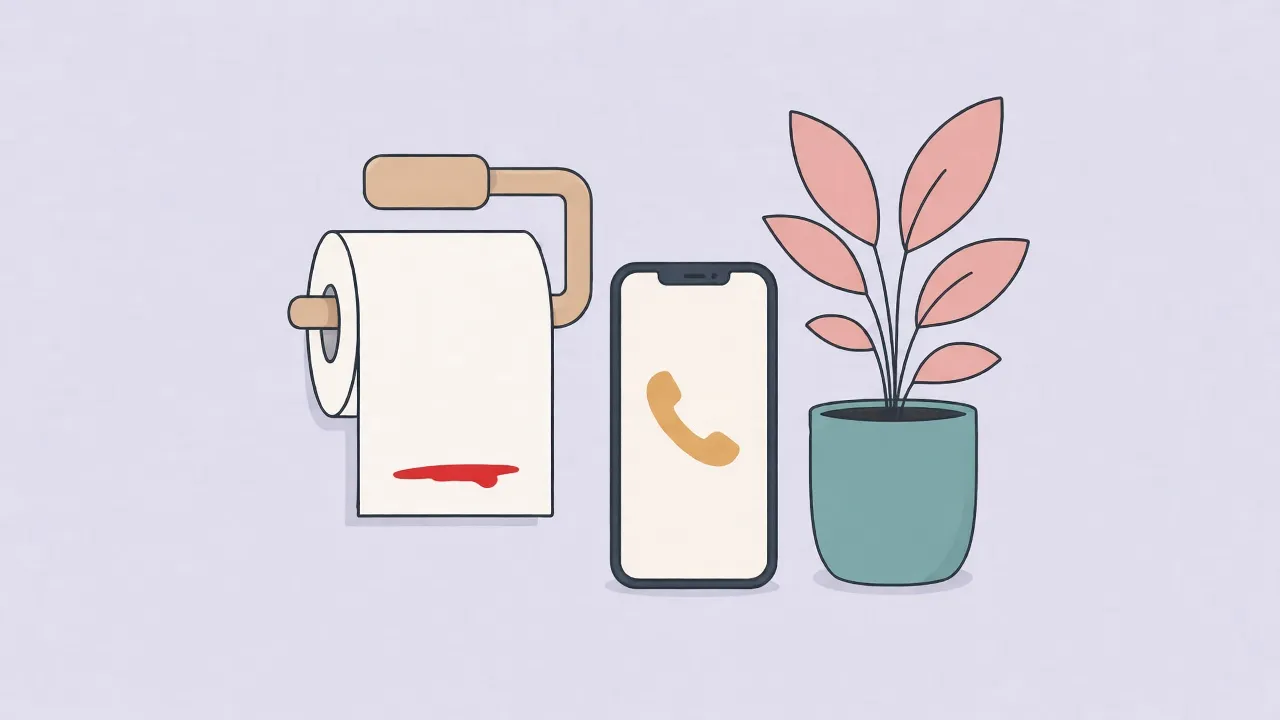
This result appears if you checked heavy bleeding, dizziness or feeling faint, black or maroon stools, or fever, pus, or pain that keeps getting worse. The text tells you to go to urgent care or an emergency department, or to call emergency services if you feel faint, and not to spend the day trying home treatment first.
That matches the reason these boxes exist. MedlinePlus says rectal bleeding should be checked because hemorrhoids are a common cause and other diseases can bleed too, including inflammatory bowel disease and colorectal cancer 3. Black or tarry stool is a different pattern from the bright red blood typical of an internal hemorrhoid 1. Fever and worsening pain can mean an infection or a clot that needs a look the same day.
Call a doctor in the next day or two
This result appears when you reported a tender lump and said it started in the last 3 days. The checker treats that as a possible thrombosed hemorrhoid, a clot under the skin at the anal edge. The ASCRS patient page says pain from that kind of lump often peaks about 48 to 72 hours after it starts and is largely easing after about four or five days 5. If you are already much better, warm baths, fiber, and a cream are the usual path. If the pain is still severe, an office procedure to remove the clot is sometimes offered, which is why the checker says to call in the next day or two rather than wait out the month. A chart review found that removing the clot eased symptoms faster than waiting, and that most people who waited still got better 7. Read thrombosed hemorrhoid for what that visit is like.
One limit of this branch: if a new lump is checked, this is the message you see, even if you also checked unexplained weight loss or a change in bowel habits. Say those on the phone as well. They still need a visit. Heavy bleeding, fainting, black stools, and fever are handled first, so those still show the same-day result.
Book a doctor’s appointment
This result is for problems that are not an emergency and should not be ignored. The checker adds it when you report unexplained weight loss, a change in bowel habits lasting more than a few weeks, symptoms for more than 3 weeks or symptoms that keep coming back, or bleeding together with a “yes” on the age and family question.
The age question is there because the USPSTF recommendation on colorectal cancer screening says to start screening at age 45 4. Bright red bleeding can be a hemorrhoid. At 45 and older, or when colorectal cancer is in the family, it is also a reason to be seen rather than to decide on your own that a hemorrhoid explains it. The result may mention colonoscopy as a possible next test a clinician might discuss.
Home care is a reasonable start
This is the result when your symptoms fit common hemorrhoid complaints and none of the warning branches fired. The checker suggests trying the steps it lists for about a week, and seeing a clinician if you are not better or if anything gets worse. If you checked bleeding, it adds a line: if nobody has ever checked rectal bleeding for you, mention it at your next appointment 13.
The home list on the result changes with what you checked. NIDDK’s treatment page is the same basic set: fiber or a stool softener, water, short toilet sits, warm soaks, and over-the-counter products often limited to about a week 2.
- Pain or a lump: warm sitz baths for 10 to 15 minutes, two or three times a day.
- Itching: rinse with water, pat dry, skip scented products.
- Bleeding: fiber and water. In a meta-analysis of seven fiber trials, fiber cut the chance of bleeding by about half 6.
- Something slipping out: less straining, shorter toilet sits, a footstool.
- Sharp tearing pain: the result treats that pattern as a clue that may be an anal fissure and links how a fissure differs from a hemorrhoid. Soft stools help both.
If you checked nothing, the result still suggests about 25 to 35 grams of fiber a day, water, and short toilet visits. The fiber calculator is the tool for the gram target that fits your age.
What this checker cannot do
It cannot diagnose hemorrhoids. It cannot see the anus, do a gloved exam, or use an anoscope, which is the short lighted tube clinicians use to look inside. MedlinePlus describes that exam as part of how hemorrhoids are actually diagnosed 3.
It cannot tell internal from external hemorrhoids with certainty, grade a prolapse, or rule out a polyp, a fissure, inflammatory bowel disease, or cancer. A home-care sentence means simple care is a reasonable start. Those other problems can still be present.
It does not know your pregnancy, your medicines, or your last colonoscopy unless you carry that into the appointment yourself. The age question is one yes-or-no item, not a screening history.
Your answers stay in the browser. They are not stored on a server and are not sent to a clinic. If you want a record, write down the result before you close the tab.

Symptoms that should skip the checker
Use the questions when you are unsure and you are stable. Go straight to care when any of these are true.
The full list of timing, from “mention it this month” to “go today,” is on when to see a doctor for hemorrhoids. Bright red blood that is new to you still belongs in bleeding hemorrhoids, even when the checker offers home care, because the suggestion there is to have it confirmed once.

What hemorrhoid symptoms look and feel like, from bleeding and itching to a lump, how internal and external types differ, and which signs need a doctor.
Frequently asked questions
Does the symptom checker store what I type?
No. The questions run in your browser. The page says your answers stay there and are not sent anywhere. Refreshing or closing the tab clears them. There is no account and no saved history.
What if I have more than one symptom?
Check every symptom you have on the first step. The result uses the whole set. Bleeding plus pain gets both the bleeding advice and the pain advice. One urgent warning sign overrides a mild symptom and tells you to get care today.
Why does it ask if I am 45 or if cancer runs in my family?
The US Preventive Services Task Force recommends colorectal cancer screening starting at age 45. New rectal bleeding around that age, or when colorectal cancer is in the family, should be mentioned to a clinician. If you answer yes and you also report bleeding, the checker tells you to book a visit.
I got a home-care result but I am still worried. Should I go in?
Yes, if you want an exam. A home-care result is a reasonable place to start, not a clearance. The NIDDK says to see a clinician if symptoms are still there after about a week of home treatment, and to mention rectal bleeding. You can book that visit now if waiting a week feels wrong.
Can I use this checker during pregnancy?
You can, for a first sort of the symptoms. Heavy bleeding, dizziness, fever, or a sudden severe lump should go to your obstetric team the same day, without working through the questions. Creams and laxatives in pregnancy need a check with that team before you use them.
Sources
- 1. Symptoms & Causes of Hemorrhoids . National Institute of Diabetes and Digestive and Kidney Diseases (NIDDK) . Government
- 2. Treatment of Hemorrhoids . National Institute of Diabetes and Digestive and Kidney Diseases (NIDDK) . Government
- 3. Hemorrhoids . MedlinePlus, US National Library of Medicine . Government
- 4. US Preventive Services Task Force Screening for Colorectal Cancer: US Preventive Services Task Force Recommendation Statement . JAMA , 2021 ; 325(19):1965-1977 . doi:10.1001/jama.2021.6238 Guideline
- 5. Hemorrhoids: Expanded Information . American Society of Colon and Rectal Surgeons . Guideline
- 6. Alonso-Coello P, Mills E, Heels-Ansdell D, et al. Fiber for the treatment of hemorrhoids complications: a systematic review and meta-analysis . Am J Gastroenterol , 2006 ; 101(1):181-188 . doi:10.1111/j.1572-0241.2005.00359.x Review
- 7. Greenspon J, Williams SB, Young HA, Orkin BA Thrombosed external hemorrhoids: outcome after conservative or surgical management . Dis Colon Rectum , 2004 ; 47(9):1493-1498 . doi:10.1007/s10350-004-0607-y Study