Quick answer
A randomized trial found that one dose of red chili did not worsen hemorrhoid bleeding, pain, itching, or burning over the next 48 hours. Chili did increase pain and burning in people with an anal fissure and in the week after hemorrhoid surgery. For ordinary hemorrhoids, an occasional spicy meal is reasonable. Soften the stool with fiber if symptoms flare.
Product links on this page go to Amazon. As an Amazon Associate I earn from qualifying purchases. No brand pays for a place on our lists. How we choose products
Key takeaways
- In a 2006 crossover trial of 50 people with hemorrhoids, one chili capsule at lunch did not raise symptom scores over 48 hours compared with a placebo capsule.
- A French survey found that people seeking care for a hemorrhoid flare were more likely to report a recent spicy diet, but that kind of survey cannot prove the spice caused the flare.
- In an anal-fissure trial, a week of chili capsules raised pain scores to 2.05 versus 0.97 on placebo, and burning to 1.85 versus 0.71.
- After hemorrhoid surgery, 3 grams of chili powder a day increased pain and anal burning in the first week.
- Fiber has trial evidence for hemorrhoid bleeding and leftover symptoms. The NIDDK diet page does not list spicy food as something to avoid.
On this page
Spicy food is not a proven cause of hemorrhoids. In the only randomized trial that fed chili to people who already had hemorrhoids, one dose did not make bleeding, swelling, pain, itching, or burning worse over the next 48 hours 1. Chili did make pain and burning worse in two other trials, one in acute anal fissure and one in the week after hemorrhoid surgery 34.
Those are different problems. A fissure is a tear in the anal lining. Surgery leaves a wound. A hemorrhoid flare, by itself, did not react to a single spicy meal in the trial. This page walks through that trial, a survey that points the other way, the fissure and surgery results, and what to eat when symptoms are up. The longer background on causes is in what causes hemorrhoids.
What the Altomare chili trial found
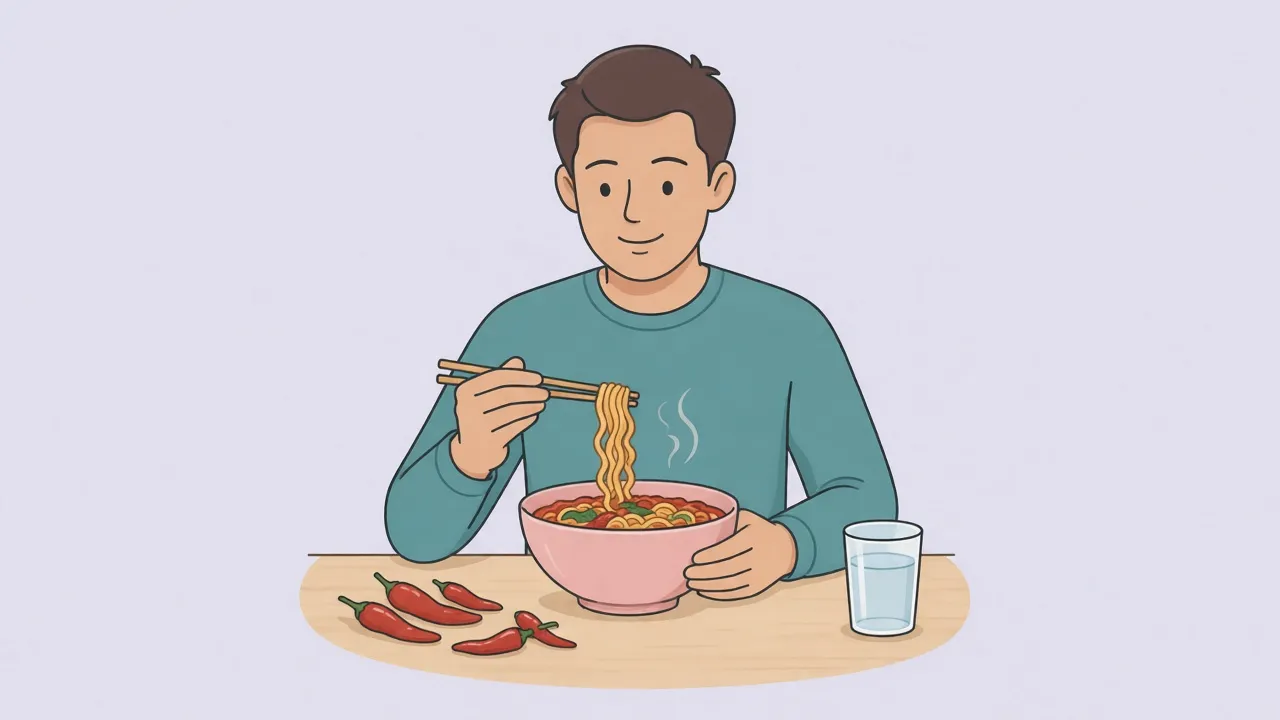
In 2006, Altomare and colleagues in Bari, Italy, published a double-blind, randomized, placebo-controlled crossover trial. Double blind means neither the patients nor the team scoring symptoms knew who had the chili that day. Crossover means each person got both treatments: a chili capsule at one lunch, and a lookalike placebo capsule at a lunch a week later, in random order 1. The paper is the randomized trial of red hot chili pepper and hemorrhoids.
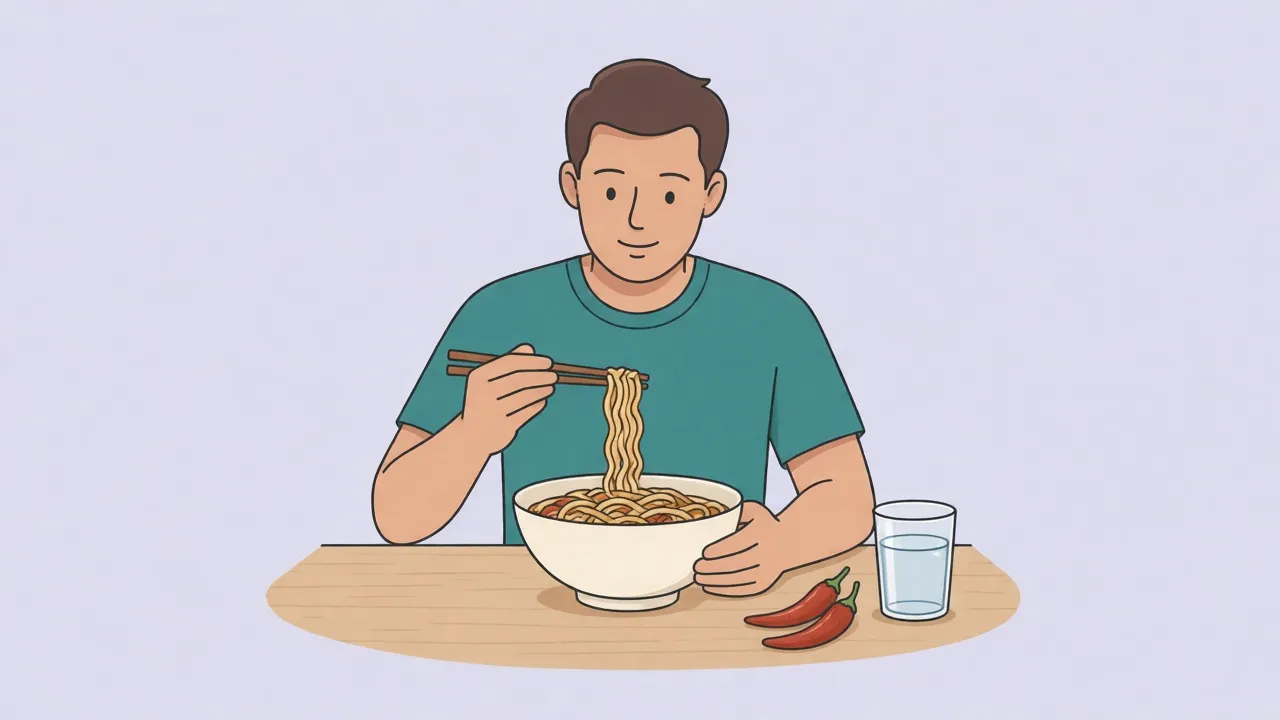
Fifty patients with second-degree and third-degree hemorrhoids took part. Those are internal hemorrhoids that slip out, which the internal hemorrhoid grades page explains. They scored five symptoms on a line scale: bleeding, swelling, pain, itching, and burning. Other treatments, and foods thought to stir up anal symptoms, were stopped during the test days.
Symptom scores were already low before the meal. They stayed flat for 48 hours after placebo and after chili. The chili day was not statistically different from the placebo day. The authors’ conclusion was that there is no scientific evidence that a spicy meal based on red hot chili pepper worsens hemorrhoidal symptoms, and no reason to keep these patients from an occasional spicy dish 1.
Read the limits with the headline. It was one capsule at one lunch, not a week of very hot food. People started with mild scores, so the trial was not built to study someone already in severe pain. It does not cover a fissure or a fresh surgical wound. Those were studied later, with different results.
Why a French survey tells a different story
A 2005 study from private gastroenterology clinics in France compared 1,033 patients coming in for acute hemorrhoid symptoms with 1,028 people coming in for other reasons. Patients and controls recalled events from the previous two weeks. A spicy diet was one of the recent events linked with a hemorrhoid crisis, with an odds ratio of 4.95. Constipation (odds ratio 3.93), physical activity (2.79), and alcohol (1.99) were in the same list. The authors used a cutoff of P less than 0.1, which is looser than the usual 0.05 2.
An odds ratio of 4.95 means that, in this sample, a recent spicy diet was much more common among people at a hemorrhoid visit than among the other patients. It does not mean spice created the hemorrhoid. People who are already sore may notice chili more, and they may be more likely to mention it when a doctor asks. The design is a survey of memory, not a feeding experiment. The Altomare trial is the feeding experiment, and it did not show a symptom jump after one dose 1.
Both papers can sit together if you keep their jobs straight. The survey suggests spice is on the list of things patients and doctors suspect during a flare. The trial tested that suspicion once and did not confirm it for ordinary hemorrhoid symptoms.
The NIDDK page on diet and hemorrhoids talks about fiber and fluids. It does not tell you to give up spicy food 10.
Chili, anal fissures, and healing after surgery
| Study | Who took part | What they ate | What happened |
|---|---|---|---|
| Altomare 2006 1 | 50 people with hemorrhoids that slip out | One chili capsule at lunch | Symptom scores did not rise over 48 hours, same as placebo |
| Gupta 2008 3 | 43 of 50 people with an acute anal fissure | Chili or placebo capsules for one week, then a switch | More pain (2.05 vs 0.97) and more burning (1.85 vs 0.71) on chili |
| Gupta 2007 4 | 60 people after surgery for grade 3 or 4 hemorrhoids | 3 grams of chili powder a day, or no chili, for the first week | More pain (14.60 vs 7.97) and more burning (12.90 vs 7.82) on chili |
The fissure trial matters if bowel movements feel like a cut. Fifty people with an acute anal fissure were randomized to chili capsules or placebo for a week, on top of pain medicine and a fiber supplement, then crossed over. Forty-three finished (22 started on chili, 21 on placebo). Mean daily pain was 2.05 on chili and 0.97 on placebo. Burning was 1.85 versus 0.71. About 81.3% preferred the placebo weeks, 13.9% preferred the chili weeks, and two people had no preference 3. The fissure trial of red chili capsules is why a burning bowel movement after a spicy meal should make you check for a tear. How that differs from a hemorrhoid is in hemorrhoid or anal fissure.
The surgery trial is narrower. Sixty patients with grade 3 or 4 hemorrhoids were randomized after hemorrhoidectomy. Everyone got the same antibiotics and pain medicine. One group also ate 3 grams of red chili powder a day. In the first week, the chili group had higher global scores for pain (14.60 versus 7.97) and anal burning (12.90 versus 7.82). Bleeding scores were 7.57 versus 6.95, and itch scores were 8.75 versus 8.06. Those two gaps were not statistically significant (P values 0.81 and 0.69). The chili group also had more frequent stools and used more pain medicine 4. If you are in that first week, leave the hot sauce in the cabinet. The week-by-week picture is in hemorrhoidectomy recovery.
Capsaicin cream and anal burning
Capsaicin is the hot compound in chili. Eating it and rubbing a tiny dose on the skin are different exposures, and the second one was tested for chronic anal itch, not for hemorrhoids.
In 2003, a crossover trial gave 44 people with severe idiopathic pruritus ani (itch with no disease found to explain it) a 0.006% capsaicin ointment or a menthol placebo for four weeks, then switched them after a one-week break. Thirty-one of the 44 had relief on capsaicin and not on menthol. Four people dropped out because of side effects. During later follow-up, responders used the ointment about every day or two to stay comfortable 5.
A 2010 systematic review looked at that trial and five others on capsaicin for various itches. The reviewers said the pruritus ani study did not report enough data to judge whether the result was solid, and that there was no convincing evidence for capsaicin as an itch treatment in any condition 6. So even the cream is not settled science. It is also not a reason to rub a chili paste on a hemorrhoid. The 0.006% ointment is a measured drug dose. Kitchen pepper is not.
If itch is the symptom that ruins your day, the practical steps that reviews do support are in the home-care and toilet pages, not in a hotter meal. How to prevent hemorrhoids covers fiber, fluids, and toilet time. Toilet habits that help covers the short sit and the footstool.
What to change in your diet during a flare
Constipation shows up more consistently than chili in the hemorrhoid research, and even that story has two chapters.
An older comparison of national surveys found that hemorrhoids and chronic constipation did not follow the same patterns by age, race, or income, which made a simple “constipation always causes hemorrhoids” claim look shaky 8. A later colonoscopy study of 2,813 people found that constipation was more common in people who had hemorrhoids recorded (odds ratio 1.43, 95% confidence interval 1.11 to 1.86). In that same study, the highest quartile of grain fiber had lower odds than the lowest (odds ratio 0.78, 95% confidence interval 0.62 to 0.98) 7.
The treatment trials are clearer than the cause debates. A meta-analysis of seven fiber trials randomized 378 people with symptomatic hemorrhoids to fiber or a non-fiber comparison. The risk of symptoms failing to improve was lower with fiber (relative risk 0.53). The risk of bleeding was about half (relative risk 0.50). Pooled results for pain and itching were compatible with a benefit and also with no effect, because the ranges were wide 9.
The NIDDK diet page puts the daily fiber target at 14 grams per 1,000 calories, which is 28 grams if you eat about 2,000 calories. It also says fluids help the fiber do its job 10. The NIDDK treatment page adds the practical rules: do not strain, and do not sit on the toilet for long stretches. It names psyllium as an example of a fiber supplement 11.
A psyllium powder is the usual first supplement when food fiber falls short of that 28 gram day. Buyers often say it is easier to drink than they expected, and that it thickens if it sits. Stir and drink it promptly, with extra water. The comparisons are on the best fiber supplements page. To see whether today’s menu already hits the target, use the fiber calculator.
Metamucil Sugar-Free Psyllium Powder, Orange
Best for: Most people starting fiber for hemorrhoids
The best-known psyllium powder and our top fiber pick. Psyllium is the fiber used in most of the hemorrhoid trials.
What recent buyers say
Reviews are strongly positive. It works, it tastes better than people expect, and a tub lasts. Recent buyers say it made them regular within a day or two, and they stress drinking plenty of water with it. The main complaint is the added sweetener and coloring, which some would rather avoid.
What buyers like
- Keeps people regular
- Orange flavor goes down easily
- Big tub is good value
Common complaints
- Some dislike the sweetener and coloring
- Thickens if you do not drink it quickly
Skip it if you prefer plain fiber with nothing added. Anthony's plain psyllium is the unflavored option.
Food lists, portion ideas, and how to add fiber without a week of bloating are in the hemorrhoid diet.

The hemorrhoid diet: daily fiber targets, high-fiber meals by the gram, how to add fiber slowly, and foods linked to flares.
Bleeding still needs a medical check when it is new or heavy. MedlinePlus notes that hemorrhoids are a common cause of rectal bleeding and that other diseases, including inflammatory bowel disease and colorectal cancer, bleed too 13. Screening is recommended from age 45 for adults at average risk 14. What the visit is for is in when to see a doctor for hemorrhoids. Bright red blood on the paper, and when it is less reassuring, is covered in bleeding hemorrhoids.
If bleeding continues past a week of softer stools, follow up with a doctor. The NIDDK uses that one-week mark for home treatment that has not helped 11.
Frequently asked questions
Can I eat spicy food if I have hemorrhoids?
An occasional spicy meal did not worsen hemorrhoid symptoms in the only randomized trial that tested this. If a meal leaves you burning the next day, skip chili for a while and try again later. Daily large amounts were not what that trial tested.
Why does my bottom burn after spicy food?
In the fissure trial and the post-surgery trial, people who consumed chili had more anal burning. A burning bowel movement can also mean a fissure rather than a hemorrhoid. The hemorrhoid-only trial, which used one chili dose, did not show that jump.
Does spicy food cause bleeding from hemorrhoids?
The hemorrhoid trial did not find more bleeding after one chili dose. The surgery trial found more bleeding in the chili group, but the difference was not statistically significant. New, heavy, or dark bleeding still needs a doctor, whatever you ate.
Should I avoid chili after hemorrhoid surgery?
In the first week after hemorrhoidectomy, people who ate 3 grams of chili powder a day had more pain and more anal burning than people who did not. Skip spicy food that week, then reintroduce it when bowel movements are comfortable.
What should I change in my diet during a flare?
Raise fiber toward 14 grams per 1,000 calories, about 28 grams on a 2,000 calorie day, and drink water with it. Fiber cut bleeding risk by about half in a pooled analysis of seven trials. Chili is optional. Straining is not.
Sources
- 1. Altomare DF, Rinaldi M, La Torre F, et al. Red hot chili pepper and hemorrhoids: the explosion of a myth: results of a prospective, randomized, placebo-controlled, crossover trial . Dis Colon Rectum , 2006 ; 49(7):1018-1023 . doi:10.1007/s10350-006-0532-3 Clinical trial
- 2. Pigot F, Siproudhis L, Allaert FA Risk factors associated with hemorrhoidal symptoms in specialized consultation. . Gastroenterol Clin Biol , 2005 ; 29(12):1270-4 . doi:10.1016/s0399-8320(05)82220-1 Study
- 3. Gupta PJ Consumption of red-hot chili pepper increases symptoms in patients with acute anal fissures. A prospective, randomized, placebo-controlled, double blind, crossover trial . Arq Gastroenterol , 2008 ; 45(2):124-127 . doi:10.1590/s0004-28032008000200006 Clinical trial
- 4. Gupta PJ Effect of red chili consumption on postoperative symptoms during the post-hemorrhoidectomy period: randomized, double-blind, controlled study . World J Surg , 2007 ; 31(9):1822-1826 . doi:10.1007/s00268-007-9148-6 Clinical trial
- 5. Lysy J, Sistiery-Ittah M, Israelit Y, et al. Topical capsaicin--a novel and effective treatment for idiopathic intractable pruritus ani: a randomised, placebo controlled, crossover study. . Gut , 2003 ; 52(9):1323-6 . doi:10.1136/gut.52.9.1323 Clinical trial
- 6. Gooding SM, Canter PH, Coelho HF, et al. Systematic review of topical capsaicin in the treatment of pruritus. . Int J Dermatol , 2010 ; 49(8):858-65 . doi:10.1111/j.1365-4632.2010.04537.x Review
- 7. Peery AF, Sandler RS, Galanko JA, et al. Risk Factors for Hemorrhoids on Screening Colonoscopy . PLoS One , 2015 ; 10(9):e0139100 . doi:10.1371/journal.pone.0139100 Study
- 8. Johanson JF, Sonnenberg A The prevalence of hemorrhoids and chronic constipation. An epidemiologic study . Gastroenterology , 1990 ; 98(2):380-386 . doi:10.1016/0016-5085(90)90828-o Study
- 9. Alonso-Coello P, Mills E, Heels-Ansdell D, et al. Fiber for the treatment of hemorrhoids complications: a systematic review and meta-analysis . Am J Gastroenterol , 2006 ; 101(1):181-188 . doi:10.1111/j.1572-0241.2005.00359.x Review
- 10. Eating, Diet, & Nutrition for Hemorrhoids . National Institute of Diabetes and Digestive and Kidney Diseases (NIDDK) . Government
- 11. Treatment of Hemorrhoids . National Institute of Diabetes and Digestive and Kidney Diseases (NIDDK) . Government
- 12. Qureshi W, Hoang S, Frye J, et al. AGA Clinical Practice Update on Diagnosis and Treatment of Hemorrhoids: Expert Review. . Clin Gastroenterol Hepatol , 2026 ; 24(7):1773-1781 . doi:10.1016/j.cgh.2026.04.008 Guideline
- 13. Hemorrhoids . MedlinePlus, US National Library of Medicine . Government
- 14. US Preventive Services Task Force Screening for Colorectal Cancer: US Preventive Services Task Force Recommendation Statement . JAMA , 2021 ; 325(19):1965-1977 . doi:10.1001/jama.2021.6238 Guideline